 By
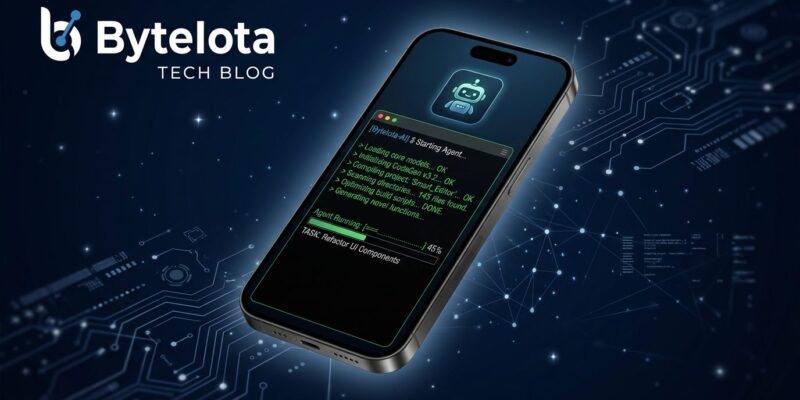
By Cursor just shipped a native iOS app. Not a code editor for your phone — a command center for AI coding agents running in the cloud. You launch an agent, put your laptop in a bag, and get a push notification when the agent finishes and the PR is ready to merge. That’s the workflow Cursor is selling with this public beta, and it’s a meaningful shift in how AI-assisted development is supposed to work.
Cloud Agents vs Remote Control: Pick Your Mode
The app supports two distinct workflows, and understanding which you want changes how useful this launch is for you.
Cloud Agents spin up an isolated VM on Cursor’s infrastructure — each gets its own terminal, browser, desktop, and fully configured dev environment. The agent runs independently, keeps working when your laptop is closed, and produces a full video recording of everything it did inside the VM. You can run multiple in parallel: ten features, ten VMs, all moving simultaneously while you’re in a meeting. Cloud agents are currently behind 35% of Cursor’s own internal pull requests, which is the company dogfooding its own bet.
Remote Control is the lighter-weight option: take an agent already running on your local machine and keep directing it from your phone. No VM spin-up, no moving your code to Cursor’s cloud. Teams and Enterprise users need admin approval to enable it. You can also use “Move to Cloud” to push a local session into a VM mid-session, then switch to the phone.
What the App Actually Lets You Do
The iOS interface is built around agent management, not editing. From the app, you can:
- Launch agents against any repository
- Use voice input to describe tasks (converted to agent instructions)
- Pick any frontier model, same as on desktop
- Review diffs, screenshots, demos, and logs produced by the agent
- Leave follow-up instructions without restarting the agent
- Merge pull requests directly from the app
iOS-native integrations include Live Activities on the lock screen and push notifications when the agent finishes, needs clarification, or hits a snag. If you’re the kind of developer who checks Slack while away from your desk, this replaces part of that loop.
The Workflows Cursor Is Targeting
Cursor is explicit about the use cases: a customer reports a time-sensitive bug while you’re traveling — launch an agent from your phone, it reproduces the issue and works toward a fix. You see a design criticism on X — screenshot it, annotate it, send it as visual context to an agent. The thread: any task that can be described and delegated doesn’t require you to be at your desk anymore.
This is the async coding model. The same logic that made CI/CD decouple humans from the build process is being applied to the coding session itself. Cursor is betting that the default developer workflow in 2027 looks like managing agents from wherever you are, not typing code on a laptop.
The Catch — And There Are a Few
This is a paid-subscribers-only launch. If you’re on the free Hobby plan, you’re out. Cloud agents also run exclusively on Cursor’s AWS infrastructure — there’s no bring-your-own-cloud option, which is a non-starter for teams with strict data residency requirements. The VMs aren’t full production environments either: no multi-service topology, no coordinated API-plus-database-plus-cache setups. Agent runs are billed at API pricing for whichever model you choose, on top of your subscription.
No Android app has been announced. If your team is Android-first, file this under “watch this space.” There’s a 75% discount on Composer 2.5 runs within the mobile app through July 5 — so if you’re going to test this, today is the day to start.
The Bigger Picture: SpaceX, $60B, and Where This Is Heading
Cursor is being acquired by SpaceX in an all-stock deal valued at $60 billion — the largest acquisition of a venture-backed startup in history, roughly double what Google paid for Wiz. The deal is expected to close in Q3 2026, and the Cursor brand stays. The company went from $100M ARR in January 2025 to $2 billion ARR by February 2026 — fourteen months. The iOS launch isn’t a feature drop; it’s a statement about what kind of product Cursor intends to be: an agent platform, not just an IDE.
If that bet plays out, “open the Cursor app” becomes a phrase you say to your phone. The development environment setup for cloud agents is already mature enough for production workloads — the iOS layer is the last piece that makes the whole thing async. Whether that’s the future of software development or a niche workflow for a specific kind of distributed team, the market is clearly voting with its ARR.