 By
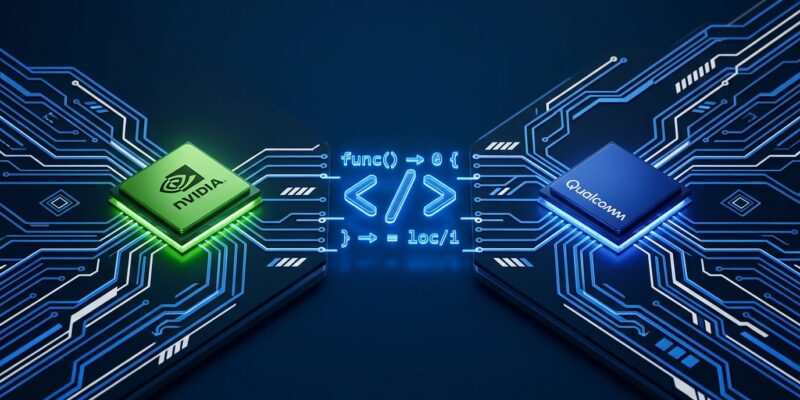
By Qualcomm announced on June 24 that it is acquiring Modular — the company behind the Mojo programming language and MAX inference engine — for $3.9 billion in stock. Modular spent four years building the most developer-friendly path to running AI models on non-NVIDIA hardware without rewriting your code. That tool now belongs to a chipmaker. Whether that is good or bad for developers trying to escape CUDA lock-in depends entirely on what Qualcomm does next.
What Modular Actually Builds
Most developers who have not used MAX picture it as a compatibility shim. It is not. MAX is a full inference engine with an OpenAI-compatible API endpoint, ahead-of-time compilation, and published benchmarks showing roughly 4.5x higher throughput than PyTorch plus HuggingFace on a 7B model at batch size 64 on a single H100. It runs models — not slowly, not approximately.
Mojo is the underlying language. It has Python-compatible syntax but compiles via MLIR to PTX for NVIDIA GPUs, AMDGPU IR for ROCm, or Metal shaders for Apple silicon. A kernel written in Mojo retargets to a different accelerator at build time. The compiler regenerates the kernel for the target architecture rather than translating CUDA instructions. Mojo 1.0 beta shipped in May 2026, meaning the language was hitting maturity just as the acquisition closed.
Why CUDA Lock-In Is Worth Attacking
NVIDIA has over four million registered CUDA developers and 40,000-plus organizations running CUDA-accelerated applications. That is not a technical moat — it is an accumulated switching cost. The actual lock-in is not the GPU. It lives in kernel fusions tuned to cuDNN behavior, distributed training code written around NCCL assumptions, and CI pipelines that were never designed to retarget hardware. Moving a mature AI workload from NVIDIA to AMD or Intel has typically meant months of engineer time. Most teams never bother.
Inference is the right place to attack that moat first. Inference workloads are cost-sensitive, increasingly spread across varied hardware tiers, and less dependent on the deep CUDA-specific training tuning that anchors teams to NVIDIA for foundation model work. Modular’s bet was that inference portability is achievable now, and their benchmarks suggest they were right.
The Deal and Qualcomm’s Play
The $3.9 billion figure tells you what Qualcomm values here: it is not Modular’s revenue. It is the software story. Qualcomm unveiled its Dragonfly AI300 inference accelerator the same day it announced the Modular acquisition. Without MAX and Mojo, the Dragonfly is another inference chip that developers will avoid because migrating to it requires rewriting CUDA kernels. With them, it becomes the only chip in the portfolio that ships with a credible write-once deployment story.
Meta signing on as a Qualcomm CPU customer in the same announcement window adds enterprise weight. Qualcomm’s stated AI revenue target is 2x by 2030. The Modular acquisition is the software layer that makes the hardware roadmap defensible.
“Joining Qualcomm gives us the scale and platform reach to accelerate that mission.”
Chris Lattner, Modular CEO
Lattner is not wrong that scale matters. Building and maintaining hardware targets for NVIDIA, AMD, Apple, and now Qualcomm’s Dragonfly family requires capital that an independent startup would struggle to sustain.
The Part That Should Make Developers Nervous
The value proposition of MAX rests entirely on one claim: it optimizes equally across all supported hardware. The moment that claim is in doubt, it is just another Qualcomm SDK.
There is a pattern here. NVIDIA acquired Mellanox in 2020. InfiniBand networking under NVIDIA’s ownership has worked — primarily for GPU cluster topologies. Apple’s Metal framework supports only Apple silicon. The pattern for chip-owned developer tooling is consistent: the owner’s hardware gets the most optimization attention, the deepest documentation, the fastest bug fixes. NAND Research flagged this specifically: the neutrality of the platform is now structurally harder to maintain than it was under independent ownership.
Qualcomm has committed publicly to maintaining openness. The community will judge by behavior, not statements.
Two Signals Worth Watching
If you are deciding whether to build on MAX post-acquisition, watch two things specifically. First, check whether third-party hardware pull requests on Modular’s GitHub continue to be merged at the same pace after the deal closes. A slowdown in AMD or Intel kernel contributions is an early warning. Second, track whether benchmark reporting stays independently verifiable — if Modular stops publishing cross-hardware comparisons or starts qualifying them heavily, that tells you something.
The practical recommendation for now: MAX is still genuinely multi-vendor until the deal closes in H2 2026. If you are running inference on non-NVIDIA hardware and have not benchmarked MAX against vLLM on your workload, do that now. If you are on NVIDIA and evaluating cost reduction, Qualcomm’s Dragonfly plus MAX is the first credible alternative stack worth a serious test. Do not migrate CUDA training pipelines — there is no compelling reason yet.
The tool that was supposed to free developers from NVIDIA now has a new owner who wants to use it to attract developers to Qualcomm silicon. That might still serve you well. Watch the GitHub, watch the benchmarks, and decide based on what you see — not what Qualcomm promises.