 By
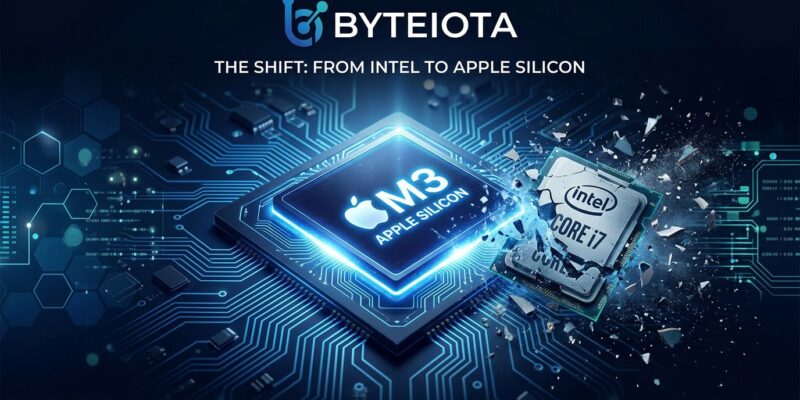
By Apple unveiled macOS 27 Golden Gate at WWDC on June 8, and the developer beta landed the same day. The design refresh and the new Siri AI demo got most of the headline ink. What got less attention: Intel Macs are done. Not deprecated with a long grace period — done. macOS 27 runs exclusively on Apple Silicon, and if you still ship a Mac app that never got a native ARM build, your clock officially started yesterday. Rosetta 2 carries you through macOS 27. When macOS 28 arrives in fall 2027, that crutch disappears.
Intel Is Out, Neural Engine Is In
Four Intel Mac models get the axe: the MacBook Pro 16-inch (2019), MacBook Pro 13-inch (2020), iMac 27-inch (2020), and the Mac Pro (2019). These machines were the last holdouts. Apple’s rationale is straightforward — the Neural Engine is now a hard system requirement for macOS 27’s core AI features, and Intel processors never had one. There is no workaround for that gap.
The practical impact on your install base is manageable. These models are six-plus years old. Most of your users are already on Apple Silicon. But 18,800 apps in the wild are still Intel-only binaries, per data cited last week. Those apps keep running today via Rosetta 2. In fall 2027, when macOS 28 ships without Rosetta 2, they fail silently at launch. Fourteen months is not a lot of runway for an enterprise app with a slow release cycle.
Three Things Mac Developers Must Do Now
1. Recompile for Apple Silicon
If your Mac app still ships an Intel-only binary, this is the priority. Open Xcode 27, set your deployment target, and build a universal binary or an Apple Silicon-only release. For most apps, the Xcode migration path is straightforward — set the architecture to “Apple Silicon” in build settings, run the build, fix any framework incompatibilities that surface. Apps that depend on third-party Intel-only libraries or legacy system extensions face more work, but there is no shortcut. The compatibility cut is final.
2. Migrate SiriKit to App Intents
SiriKit received a formal deprecation notice at WWDC. It still compiles and runs on macOS 27, but it generates warnings, and Apple has signaled a two-to-three year window before removal — meaning macOS 29, likely fall 2028. App Intents has been available since macOS 13. If your app integrates with Siri through the old INExtension and intent classes, you have had four years to migrate and the deadline is now visible. The new Siri AI on macOS 27 is Gemini-powered and routes through App Intents exclusively. Apps that haven’t migrated won’t surface in the new Siri experience.
3. Audit Your AppKit Custom UI for Liquid Glass
Liquid Glass is now system-wide on Mac — applied to app icons, window chrome, and toolbars. SwiftUI apps pick this up automatically via standard components. AppKit apps that draw custom toolbars, use non-standard window decorations, or render icons manually will look visually mismatched against the system aesthetic. Run your app on the developer beta and look for anything that feels visually stranded. This isn’t a breaking issue, but user perception of “outdated” kicks in fast when everything around your app looks polished and yours doesn’t.
New APIs Worth Using Now
macOS 27 ships Core AI — Apple’s redesigned inference framework replacing Core ML. It unifies on-device model execution, Neural Engine scheduling, and access to Apple Foundation Models v2, which now understands both speech and images. If your app does any local inference — image classification, on-device text generation, custom model execution — Core AI is the upgrade path. Most Core ML code migrates with minimal changes; Apple provides a migration guide in the WWDC 2026 developer documentation. The payoff: better performance on M-series hardware and access to the Foundation Models layer without building your own inference stack.
Apple also ships a new Handoff API on macOS 27 that mirrors the iOS 27 version. It lets your app specify state that resumes on another Apple device — useful if you build cross-platform Apple apps. Worth reading before the public beta, not after.
The Bottom Line
macOS 27 Golden Gate is not a surprise. The Apple Silicon transition started in November 2020. Dropping Intel in 2026 is six years in — that is textbook Apple platform hygiene. What is a surprise is how many apps haven’t made the jump. If you’re in that group, WWDC’s message is unambiguous: you have until fall 2027. After that, users on macOS 28 will see your app fail to open. The developer beta is live at developer.apple.com. Start the recompile.