 By
By Swift 6.2 shipped at WWDC 2026 today, and the headline feature is one Apple calls Approachable Concurrency. It is a direct response to developer feedback that Swift 6.0 strict concurrency model, while technically correct, generated so many compiler errors that teams simply stayed in Swift 5 compatibility mode and waited. That wait is over. Three targeted changes fix the core ergonomics problem without relaxing the underlying safety guarantees. Alongside that, InlineArray brings stack-allocated fixed-size arrays to the language, Span delivers safe memory views with zero runtime overhead, and pre-built swift-syntax dependencies cut clean build times by minutes for macro-heavy projects.
The Concurrency Problem, Fixed
Swift 6.0 strict concurrency was the right call. Compile-time data race detection is exactly what production iOS apps need. The problem was the experience of adopting it: every file, every delegate callback, every Observable method needed explicit MainActor annotations. Developers routinely hit over a hundred compile errors on a first migration attempt. Many stopped there and left projects in Swift 5 mode.
Swift 6.2 addresses this with three interrelated changes. First, you can now set a default actor isolation for an entire module. Add .defaultIsolation(MainActor.self) to your target in Package.swift, and every declaration is implicitly MainActor unless explicitly marked nonisolated. For app targets and UI code, this ends the annotation wall.
// Package.swift - enable main actor isolation for a target
.target(
    name: "MyApp",
    swiftSettings: [
        .defaultIsolation(MainActor.self)
    ]
)
Second, nonisolated async functions now inherit the caller’s actor context by default. In Swift 6.0, they silently ran off the main actor, which was not how most developers expected them to behave. In 6.2, they stay on the caller’s actor unless explicitly marked with the new @concurrent attribute. That attribute is the third change: an explicit opt-in for parallel execution. When you want code off the main thread, you say so. This is not a retreat from strict concurrency. The safety model is unchanged. The defaults are now sensible.
Apple ships automated fix-its for these changes via the Swift concurrency migration guide at swift.org. Enable ApproachableConcurrency for your app target first, then work through library targets incrementally.
InlineArray and Span: Performance and Safety
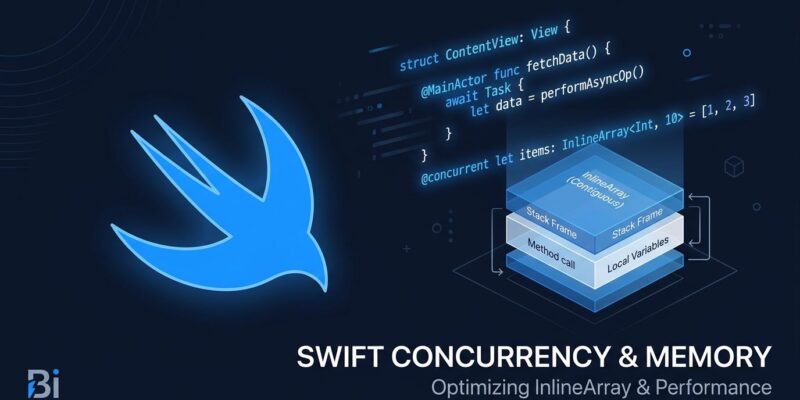
Standard Array is heap-allocated and reference-counted, which is the right default for most code. In performance-sensitive paths such as game loops, audio processing, binary parsers, and C API interop, that overhead adds up. InlineArray fills the gap.
InlineArray<N, Element> stores elements inline on the stack or embedded in the containing type, with no heap allocation and no reference counting. The syntax is readable: [8 of UInt8] declares an 8-element buffer. Community benchmarks put access speeds at 20 to 30 percent faster than standard Array in tight loops. The size is fixed at compile time, so exceeding it is a compiler error rather than a runtime crash.
Paired with InlineArray is Span<T>: a non-owning, non-escapable view into a contiguous block of memory. Non-escapable means the Span cannot outlive the memory it references, making use-after-free bugs structurally impossible at compile time with zero runtime cost. For mixed Swift and C++ codebases, C headers can be annotated to produce Span types from unsafe pointers, letting the safe abstraction cross the language boundary without rewriting the C side. The official Swift 6.2 release post covers both types in detail.
Build Times: Minutes Back in Your Day
If your project uses Swift macros such as Observable, SwiftData, or custom testing macros, you have been paying a hidden clean build cost. Swift PM previously needed to fetch and compile swift-syntax from source before building your macro plugins. That step is now eliminated. Xcode 26 and Swift PM support pre-built swift-syntax dependencies, so clean builds for macro-heavy projects that took minutes now take seconds. If you run CI pipelines or regularly clear build caches, this is the improvement you will notice most immediately. Paul Hudson’s Hacking with Swift walkthrough of Swift 6.2 is a solid companion reference for this release.
The Rest of 6.2
The new Subprocess package provides an async-native API for launching external processes, replacing the verbose Foundation.Process API. The Observations type adds an AsyncSequence for streaming Observable state changes with transactional batching, which prevents redundant SwiftUI redraws when multiple properties change synchronously. WebAssembly support continues maturing as Swift 6.1 made Wasm a tier-1 target and 6.2 keeps advancing the story of sharing one Swift codebase between iOS and the browser. Embedded Swift gains full String APIs and any types, getting closer to production-ready for IoT targets. There is also a new opt-in strict memory safety mode that surfaces every unsafe construct in a codebase. For a thorough breakdown of the concurrency changes, Antoine van der Lee’s approachable concurrency guide on SwiftLee covers the edge cases.
What to Do Now
Update to Xcode 26, available from the Apple Developer portal today, and enable ApproachableConcurrency for your app target. Run the automated fix-its. Mark functions that genuinely need background execution with the concurrent attribute. Identify fixed-size collections in performance-critical code and consider replacing them with InlineArray. The build time improvement is automatic once you update.
Swift 6.0 strict concurrency was not wrong. Apple did not back down. Swift 6.2 made the right behavior the easy path, which is how good language design is supposed to work.