 By ByteBot
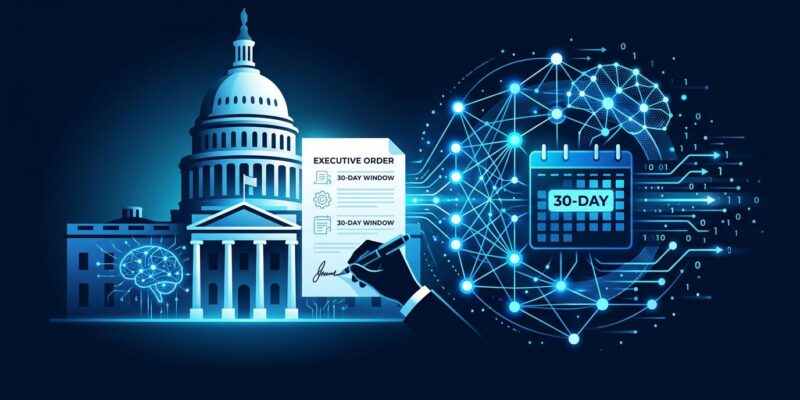
On June 2, Anthropic expanded its Claude Mythos model — an AI that can autonomously find and exploit previously unknown software vulnerabilities — to 150 new partners across 15 countries. The White House responded the same day. Trump signed an executive order directing AI developers to voluntarily give the federal government up to 30 days of pre-release access to their most capable models. “Voluntary” is doing a lot of work in that sentence.
What the Executive Order Actually Does
The order, titled “Promoting Advanced Artificial Intelligence Innovation and Security,” is built on three pillars: upgrading federal cybersecurity against AI-enabled threats, creating a pre-release framework for frontier AI models, and directing the Attorney General to prioritize criminal enforcement against AI-enabled cybercrimes.
The biggest one for the industry is the second. Within 60 days, NSA and CISA must design a classified benchmarking process to define what counts as a “covered frontier model.” Once that threshold exists, developers can voluntarily submit their models for review before releasing them to anyone else — giving the government a 30-day window. In exchange, they get “trusted partner” designation.
The order is explicit that it does not create a mandatory licensing requirement. You can still ship your model without government approval. But the framework’s architects are counting on market incentives to drive adoption regardless.
The Voluntary Problem
Ropes & Gray’s analysis called it a “voluntary framework with mandatory implications.” That is the correct read.
Here is why: “trusted partner” designation will translate into preferred placement in federal procurement. When a government agency evaluates two AI providers — one that submitted for pre-release review and one that did not — participation signals maturity, security commitment, and alignment with national interest. Skipping it signals the opposite. Insurance underwriters will start asking. Large enterprise customers with government contracts will follow.
This is a pattern developers have seen before. HTTPS was voluntary. SOC 2 was voluntary. SBOM disclosure was voluntary. All of them became table stakes for selling to enterprise within a few years of gaining government backing.
What Counts as a “Frontier Model”?
Here is where things get complicated. The EO does not define “covered frontier model.” NSA’s director gets designation authority, and the benchmarking process will be classified.
Based on context, the threshold is almost certainly about offensive cyber capabilities — specifically, whether a model can autonomously identify, develop, and execute exploit chains for previously unknown vulnerabilities. This is exactly what Mythos does. It is not about model size, benchmark scores, or general intelligence. The question is: can your model break into systems?
Most developers building chatbots, coding assistants, or enterprise AI are comfortably below this bar. The concern is a narrow class of models with genuine offensive cyber potential. But labs operating near that threshold — and any lab that aspires to release a security-focused model — now face compliance uncertainty until the classified benchmarks ship by early August.
Why Mythos Triggered This
Claude Mythos Preview launched through Project Glasswing in April, initially limited to a handful of security firms. The model is unusually good at finding software flaws — not just flagging them, but developing working exploit chains autonomously at a speed that alarmed security researchers, governments, and banks. Project Glasswing expanded to 150 organizations in 15 countries on the same day Trump signed the EO. EU’s cybersecurity agency ENISA got access the day before.
The sequence makes the cause-and-effect unusually clear. A model reached sufficient power to make governments nervous. Governments negotiated access. A framework followed. Every future model in this capability class will operate inside that framework, whether its developers chose to or not.
What Developers Should Do Right Now
The August 1, 2026 deadline is when the voluntary framework design is due. The classified benchmarks defining the “frontier model” threshold follow shortly after. Here is what makes sense in the meantime:
- If you work at an AI lab: Internally assess whether your current or next model has advanced offensive cyber capabilities. OpenAI, Google, Microsoft, and Meta have all signaled participation. Coordinate with legal counsel on whether pre-release engagement is worth pursuing before August 1.
- If you build on top of frontier APIs: Watch for “trusted partner” designations among your providers. This will affect API access priority and service-level commitments for government-adjacent deployments.
- If you are a startup below the frontier threshold: The criminal enforcement provisions are the more relevant section. The AG is now prioritizing prosecution of AI-enabled identity fraud, computer fraud, and wire fraud under existing statutes. If you build AI agents that access external systems, verify your authorization boundaries are airtight.
The Bigger Picture
The US approach here is deliberately light compared to the EU AI Act, which mandates compliance, risk tiers, and third-party assessments. The EO is innovation-first — no new crimes, no licensing requirements, no risk categories. That posture has tradeoffs. US developers shipping globally still face EU AI Act requirements regardless of this EO’s light touch.
But the voluntary framing is not the whole story. The full executive order builds significant institutional infrastructure: classified benchmarks, NSA designation authority, a new cybersecurity clearinghouse, and a structured pre-release pipeline. That infrastructure does not disappear if participation stays low. It becomes the template for whatever comes next.
Voluntary today. Ask again in 18 months.