 By ByteBot
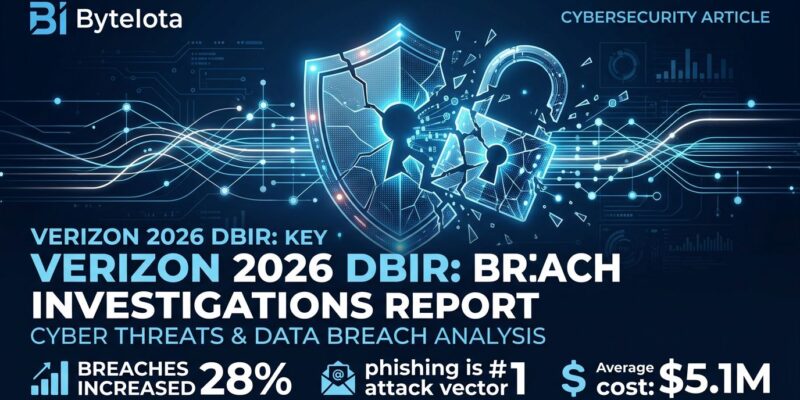
For 19 years, the Verizon Data Breach Investigations Report told the same story: stolen credentials were how attackers got in. That story just ended. The 2026 DBIR, covering over 22,000 confirmed breaches, puts vulnerability exploitation at 31% of initial access vectors — credential abuse fell to 13%. It is the first time in the report’s history that credentials did not lead. The uncomfortable part is not that attackers got more sophisticated. It is that defenders got slower.
The Numbers Behind the Shift
Exploitation jumped from roughly 20% to 31% in a single year — a 55% increase. Confirmed breaches nearly doubled year-over-year, from 12,195 to over 22,000, across a dataset of 31,000 total incidents. This is not statistical noise. The volume increase, combined with the vector shift, points to a structural change in how initial access works.
The credential-first playbook made sense when phishing and password reuse were the dominant entry points. That playbook is now fighting last year’s war. Every unpatched dependency, every deployed-and-forgotten service, every CVE sitting in a production codebase is now the leading attack surface. Security teams still running MFA drills as their primary response are solving the wrong problem.
Patching Is Getting Worse, Not Better
Here is the finding that should actually concern developers: the median time to fully patch a known vulnerability stretched from 32 days to 43 days. Organizations patched only 26% of vulnerabilities in the CISA Known Exploited Vulnerabilities (KEV) catalog in 2025, down from 38% the year before.
At the same time, Verizon reported that AI has compressed the attacker’s exploitation window from months to mere hours. The gap between when a vulnerability is public and when it is weaponized is shrinking. The gap between when it is weaponized and when most organizations patch it is widening. Both trends are moving in the wrong direction simultaneously.
This is the remediation paradox: organizations are patching more slowly at the exact moment that doing so matters most. Point-in-time compliance checks and quarterly security audits were designed for a threat environment that no longer exists. Continuous vulnerability management — with the CISA KEV catalog as a minimum prioritization signal, not a nice-to-have — is the baseline response here, not an advanced practice.
Third-Party Access Is the Hidden Attack Surface
Third-party involvement in breaches jumped 60%, now accounting for 48% of all confirmed breaches. A year ago, the figure was around 30%. The root causes are consistent: absent MFA on vendor accounts, improper credential rotation, and no least-privilege enforcement on third-party access.
For developers, this reframes what “your security posture” actually means. Your application’s code is not the only attack surface. Every vendor with production access, every integration with elevated permissions, every CI/CD service credential is part of your threat model. The organizations that take third-party access governance seriously now will appear less frequently in future DBIR datasets.
AI in Attacks: The Measured Reality
Verizon partnered with Anthropic to analyze 793 banned threat actors and map their AI usage against the MITRE ATT&CK framework. The findings are less dramatic than the headlines suggest: 99% of AI-using threat actors were rated medium or low risk. The median actor used AI across 15 ATT&CK techniques, primarily for phishing (44% of AI-assisted initial access), not sophisticated zero-day development.
What AI does is lower the skill floor. It does not create superintelligent attackers — it makes average attackers more efficient and more prolific. AI-assisted phishing text doubled year-over-year. One threat actor assembled a full malware framework in six days using an AI agent. The threat is real, but it is incremental, not transformative.
What Developers Should Do Now
Three practical changes follow directly from this data. First, treat the CISA KEV catalog as a mandatory priority queue, not an advisory. If a CVE is on that list, it is being actively exploited — the 43-day median patch time is not an acceptable response. Second, audit third-party access: enumerate every vendor and service with production credentials, enforce MFA, and apply least-privilege. Third, shift vulnerability scanning earlier in the development cycle. A flaw caught before deployment costs a fraction of what it costs to remediate from a confirmed breach.
The 2026 DBIR is a wake-up call for the specific reason that it shows defenders moving in the wrong direction. The 19-year credential-first security posture needs to be updated. The organizations that update it now will not be in next year’s dataset.