 By ByteBot
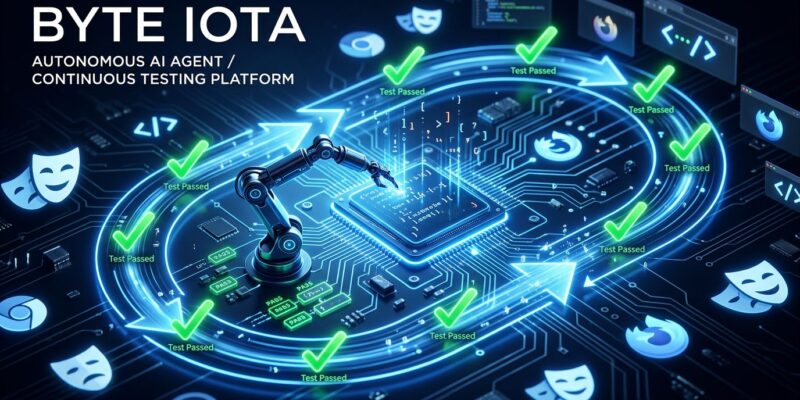
AI coding tools solved the wrong half of the problem. They made writing code faster — they didn’t make verifying it faster. That gap is now wide enough to drive a production incident through. Checksum’s Continuous Quality Agent, launched last week, is a direct response: an autonomous system that runs nightly against your deployed application, generates Playwright tests for uncovered flows, and heals broken tests — 70% of them without a human ever getting involved.
The QA Debt Everyone Ignores
The productivity pitch for AI coding tools focuses on velocity. The numbers no one leads with are on the quality side. Teams using AI assistance now merge 98% more pull requests that are 154% larger on average. Sixty percent of engineering organizations experienced quality problems because development moved faster than testing could validate, according to SmartBear’s AI Software Quality Gap Report. AI-generated code carries 1.75x more correctness issues than human-authored code — it looks right, passes review, and then breaks in production.
Test suite maintenance has become a bigger burden than writing new code for 70% of surveyed teams. That’s not a small problem. That’s an infrastructure crisis hiding behind a productivity win.
What the Continuous Quality Agent Does
Checksum’s CQA runs as a four-agent pipeline on a nightly schedule against your deployed application. The Session Analysis Agent mines production traffic to find real user flows without test coverage. The Test Generation Agent converts those flows into Playwright tests — fine-tuned on over 1.5 million test runs with roughly 97% claimed accuracy. The Autonomous Healing Agent identifies and fixes broken tests; 70% of failures resolve without human input. The Coverage Intelligence Agent maps real-world usage to test coverage in real time, so your coverage report reflects what users actually do, not what developers assumed.
The output is standard Playwright code, delivered as pull requests to your own repository. No proprietary test format. No vendor lock-in. If you part ways with Checksum tomorrow, you still own a working Playwright suite.
The IDE Integration Is the Smart Part
A /checksum slash command is available directly in Claude Code and Cursor. Developers can trigger, steer, and review the agent without switching context. This matters because the teams generating AI code are the exact teams generating the test debt — the same workflow, the same tools. Putting the QA agent inside the coding environment closes the loop rather than requiring a separate tool and context switch.
Real Behavior, Not Synthetic Test Cases
Most AI test generators work from code structure — they read components and write tests for what they see. Checksum works from production session data. The Session Analysis Agent learns how real users navigate the application, not how developers expected them to. That distinction is where the value lives. The gap between assumed user behavior and actual user behavior is precisely where the most critical bugs hide. A test suite built from production sessions covers the paths that matter.
Checksum describes this as building a world model of software — a simulation of user behavior that drives test generation. It’s a more durable foundation than synthetic test cases that age out the moment the UI changes.
The Trust Question
The obvious developer objection: if you’re already trusting AI to write your code, are you now also trusting AI to verify it? Checksum’s structural answer is PR delivery. Every generated and healed test arrives as a reviewable pull request. The team decides whether to merge. The Feature Health Dashboard surfaces sessions, failure classifications, and separates real product bugs from broken tests. The 97% accuracy figure means roughly 3% noise — manageable with a quick PR review, not a liability. That’s a reasonable trust model.
The limits are real, though. CQA requires a deployed application — no testing against local code. It handles selector-level test failures well; logic-level bugs still need engineers. It covers E2E flows only, not unit or integration tests. A free tier exists; production-scale use requires a paid plan.
Where This Sits in the Stack
The AI developer toolchain is assembling layer by layer. Coding tools (Claude Code, Cursor, Codex) generate code. Review tools (Graphite, CodeRabbit) check it. Checksum’s CQA fills the verification layer. Observability tools (Langfuse, Helicone) watch production. Checksum fills the layer that was most conspicuously missing.
72.8% of experienced testers named autonomous test generation their top priority for 2026. The industry was waiting for this tooling. Now it’s here — and the question shifts from whether to automate QA to whether you can afford not to.