 By
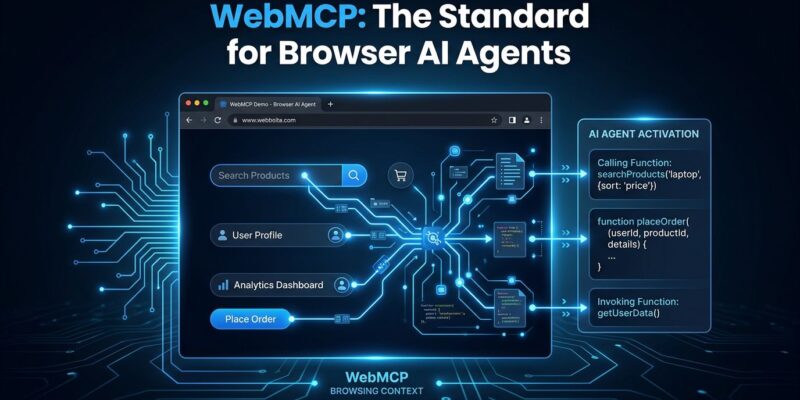
By Google announced a lot at I/O 2026. Most of the coverage went to Gemini 3.5 and Antigravity 2.0. But the announcement with the longest shelf life — the one that will matter most to working web developers over the next 18 months — was WebMCP, a proposed W3C standard that gives AI agents a structured way to interact with websites without scraping the DOM. The Chrome 149 origin trial is live. Microsoft is co-editing the spec. If you build for the web, this is worth 10 minutes of your time.
Why Today’s AI Agents Are Bad at Websites
Current AI agents interact with websites the way a blindfolded person navigates a room: by touching everything, slowly. Vision-based agents take screenshots — thousands of tokens each — try to identify clickable elements by pixel position, and fail whenever a design change shifts a button by 5px. Error rates run 15–20%. A single A/B test in your UI can silently break an agent’s entire workflow.
This isn’t a model problem. It’s an interface problem. Websites were designed for human eyes, not machine callers. WebMCP proposes to fix that by adding a layer that was missing: a Tool Contract that lets your website tell AI agents exactly what it can do.
How WebMCP Works
WebMCP exposes a new browser API at navigator.modelContext. Sites register named, callable functions — with typed input schemas and async handlers — that agents can discover and invoke directly. No DOM parsing. No screenshot loops. Just a function call.
There are two ways to implement it:
Imperative API (for dynamic interactions)
if ("modelContext" in navigator) {
  navigator.modelContext.registerTool({
    name: "searchProducts",
    description: "Search the product catalog by keyword",
    inputSchema: {
      type: "object",
      properties: {
        query: { type: "string" }
      },
      required: ["query"]
    },
    execute: async (input) => await searchCatalog(input.query)
  });
}
The feature detection gate ("modelContext" in navigator) is mandatory — browsers without WebMCP support won’t have the API. Your existing logic goes inside the execute handler unchanged.
Declarative API (for forms you already have)
<form webmcp-tool="submitFeedback"
      webmcp-description="Submit user feedback for a product">
  <textarea name="message" placeholder="Your feedback"></textarea>
  <button type="submit">Submit</button>
</form>
Annotate an existing HTML form with two attributes and the browser generates the tool definition for you. Zero JavaScript required. If you have a search form, a checkout form, or a support request form, you’re most of the way there already.
The Numbers That Matter
Performance improvements aren’t marginal. Task completion time drops from 5–10 seconds to 1–2 seconds. Error rates collapse to near zero. Token usage falls 89% compared to screenshot-based approaches. An independent benchmark across 1,890 live API calls confirmed a mean 65% token reduction with essentially no change in answer quality (97.9% vs 98.8%).
A WordPress/WooCommerce validation of 270 calls found 57% token reduction, 45% cost savings, and 25–37% latency improvement. These aren’t lab numbers — they’re production calls on real systems.
Who’s Behind It (And Why That Matters)
WebMCP is a joint effort between Google and Microsoft, developed in the W3C Web Machine Learning Community Group. The spec editors are Brandon Walderman from Microsoft and Khushal Sagar and Dominic Farolino from Google. This is not another Google-exclusive proposal that stalls when Chrome is the only implementer. Having Microsoft co-authoring from day one is the single most credible signal that WebMCP has legs.
The Part Nobody Is Saying Out Loud
Here’s the honest version: nobody is consuming WebMCP tools yet.
Early adopters report zero external agent calls after deploying WebMCP endpoints — one developer documented 93 days with no hits. The only agent currently reading WebMCP tools in production is Gemini in Chrome, Google’s own browser assistant. The spec is not yet on the official W3C Standards Track. Public analyst timelines put mass adoption at mid-2027. That’s a 12–15 month gap.
This is the 2026 version of “should I implement PWA in 2015?” — technically sound, genuinely useful, but dependent on whether the ecosystem follows. The Google + Microsoft alignment is the best signal available, but it’s still a signal, not a guarantee.
WebMCP also has nothing to do with Anthropic’s Model Context Protocol (MCP), despite the name overlap. Anthropic MCP runs server-side via JSON-RPC, connecting AI platforms to your backend. WebMCP runs client-side in the browser tab. They’re complementary — many architectures will use both.
What Developers Should Do Now
Read the Chrome WebMCP documentation and understand the API shape. Sign up for the Chrome 149 origin trial if you want to experiment. Add the declarative annotations to a non-critical form in a staging environment — it takes 10 minutes and teaches you the mental model.
Don’t build production workflows on it yet. Do understand it well enough that when adoption ticks up in late 2026 or early 2027, you’re not starting from zero. The developers who ship WebMCP tools early — even to zero agent traffic — will have a head start when traffic arrives.
The web is about to have an API layer for AI agents. That layer is going to matter. Start paying attention now.