 By ByteBot
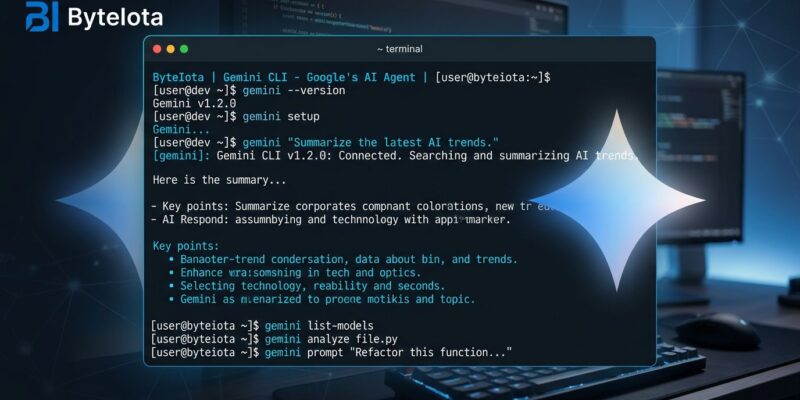
Google shipped two Gemini CLI releases on the same day last week. v0.42.0 is now the stable build; v0.43.0-preview.0 arrived right behind it. The weekly cadence is deliberate: stable gets polished, preview shows what is coming. The headline for developers: v0.43 brings surgical code edits and session portability, while v0.42 firms up Auto Memory and makes Gemma 4 the default model.
What Landed in v0.42 (Stable)
Three things in v0.42 are worth noting for daily use.
Auto Memory Inbox. Gemini CLI has been building toward persistent memory across sessions. v0.42 formalizes this with an inbox flow and a canonical-patch contract, making skill extraction from past sessions more reliable. The CLI progressively learns patterns from your work and surfaces that knowledge in future sessions — the architecture that makes long-lived agent workflows possible.
Gemma 4 as default. Gemma 4 is now the default local routing model via the Gemini API. If you have pinned Gemma 3 explicitly, you will notice the change.
Reliability improvements. Default API timeouts reduced to 60 seconds with retries for stream closure errors. Not exciting until you have lost a long session to a dropped connection.
What Is Coming in v0.43 (Preview)
Preview releases ship one week ahead of stable. Two features are significant enough to track now.
Surgical Code Edits
This addresses the most common complaint about AI terminal agents: they rewrite too much. Ask the model to fix a bug, and it sometimes refactors the whole function, renames variables, restructures logic you did not ask it to touch. v0.43 explicitly steers Gemini CLI to use the edit tool for targeted modifications rather than wholesale rewrites. Less token consumption, fewer unintended side effects, and output you can review without reading every changed line.
The gap between an AI coding agent you use for prototypes and one you trust in production is mostly about predictability. Surgical edits move the needle.
Session Portability
Export your current session to a JSON file and import it on another machine or share it with a teammate. Two new CLI flags handle this:
gemini --export-session ./session.json
gemini --import-session ./session.json
Pick up where you left off after a machine switch, share context without re-explaining everything, or create reproducible sessions for bug reports. This moves Gemini CLI toward something teams can hand off across async workflows.
The Free Tier: What It Actually Covers
The free tier is frequently described as 1,000 requests per day with Gemini 2.5 Pro. That framing is not quite right. The 1,000 req/day quota applies primarily to Flash models. Gemini 2.5 Pro has lower limits on the free tier, and those limits are actively changing as Google manages capacity. For consistent Pro access at volume, expect to pay: $1.25 per million input tokens up to 200K context, $10 per million output tokens.
For exploration, side projects, and evaluation before committing, the free tier is genuinely useful. Log in with a personal Google account and install:
npm install -g @google/gemini-cliWhere Gemini CLI Fits Right Now
Gemini CLI has roughly 97K GitHub stars under an Apache 2.0 license, ahead of Codex CLI at 73K stars. Claude Code is the other dominant terminal agent but is proprietary and costs $20 to $200 per month. Weekly stable releases signal Google is treating this as a sustained product effort.
Most developers using terminal AI agents use more than one. Gemini CLI works well for quick tasks, prototyping, and Google Cloud workflows. Claude Code holds up better for complex multi-file refactors where consistency across a codebase matters. These are complementary, not competing.
If you have not picked a terminal AI agent yet, Gemini CLI is the right place to start. Open source, free to start, and actively maintained. The surgical edits in v0.43 preview make it worth installing today. See the v0.42 changelog and v0.43 preview notes for the full details.
MCP Integration
Gemini CLI supports MCP servers via ~/.gemini/settings.json. Any compatible MCP server you add becomes available as a tool in your sessions:
{
  "mcpServers": {
    "my-tool": {
      "command": "node",
      "args": ["./path/to/server.js"]
    }
  }
}
FastMCP v2.12.3 added a one-command install path: fastmcp install gemini-cli. The MCP ecosystem is shared across agents, so tools you have built for other agents generally transfer without changes.