 By
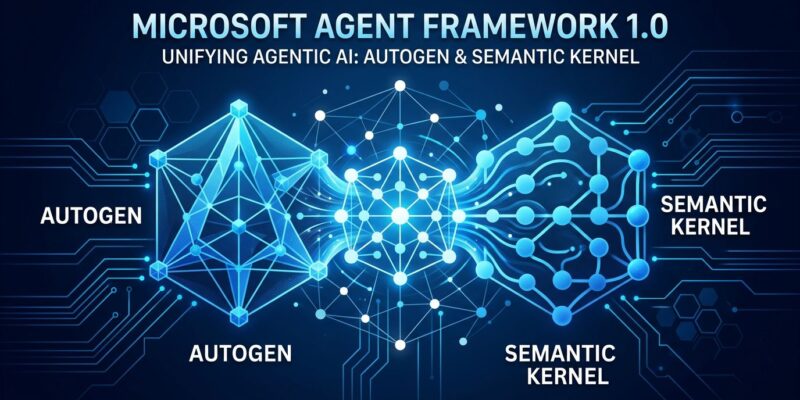
By Microsoft ended a two-year developer argument on April 3, 2026. The AutoGen versus Semantic Kernel question — which framework do you actually build on? — finally has a clean answer: neither. Microsoft Agent Framework 1.0 is now generally available, merging both into a single production-ready SDK for .NET and Python. MCP support ships built-in. Five orchestration patterns are stable. Seven model providers are supported out of the box. The fragmentation problem Microsoft created is now Microsoft’s problem to have solved.
One Framework to Replace Two
AutoGen and Semantic Kernel served different masters. AutoGen was research-grade: flexible, conversational, great for experimental multi-agent workflows, but weak on production concerns like state management and telemetry. Semantic Kernel was the enterprise play: type-safe, telemetry-rich, middleware-friendly — but with orchestration rigid enough to frustrate anyone who needed agents to reason dynamically.
Microsoft’s official answer when developers asked which to use was “it depends on your use case” — which satisfied nobody who needed to ship software. Agent Framework 1.0 is what “it depends” looks like when actually resolved. It takes AutoGen’s agent abstractions and layers in Semantic Kernel’s enterprise features — session-based state management, middleware pipeline, pluggable memory backends — then adds graph-based workflow orchestration that neither predecessor offered cleanly.
What Ships in v1.0
The stable release includes two primary capability areas. Agents handle individual LLM interactions with tool use, MCP server integration, and multi-turn conversation. Workflows handle multi-agent coordination through a graph-based engine with type-safe routing, checkpointing, and human-in-the-loop support.
Five orchestration patterns are stable at launch: sequential (deterministic pipeline), concurrent (fan-out/fan-in), handoff (mid-task agent transfers), group chat (multi-agent conversation with a selector), and Magentic-One (task-oriented hierarchical reasoning). Every pattern supports streaming, pause/resume, and checkpointing for long-running processes.
Model provider support spans seven options: Microsoft Foundry, Azure OpenAI, OpenAI, Anthropic Claude, Amazon Bedrock, Google Gemini, and Ollama for local models. Switching providers is a one-line configuration change — at least in theory.
Getting started is intentionally minimal:
pip install agent-framework
# or
dotnet add package Microsoft.Agents.AI
MCP Is Infrastructure, Not a Checkbox
Model Context Protocol support deserves its own paragraph because it changes how you think about tool integration. MCP lets agents dynamically discover and invoke tools from any MCP-compliant server. As external tool catalogs evolve, your agent picks them up automatically — no code changes required. This is first-class architecture in MAF, not a bolt-on addition added six months after release to match competitors.
MCP has reached the point where VS Code, JetBrains, and dozens of platforms ship native support. Building agent infrastructure on a framework where MCP is foundational — not retrofitted — matters for long-term maintenance costs. If you’re evaluating agent frameworks and your tooling ecosystem is moving toward MCP, this is not a minor point.
The Migration Reality
Here is the part Microsoft’s marketing glosses over: migration difficulty varies significantly depending on which framework you’re coming from.
Semantic Kernel teams have a clean path. Migration guides are provided, and Microsoft is committing to maintain Semantic Kernel v1.x for at least one year post-GA. The API surface is compatible enough that migrations can be phased rather than ripped out all at once.
AutoGen teams face harder work. The programming model changed fundamentally — from conversation-centric multi-agent dialogue to graph-based workflow orchestration. A compatibility layer exists, but it will be deprecated. If you have substantial AutoGen code, plan for a real migration, not an upgrade. The payoff is there, but budget the effort honestly.
Where MAF Sits in the Landscape
Microsoft Agent Framework is not a LangGraph killer, and treating it as one will lead to poor architectural decisions. LangGraph remains the Python-first choice for stateful production workflows with the deepest enterprise deployment track record — Klarna, Uber, LinkedIn, JPMorgan are all running it. CrewAI remains the fastest path from idea to working multi-agent demo.
MAF is the clear default for two specific audiences: .NET teams that previously had no competitive multi-agent option, and Azure-native organizations that want deep Microsoft Foundry integration while retaining the flexibility to swap to Claude, Bedrock, or Gemini. For these teams, MAF is genuinely the right answer. For Python-first shops without Azure commitments, the framework choice remains a judgment call.
The Bigger Picture
Agent Framework 1.0 is Microsoft’s stake in the MCP and A2A (Agent-to-Agent) protocol convergence story. Full A2A 1.0 support is listed as coming soon, which would let Agent Framework agents coordinate with agents running in other frameworks — Hermes, LangChain, or custom implementations. That cross-runtime interoperability is where enterprise deployments get interesting, because those deployments are never going to be monolithic.
The fragmentation between AutoGen and Semantic Kernel cost developers real time and real architectural debt. Microsoft fixing it is the right call, even if it arrived later than it should have. Whether Agent Framework becomes the dominant enterprise choice depends on whether the A2A and MCP ecosystems mature around it as promised — and whether Microsoft can resist the temptation to make Azure feel mandatory when it’s supposed to be optional. The framework is solid. The follow-through is what to watch. Install it via the GitHub repo and judge for yourself.