 By
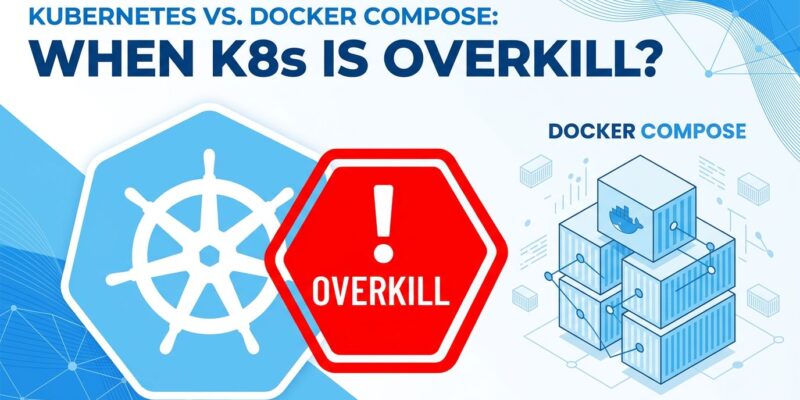
By Most companies use Kubernetes because Google does, but they don’t have Google-scale problems. Industry analysis shows 90% of companies don’t actually need Kubernetes. Real case studies from 2026 document companies saving 60 hours of engineering time per week and $20,000 per year by moving FROM Kubernetes TO Docker Compose. A full observability platform runs on Docker Compose handling 500,000 logs per day with 99.8% uptime. The over-engineering epidemic is real, costly, and the backlash is here.
The 60-Hour Problem: When Infrastructure Eats Your Team
A company spent six months setting up Kubernetes for a five-service application. The team burned 60 hours per week—that’s 1.5 engineer-months every month—just managing infrastructure instead of shipping features. When they finally migrated to Docker Compose, it took 12 hours spread over three days. They scaled to 18,000 users on Docker Compose without issues.
The cost difference is staggering. Docker Compose deployments run at $340 per month. An equivalent Kubernetes cluster costs $1,500 to $2,000 monthly. That’s $14,000 to $20,000 per year in infrastructure alone. Personnel costs are worse: self-hosted Kubernetes averages $335,000 annually versus $113,000 for managed Kubernetes, with the $222,000 gap almost entirely staffing overhead.
“Everyone over-architects their infrastructure,” says Jeff Delaney of Fireship. “If your app runs on one server, Docker Compose is your best friend. Kubernetes is designed for Google-scale problems. Most of us don’t have Google-scale problems.”
Proof That Simple Scales
The “you’ll need Kubernetes eventually” argument falls apart when you examine production systems running Docker Compose at scale. Logtide, a full observability platform, processes 500,000 logs per day on Docker Compose while maintaining 99.8% uptime and serving thousands of users. Another company runs 28,000 active users on Docker Compose for $340 per month—a scale most startups never reach.
Docker Compose isn’t a temporary solution or development tool. It’s production-ready infrastructure that handles more load than most companies will ever generate. By the time you actually need Kubernetes, you’ll have the revenue to justify its operational overhead. Premature optimization is waste. Add complexity when the pain is real, not when you imagine it might happen someday.
Even Kubernetes Users Are Hiding It
In 2026, 80% of organizations are adopting Internal Developer Platforms with a singular goal: hide infrastructure complexity under the hood and give developers intuitive self-service interfaces. Even companies running Kubernetes are abstracting it away from their own developers. The platform engineering movement acknowledges what many won’t say out loud—Kubernetes complexity is a problem to solve, not a feature to embrace.
“Kubernetes is now mature and operationally stable,” notes the platform engineering community. “What differentiates platforms now is how much of that complexity developers are exposed to.” TechTimes published an article in April 2026 titled “Kubernetes Fatigue Is Driving DevOps Teams Toward Smarter Abstraction.” Teams are burnt out on YAML configuration, troubleshooting, and operational overhead.
If companies using Kubernetes need to hide it from their own engineers, that tells you everything about whether your startup needs it.
When You Actually Need Kubernetes
Kubernetes isn’t bad technology. It’s incredible technology solving Google-scale problems. The issue is that most companies aren’t Google.
You don’t need Kubernetes if your application fits on one server, you have fewer than 10 to 15 microservices, traffic is relatively predictable, you’re deploying to a single region, or your team has no Kubernetes expertise. That covers most startups, small-to-medium SaaS products, and internal tools.
You need Kubernetes if you’re running 50 or more microservices across multiple datacenters, require automatic horizontal scaling for 10x traffic variations, operate multi-cloud or hybrid cloud infrastructure, need enterprise compliance with advanced RBAC for SOC 2 or HIPAA, or manage 500 plus microservices across 50 plus nodes. At true enterprise scale, Kubernetes orchestration overhead pays for itself through better resource utilization.
The “one server test” simplifies the decision: if your application runs on one server with room to spare, you don’t need Kubernetes. Start simple. Add complexity only when scale demands it.
What to Use Instead
Docker Compose handles zero to ten services on single-node or small cluster deployments. It’s built into Docker with no additional tooling required. The learning curve is hours, not weeks. Production scale is proven at 500,000 logs per day serving thousands of users. Infrastructure costs run $300 to $500 per month.
Docker Swarm delivers 80% of Kubernetes value at 20% of the complexity for five to 50 services across three to ten nodes. It’s built into Docker, effectively free to operate, requires no specialist, and costs 30 to 50% less than Kubernetes in year one. Portainer’s 2026 analysis shows Swarm is underrated for teams that need orchestration but not Kubernetes complexity.
Managed PaaS solutions abstract infrastructure entirely. Kamal deploys Docker containers over SSH with no orchestrator. Coolify provides a self-hosted Vercel/Netlify alternative with Docker Compose support. Render, Fly.io, and Railway handle everything so you can focus on code.
The migration path is straightforward: start with Docker Compose, move to Docker Swarm if you outgrow one node, and only adopt Kubernetes when you hit real scale limits. Better Stack’s guide provides decision frameworks for when to make each jump. By the time Kubernetes is justified, you’ll have revenue to cover its operational overhead.
The Complexity Audit
When your architecture is more complex than your business, you’ve over-engineered. Warning signs include infrastructure taking more time than features, spending more hours on YAML than code, onboarding requiring weeks of infrastructure training, and choosing Kubernetes for three to ten services “for future scale.”
Calculate the return on investment. Does Kubernetes overhead pay for itself through scale benefits? Most companies can’t answer yes. DataCamp’s comprehensive comparison shows Docker Compose and Swarm meet the needs of 90% of applications without the operational burden.
Right-size your infrastructure to actual needs, not imagined future scale. The “future-proofing” argument is usually fear-driven architecture. You can migrate to Kubernetes later when revenue justifies it. Starting simple doesn’t prevent scaling—it accelerates feature velocity while you figure out what product-market fit actually looks like.
Audit your setup. If your team spends 60 hours per week on infrastructure for a handful of services, you’re solving the wrong problems. Simplify, ship features, and add complexity only when scale forces your hand.