 By ByteBot
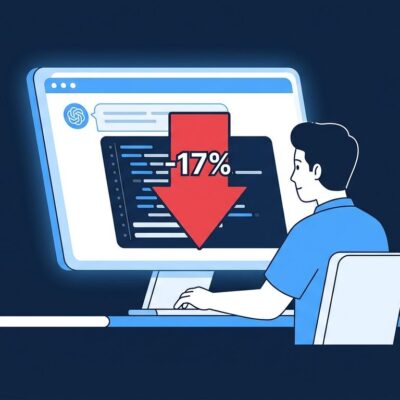
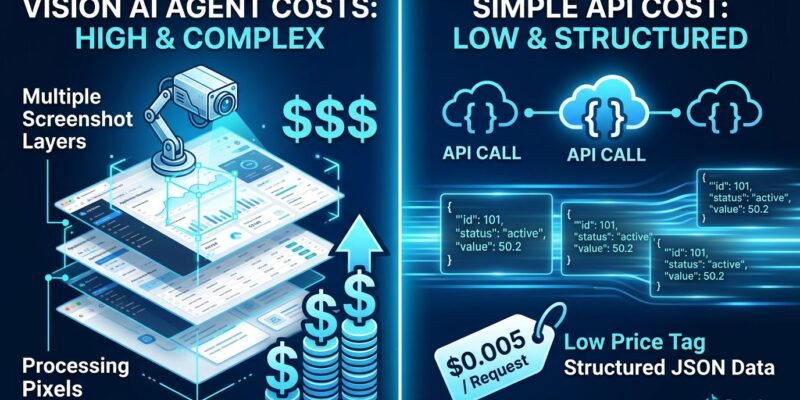
A benchmark study from Reflex published May 6, 2026 found that vision AI automation costs 45 times more than agents using structured APIs for identical tasks. Testing Claude Sonnet on the same admin panel workflow, vision agents consumed 550,000 input tokens and took 17 minutes, while API agents used just 12,000 tokens and finished in 20 seconds. At production scale with 1,000 daily runs, that differential translates to $50,000-$70,000 per month for vision approaches versus $1,500 for APIs.
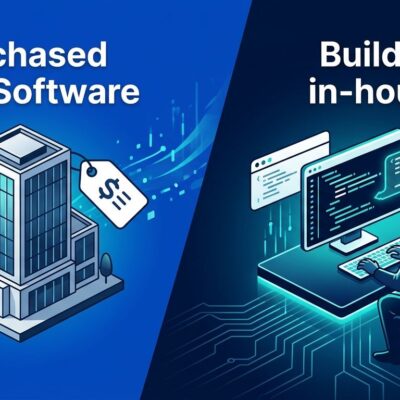
This isn’t theoretical optimization—it’s real budget impact. Vision-based AI agents offer convenience since they work with any UI without backend changes. However, the 45x cost penalty and reliability issues make them financially unsustainable at scale. Development teams face a critical choice: invest upfront in API development or pay exponentially higher operational costs monthly.
The 45x Cost Penalty: Real Numbers from Production Testing
Reflex tested Claude Sonnet operating an admin panel managing customers, orders, and reviews through two distinct paths. The vision agent required 550,976 input tokens with a variance of ±178,849, processed 37,962 output tokens, and completed 53 steps averaging 17 minutes per workflow. Meanwhile, the API agent consumed just 12,151 input tokens with minimal ±27 variance, generated 934 output tokens, and executed exactly 8 calls finishing in 20 seconds.
At Claude Sonnet 4.6 pricing of $3 per million input tokens and $15 per million output tokens, vision automation costs $1.65 to $2.32 per run compared to just $0.05 for APIs. Consequently, when you scale those numbers to production levels with 1,000 automation runs daily, vision agents will cost your team $49,500-$69,600 monthly while APIs run at $1,500. The annual savings from using APIs instead of vision automation reaches $552,000 after accounting for typical API development costs of $30,000.
Furthermore, the break-even timeline is striking. If API development costs $30,000 and saves $48,500 monthly, you recover the investment in under three weeks. This isn’t a long-term optimization play—it’s an immediate budget impact that finance teams notice.
Why Vision AI Agents Will Always Be Expensive
The cost problem is architectural, not a limitation that better models will solve. Vision agents process screenshots for every interaction, generating thousands of input tokens per image. As the Reflex engineering team observed: “An agent that must see in order to act will always pay for the seeing. Better vision models reduce error rates per screenshot, but they do not reduce the number of screenshots required.”
Even as vision language models improve, they can’t escape the fundamental overhead of converting pixels to understanding. The benchmark demonstrated this structural issue clearly: vision agents needed 53 interactions with screenshot processing versus 8 direct API calls. Each screenshot consumes 1,000-2,000+ tokens depending on resolution and UI complexity. That overhead is inherent to the architecture—you’re navigating a visual interface rather than requesting structured data.
Moreover, organizations betting on “vision costs will drop as models improve” are making flawed assumptions. Performance optimizations like SpecVLM deliver 1.5-2.3x speedups, which still leaves vision agents 20x+ more expensive than APIs. The architecture itself is costly regardless of model efficiency gains.
The Hidden Costs: Variance, Prompts, and Failures
Token costs represent only part of the problem. Vision agents failed Reflex’s benchmark without explicit prompting, discovering just one of four pending reviews and never paginating through results. The agent interpreted rendered pixels without metadata indicating incomplete data. Resolution required a 14-step walkthrough with numbered UI navigation instructions—hidden engineering costs beyond token consumption.
After fixes, vision agents still exhibited massive variance. Runs consumed anywhere from 407,000 to 751,000 tokens, took between 749 and 1,257 seconds, and required 43 to 68 steps across different trials. In contrast, API agents demonstrated perfect consistency: exactly 8 calls every time with just ±27 token variance. In production environments, this unpredictability impacts both operational budgets and user experience.
The variance makes capacity planning nearly impossible. A workflow costing $1.22 in one execution might cost $2.25 the next (407k versus 751k tokens). API costs remain predictable at $0.05 ±$0.001 for every single run. Therefore, when finance teams ask for budget projections, “somewhere between $1.22 and $2.25 per run” is not the answer they want.
When API Development Pays Off (Usually Fast)
API development costs range from $5,000-$20,000 for simple CRUD endpoints covering 10-30 operations to $50,000-$100,000+ for complex enterprise APIs with extensive business logic. Reflex’s approach of auto-generating HTTP endpoints from existing event handlers can dramatically reduce this investment. The decision formula is straightforward: calculate annual savings from the cost differential, then compare against development investment.
Practical thresholds demonstrate when APIs justify themselves. At 100 runs monthly, vision costs $165 versus API at $5, yielding $1,920 in annual savings—vision remains acceptable for prototyping at this scale. At 1,000 runs monthly, vision costs $1,650 versus API at $50 for $19,200 annual savings, which justifies API development under $19,000. At 10,000 runs monthly, vision costs $16,500 versus API at $500 for $192,000 in annual savings, making APIs a no-brainer at any reasonable development cost.
This gives engineering teams concrete numbers for leadership discussions. Instead of vague assertions that “APIs will be better eventually,” present quantified ROI: “We’ll break even in three weeks at current usage, saving $192,000 annually.” Finance understands that language.
When to Use Vision vs APIs
Vision agents retain value for specific scenarios: one-off automation tasks under 100 total runs, systems lacking API access like legacy tools or third-party UIs, rapid prototyping before API investment decisions, UI and UX testing requirements, and low-frequency operations such as weekly or monthly reports. Meanwhile, APIs make sense for repeated automation exceeding 100 monthly runs, budget-conscious operations, performance-critical workflows requiring speed, production systems demanding consistency, and any scale operations.
The model comparison reveals another cost consideration. Anthropic’s Haiku model couldn’t complete the vision path due to schema complexity but succeeded on API calls in just 7.7 seconds consuming 9,478 tokens—significantly cheaper than Sonnet. Smaller, economical models work effectively with structured APIs but struggle with vision complexity, widening the practical cost gap even further.
The smart approach isn’t choosing vision or APIs exclusively—it’s hybrid strategy. Use vision agents for discovery and prototyping to validate automation value quickly. Once workflows prove valuable and run frequently, migrate high-volume operations to APIs for production. Reserve vision for edge cases lacking API coverage. This balances speed-to-market with long-term cost efficiency.
Key Takeaways
- Vision AI automation costs 45x more than APIs for identical tasks—$50,000-$70,000 monthly versus $1,500 at 1,000 daily runs—creating immediate budget impact for production automation
- The cost problem is architectural and permanent: vision agents must process screenshots for every interaction, generating thousands of tokens that APIs avoid through structured responses
- Vision agents exhibit high variance (407k-751k tokens per run) and require detailed prompt engineering for pagination, while APIs deliver consistent performance (±27 tokens) and predictable costs
- API development breaks even fast: typical $30,000 investment recovers in under a month at 1,000 daily runs, generating $552,000 net savings annually
- Use vision for prototyping and systems without API access, then migrate production workflows to APIs—hybrid strategy balances convenience with cost efficiency
The vision agent convenience that looks attractive in month one becomes a CFO conversation by month three. For engineering teams building automation at scale, the math is clear: APIs win for production workloads. Vision belongs in the prototyping phase, not the operations budget.