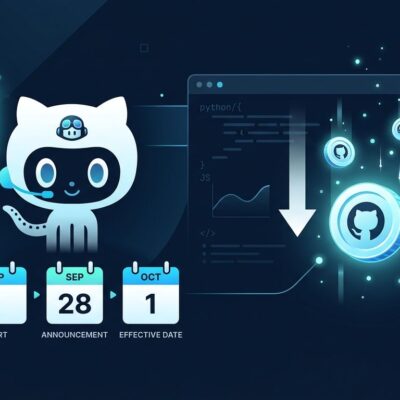
GitHub announced today (April 27, 2026) that it’s killing the unlimited subscription model for Copilot, switching to token-based billing on June 1, 2026. This isn’t just a pricing change—it’s proof that flat-rate AI tool subscriptions are economically dead. Microsoft’s infrastructure costs doubled since January, forcing them to abandon the $10-39/month unlimited model. The 18-month era of “unlimited AI for $10/month” is over, and every AI tool maker will follow GitHub’s path to metered billing because they all face the same impossible math.
Agentic AI Broke Subscription Economics
GitHub’s weekly Copilot infrastructure costs nearly doubled since January 2026 because agentic workflows—multi-step, multi-file coding sessions that read codebases, implement features, run tests, and iterate through failures—consume 1000x more tokens than simple code completions. Consequently, a single multi-hour agentic session can now cost more than an entire month’s subscription fee, making flat-rate pricing financially unsustainable.
The token consumption breakdown tells the story. Code completions burn 100-500 tokens (roughly $0.0005). Simple chat questions consume 1,000-5,000 tokens (~$0.05). Agentic workflows devour 500,000-2,000,000 tokens (~$5-20 per session). Research from ArXiv confirms that “agentic tasks consume 1000x more tokens than code reasoning and code chat.”
GitHub’s own announcement admits the problem: “It’s now common for a handful of requests to incur costs that exceed the plan price.” When power users cost $150/month in actual infrastructure while paying $10/month, no business model can absorb that gap forever. Microsoft tried, burned hundreds of millions on subsidies, and finally admitted defeat.
What’s Changing June 1: Token Billing Details
Starting June 1, 2026, all GitHub Copilot plans switch from unlimited usage to token-based billing with included AI Credits. Copilot Pro stays $10/month but only includes $10 in credits. Copilot Pro+ stays $39/month with $39 in credits. Moreover, Business and Enterprise get promotional credits (June-August) before dropping to match subscription prices.
Code completions remain unlimited and unmetered—the Tab/Enter suggestions that developers use hundreds of times per day. However, chat questions, agentic workflows, and multi-step sessions now consume credits based on token usage. No more fallback to cheaper models when you hit limits. You either stop working or pay overage charges.
For developers, this means budgeting for variable costs. Light users (100 completions/day, 20 chat questions) will see roughly 50% increases (~$5/month overage). Power users running agentic workflows multiple times per week face 10-15x increases (~$140/month overage). Furthermore, GitHub is launching preview billing in May so developers can calculate projected costs before the June 1 shock.
Everyone Will Follow: Cursor, ChatGPT, Claude
GitHub isn’t alone. Cursor launched with hybrid subscription + usage credits from day 1: $20/month includes $20 in credits (Pro), $60/month includes $70 (Pro+), $200/month includes ~$400 (Ultra). Meanwhile, Anthropic nearly removed agentic features from Claude Pro entirely in February 2026, opting instead for strict rate limits. OpenAI ChatGPT Plus still claims “$20/month unlimited GPT-4,” but soft rate limits already throttle power users behind the scenes.
According to industry research, 77% of the largest software companies now use usage-based or hybrid pricing models. This is the dominant approach because all AI tool makers face identical economics: agentic AI costs 1000x more than simple chat, making flat-rate subscriptions unsustainable. Industry analysis predicts agentic AI subscriptions will increase 10x-100x by the end of 2027 from January 2026 baseline levels.
This isn’t a GitHub-specific problem. Every developer using AI tools should expect ChatGPT, Claude, Cursor, and others to announce similar transitions within the next 12-18 months. The subscription AI era lasted 18 months (November 2024 – June 2026). It’s over.
What Developers Should Do Now
Prepare for 2-10x cost increases depending on usage patterns. Track your current usage with GitHub’s May preview billing tool to calculate projected costs. Budget conservatively—assume 3x your average usage to account for token consumption variability, which can differ by up to 30x on identical tasks due to non-deterministic AI behavior.
Usage optimization strategies matter now. Use code completions aggressively since they remain unlimited and unmetered. Additionally, save agentic workflows for critical tasks where the $5-20 cost is justified—debugging production issues, complex refactoring, architecture decisions. Enable prompt caching on all tools (Anthropic reports up to 90% savings on repetitive contexts). Stack free tiers across multiple tools: Claude Free for general questions, ChatGPT Free for research, Copilot base for code completions.
Set budget alerts to avoid surprise bills. Treat AI tools as variable operational expenses (like AWS compute) rather than fixed subscriptions. The days of predictable monthly costs are gone. Consequently, plan infrastructure budgets accordingly, and don’t build business models assuming unlimited AI access will return—it won’t.
Why Subscription AI Is Economically Dead
Subscription pricing works for Netflix because content delivery costs are fixed per user. It fails for AI because compute costs vary wildly with usage intensity. When a single user’s agentic session costs $50 in tokens but they pay $10/month, no business model can absorb that variance profitably.
The “AI subsidy party” powered by investor funding is ending as companies demand profitability. As one industry analysis noted, “The current era of ‘free’ or heavily subsidized AI is a temporary phase, and as AI shifts from experimental tool to core infrastructure, its underlying economics are beginning to assert themselves.” GitHub’s own words capture the problem: “A quick chat question and a multi-hour autonomous coding session can cost the user the same amount [under subscription model].”
Understanding why subscriptions failed helps developers see this shift is permanent, not temporary. Metered billing is the only economically viable path when usage can vary 1000x between light and heavy users. The economics always win eventually, and they’re winning now.
Key Takeaways
- GitHub Copilot’s switch to token-based billing on June 1, 2026 proves subscription AI is economically dead—every major AI tool will follow within 12-18 months
- Agentic AI workflows consume 1000x more tokens than simple code completions, breaking the cross-subsidization model that made flat-rate pricing viable
- Microsoft’s Copilot infrastructure costs doubled since January 2026, forcing the shift from unlimited subscriptions to metered billing with included credits
- Developers should budget 2-10x cost increases depending on usage: light users +$5/month, power users +$50-150/month, with variable expenses replacing fixed subscriptions
- Use GitHub’s May preview billing tool to calculate projected costs, optimize usage by reserving agentic workflows for critical tasks, and stack free tiers across multiple AI tools to minimize overage charges