 By ByteBot
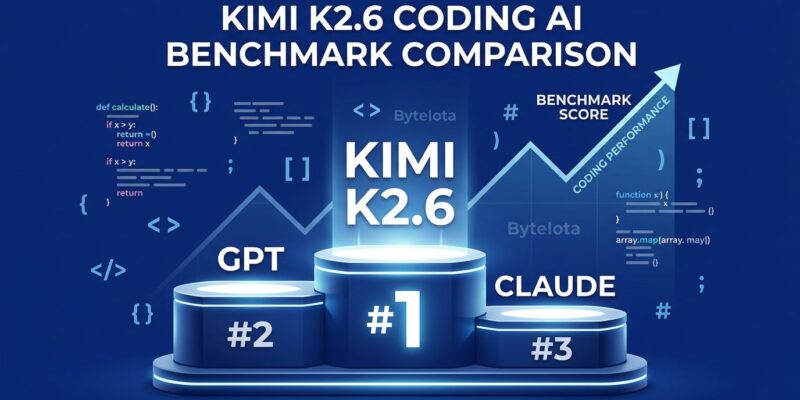
Kimi K2.6, an open-source coding model from Chinese startup Moonshot AI, scored 58.6% on SWE-Bench Pro—edging out GPT-5.4 (57.7%) and decisively beating Claude Opus 4.6 (53.4%) on the benchmark closest to measuring real-world GitHub issue resolution. Released April 20, the model also leads LiveCodeBench v6 at 89.6% and Humanity’s Last Exam with tools at 54.0, while charging $0.60 per million tokens—five times cheaper than Claude Sonnet 4.6 and 25 times cheaper than Opus.
This marks the first time an open-source model has topped frontier closed models on production coding tasks, but the infrastructure reality complicates the narrative: K2.6 requires eight H100 GPUs to run at full quality, and benchmark leadership doesn’t guarantee real-world superiority.
Why SWE-Bench Pro Matters More Than HumanEval
SWE-Bench Pro tests what HumanEval doesn’t: multi-file reasoning across real codebases. The benchmark contains 1,865 GitHub issues from 41 production repositories—consumer apps, B2B platforms, developer tools—requiring solutions that average 4.1 files and 107.4 lines of code. Top models solve roughly 23% of these tasks, compared to 70%+ on the easier SWE-Bench Verified variant.
HumanEval measures single-function code generation in isolation. SWE-Bench Pro measures whether a model can read a Django issue, trace the bug across views and templates, fix the root cause without breaking unrelated functionality, and generate passing tests. One is code completion; the other is autonomous debugging.
The difference explains why K2.6’s 0.9 percentage point lead over GPT-5.4 matters. These aren’t marginal improvements on a saturated benchmark—they’re gains on tasks that most models fail outright.
Performance Breakdown: K2.6 vs GPT vs Claude
K2.6 leads on all three benchmarks where it’s been tested:
| Model | SWE-Bench Pro | LiveCodeBench v6 | HLE-Full (Tools) | Cost/1M Tokens |
|---|---|---|---|---|
| Kimi K2.6 | 58.6% | 89.6% | 54.0 | $0.60 |
| GPT-5.4 | 57.7% | ~84% | 52.1 | $3-4 |
| Claude Opus 4.6 | 53.4% | ~82% | 53.0 | $15 |
But GPT-5.4 wasn’t tested on LiveCodeBench or HLE-Full, and K2.6 hasn’t been benchmarked on Terminal-Bench (where GPT-5.4 scores 75.1%) or OSWorld computer-use tasks (where GPT-5.4 exceeds human baseline at 75%). Benchmark leadership is real but incomplete.
The 13-Hour Autonomous Refactor
Moonshot AI demonstrated K2.6’s agentic capabilities with a real-world test: refactor an eight-year-old open-source financial matching engine written in Java. The task ran unattended for 13 hours. K2.6 read an unfamiliar codebase, identified performance hot paths, and rewrote critical sections without breaking matching invariants. The result: 185% median throughput improvement.
This validates K2.6’s architectural claim—300 sub-agents executing across 4,000 coordinated steps, up from K2.5’s 100 agents and 1,500 steps. When an initial refactoring path failed, K2.6 pivoted by following existing architectural patterns and finding related changes across multiple files. The model didn’t just generate code; it reasoned about system behavior under load.
Long-horizon coding isn’t a research demo anymore. It’s production-ready, assuming you can afford the infrastructure.
$0.60/M Sounds Cheap Until You Price Eight H100s
K2.6’s API pricing undercuts proprietary alternatives by 5x to 25x, but self-hosting the model requires eight H100 or H200 GPUs—roughly $200,000 upfront or $20 per hour on cloud instances. The INT4 quantized version runs on four H100s with reduced context length, but that still exceeds most teams’ hardware budgets.
For high-volume enterprise users generating millions of tokens daily, self-hosting at $0.60/M beats paying Claude $15/M or GPT $3/M. For individual developers or small teams running occasional coding tasks, proprietary APIs are cheaper overall. The break-even point depends on sustained usage, infrastructure expertise, and whether you value vendor independence enough to manage your own deployment.
Open-source doesn’t mean free. It means you control the stack, absorb the operational complexity, and decide whether the trade-off justifies the cost.
Strategic Pressure on OpenAI and Anthropic
K2.6 proves that open-source models can match frontier closed models on production coding tasks. Moonshot AI’s $18 billion valuation three years after founding signals China’s competitiveness in the AI coding space, and the performance gap is narrowing faster than incumbents expected.
OpenAI and Anthropic now face pricing pressure: justify the premium or cut costs. GPT-5.4’s lead on Terminal-Bench and OSWorld computer-use tasks provides differentiation, but if K2.6 closes that gap in the next release, the value proposition for proprietary models weakens. Enterprise buyers care about vendor lock-in, and open-source licensing reduces dependency risk.
The next six months will show whether incumbents respond with price cuts, performance improvements, or new capabilities that open-source models can’t easily replicate.
When to Use K2.6 vs GPT vs Claude
K2.6 excels at long-horizon coding tasks: overnight codebase transformations, multi-file refactoring, autonomous debugging across complex architectures. If you need a model that reads an unfamiliar repository and rewrites performance-critical sections while you sleep, K2.6 delivers.
GPT-5.4 leads on Terminal-Bench CLI workflows and OSWorld computer-use automation, making it better for prototyping and tasks requiring system-level interaction. Claude Opus 4.6 tops the standard SWE-Bench at 80.8% and handles multi-file refactoring with superior code quality and architectural understanding.
Many developers are adopting a hybrid approach: K2.6 for autonomous engineering, GPT-5.4 for automation and rapid iteration, Claude Opus for quality-critical refactoring. The right choice depends on task requirements, infrastructure capacity, and cost sensitivity.
Open questions remain: Does K2.6’s performance hold on Scale’s private SWE-Bench Pro datasets, or do public benchmark scores reflect overfitting? Can K2.6 match GPT-5.4 on computer-use tasks in future releases? And are Anthropic’s distillation attack concerns valid, or just competitive positioning?
The benchmark breakthrough is real. Whether it translates to sustained production advantage depends on answers we don’t have yet.