 By ByteBot
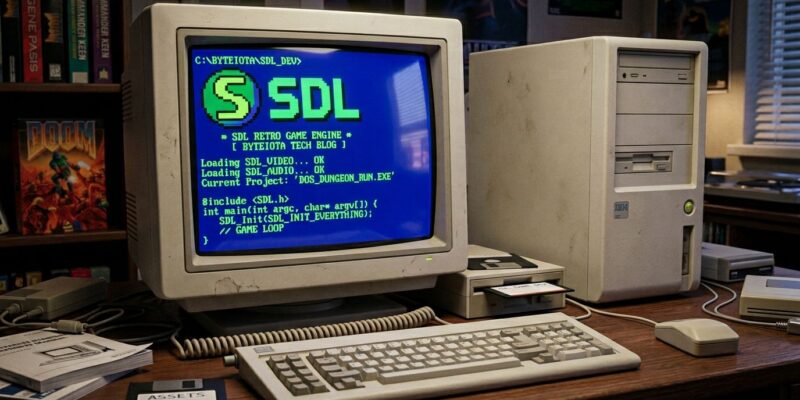
SDL (Simple DirectMedia Layer), the cross-platform multimedia library powering thousands of games including Valve’s entire Source Engine catalog, officially added DOS support yesterday. Developers can now use modern SDL3 APIs to create games and applications that run natively on a 45-year-old operating system Microsoft discontinued 26 years ago. The implementation includes full VGA/VESA graphics, Sound Blaster audio, keyboard/mouse/joystick input, and cooperative multithreading. This isn’t a curiosity project—it’s serious infrastructure for a measurable retro computing trend.
Why Modern Tools Target ‘Dead’ Platforms
Retro gaming interest exploded in 2026. Windows Central reports searches for “retro PC gaming builds” skyrocketed, with 2026 marking a tipping point driven by expensive modern hardware. Complete 486/Pentium systems cost a fraction of $2000+ contemporary rigs. Consequently, communities like r/RetroGaming and r/CRTGaming have become active centers, and retro arcades are packed on weekends.
Moreover, preservation urgency is real. Myrient, one of the internet’s largest retro game archives, shut down March 31, 2026, due to hosting costs driven by AI company storage demand. Meanwhile, the demoscene—computer art competitions on vintage platforms—remains active, with Meteoriks Award 2026 nominees announced at Mountain Bytes. SDL’s DOS support responds to this cultural moment: when digital archives are fragile and hardware limitations become creative features, modern development tools matter.
SDL DOS Support: Serious Engineering for Serious Constraints
SDL’s DOS implementation isn’t minimal. GitHub PR #15377, merged April 24, demonstrates comprehensive platform support: VGA mode 13h (320×200, 256 colors) and VESA 1.2+ modes with direct hardware palette programming, Sound Blaster 16 audio (16-bit stereo, 44.1 kHz) with IRQ-driven DMA, and PS/2 keyboard/mouse with gameport joystick support. The threading system implements cooperative scheduling using setjmp/longjmp with stack patching, providing real mutexes, semaphores, TLS, and condition variables.
Technical decisions reveal depth: developers moved audio mixing from interrupt handlers to the main loop for stability, drew inspiration from PlayStation 2 port architecture, and explicitly documented limitations (no audio recording, no dynamic library loading). Testing occurred primarily in DOSBox and DOS 6.22, with limited real hardware validation—a pragmatic acknowledgment of modern development realities.
This proves targeting “dead” platforms requires real expertise. Implementing VGA DAC palette control, Sound Blaster IRQ handling, and DMA buffer management demands hardware-level programming rarely needed in 2026. It’s modern software engineering applied to ancient constraints, not patronizing nostalgia.
SDL Powers Thousands of Games—Now Including DOS
For readers unfamiliar with SDL: it’s battle-tested infrastructure, not a niche hobby library. SDL provides hardware abstraction for video, audio, input, and threading across Windows, macOS, Linux, iOS, Android, and now DOS. Valve’s Source Engine—powering Half-Life, Portal, Team Fortress 2, Counter-Strike, and Dota 2—uses SDL extensively for cross-platform compatibility. Additionally, commercial titles (Angry Birds, Unreal Tournament) and hundreds of indie/open-source games (OpenTTD, The Battle for Wesnoth, Freeciv) rely on it.
SDL has maintained active development since 1998, spanning 26 years. When infrastructure of this caliber adds DOS support, it signals retro platforms are being taken seriously by mainstream development communities, not just hobbyists tinkering in basements. DOS joins modern platforms as a first-class target—an unusual vote of confidence for 1981 technology.
Modern C++ Compiler Meets 1981 Operating System
SDL’s DOS support leverages DJGPP (DJ’s GNU Programming Platform), a complete 32-bit C/C++ development environment for DOS maintained since 1989—37 continuous years. DJGPP ports GCC, GNU utilities, and POSIX APIs to DOS Protected Mode Interface (DPMI). Current versions support GCC 14.2.0 with C++23 features and access to 4GB RAM, far beyond DOS’s infamous 640KB conventional memory limit.
DJGPP bridges eras: modern compiler technology running on a platform designed when Reagan was president. Without it, developers would wrestle with ancient Borland C++ or Watcom compilers and C89 limitations. Instead, they get familiar GCC tooling, contemporary language features, and POSIX compatibility. This lowers the barrier from “learn archaeological toolchains” to “use familiar development workflows.”
What SDL DOS Support Means for Retro Development
SDL’s DOS support reflects broader themes in 2026 software development. Retro computing isn’t fleeting nostalgia—it’s a response to modern complexity, preservation fragility, and economic pressures. The demoscene has kept vintage platforms alive for decades through creative constraint. Now mainstream libraries are acknowledging these communities with production-quality tooling.
Platform constraints can be features. DOS forces developers to think carefully about memory, concurrency, and hardware interaction—skills diluted by modern abstractions. While not commercially viable, demoscene competitions, hobbyist projects, and educational initiatives benefit from accessible tools that don’t sacrifice technical depth.
The technical achievement deserves respect. Implementing cooperative threading, VGA/VESA graphics, and Sound Blaster audio isn’t trivial—it’s legitimate systems programming applied to historical platforms. SDL treated DOS development seriously, and the retro computing community gains modern infrastructure for creating new content on preserved systems.
Key Takeaways
- SDL added comprehensive DOS support April 23-24, 2026, including VGA/VESA graphics, Sound Blaster audio, and cooperative multithreading—production-quality platform support, not a minimal proof-of-concept.
- Retro computing surged in 2026 driven by economic factors (cheap vintage hardware vs expensive modern rigs), preservation concerns (Myrient shutdown March 2026), and active demoscene communities creating art on constrained platforms.
- DJGPP bridges 1989 and 2026, providing GCC 14.2.0, C++23 features, and 4GB memory access for DOS—modern compiler technology targeting a 45-year-old operating system.
- When major development libraries add retro platform support, it signals these communities are being taken seriously by mainstream infrastructure projects, not dismissed as hobbyist curiosities.
- Platform constraints aren’t limitations—they’re creative features that force careful thinking about memory, concurrency, and hardware interaction, skills diluted by modern abstractions.