 By ByteBot
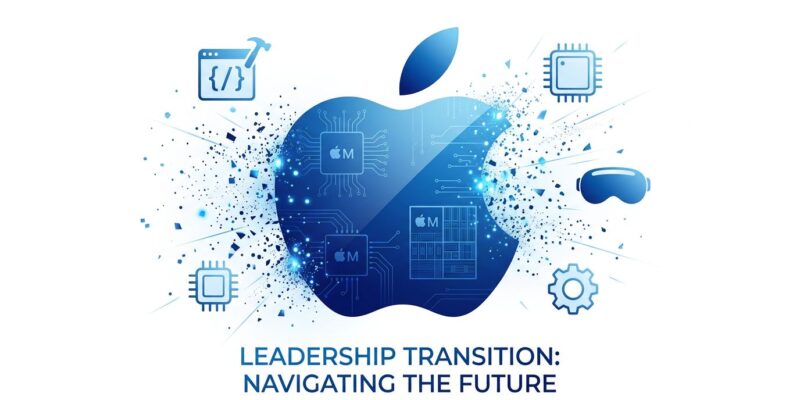
Apple announced on April 20 that hardware engineering chief John Ternus will succeed Tim Cook as CEO on September 1, 2026. Cook transitions to Executive Chairman after 15 years running the company. This is Apple’s first CEO change since 2011 and its first engineer CEO since Steve Jobs. For developers, the news isn’t just about corporate reshuffling—it’s about the architect of Apple Silicon now controlling the platform’s future.
Ternus led the 2020-2022 transition from Intel to Apple’s M-series chips, completing the fastest platform migration in computing history. Developer build times jumped 2-3x faster. Battery life hit 15-20 hours on MacBook Pros. The entire Mac lineup switched to ARM in two years while the business grew—rare for platform shifts. Now the person who designed that silicon runs the company.
The Apple Silicon Track Record
When Apple announced the Intel-to-ARM transition in June 2020, the tech press was skeptical. Moving an entire product line to a new architecture while maintaining compatibility and performance seemed ambitious. However, Ternus delivered ahead of schedule. The M1 launched in November 2020 with battery life that seemed impossible for the performance being delivered. Within two years, every Mac ran on Apple Silicon.
For developers, the impact was immediate. Xcode compilation times dropped by half. Apps built for x86 ran seamlessly through Rosetta 2. Universal binaries let developers ship once for both architectures. Moreover, by 2026, over 80% of Mac apps run natively on ARM. The performance gap versus Intel grew so wide that Intel still struggles to close it. This wasn’t just a chip swap—it was hardware, software, and developer tools coordinated into a single successful platform shift.
The architect of that success now sets Apple’s roadmap. Expect faster Silicon releases. The M5 chip will likely arrive in late 2026, potentially with dedicated AI cores. Developer APIs that leverage the Neural Engine should mature. Xcode optimization for Apple Silicon will accelerate. When the person who built the platform controls its future, developers benefit.
The Challenges Ternus Inherits
Apple’s AI strategy lags its competitors by a measurable margin. Microsoft, Google, Meta, and Amazon collectively spend over $100 billion annually building AI data centers. Meanwhile, Apple’s approach—on-device AI powered by the Neural Engine—requires minimal infrastructure spending but delivers fewer features. Apple Intelligence launched with limited capabilities and remains unavailable in China, Apple’s largest market.
Geopolitics is the second major challenge. China represents both Apple’s manufacturing advantage and its greatest regulatory vulnerability. The EU’s Digital Markets Act forces App Store changes. The U.S. Department of Justice lawsuit over App Store monopoly practices continues. Furthermore, Cook handled these political headwinds by flying to Brussels, Beijing, and Washington himself. Ternus has zero experience engaging with policymakers. Cook stays on as Executive Chairman specifically to handle government relations while Ternus focuses on products.
Software quality rounds out the top concerns. The top comment on Hacker News summed it up: “Hopefully Ternus brings what he brought to Apple’s hardware to their software. The hardware is leaps and bounds ahead of anything else, but their software gets worse and worse every generation.” Xcode crashes. macOS releases ship with bugs. Developers are asking whether a hardware-focused CEO can fix software problems or if the gap will widen.
Hardware CEO Versus Operations CEO
Tim Cook came from operations. His strength was supply chain efficiency and building a $100 billion services business. Decision-making was slow, collaborative, and consensus-driven. Steve Jobs was the opposite—autocratic, product-focused, and fast. Ternus reportedly lands closer to Jobs than Cook in decision-making style. Bloomberg described him as “charismatic and well-liked,” which is corporate speak for “engineers actually want to work with this person.”
The developer community reaction splits between excitement and skepticism. “Best Apple news in a while. Apple needs a product visionary after 5 years of stagnation,” one MacRumors commenter wrote. Others worry: “Can an engineer CEO handle geopolitics?” Services might suffer under a hardware-first leader. The $100 billion-per-year App Store, iCloud, and Apple Music business accounts for 25% of revenue. If Ternus over-indexes on hardware, that quarter of the company’s income is at risk.
What developers hope for: better Xcode, macOS quality improvements, Vision Pro SDK maturity, and APIs that unlock what Apple Silicon can actually do. What they fear: neglected developer tools while Ternus obsesses over thinner MacBooks.
Vision Pro and What’s Next
Ternus led Vision Pro’s hardware development. In an April 23 interview, he said, “We’re still very much in the early innings of spatial computing. The Vision Pro is an extraordinary product.” Translation: Apple knows adoption is niche. Enterprise and medical use cases are growing, but consumer apps remain limited. With a hardware expert as CEO, Vision Pro might get more aggressive hardware iteration—lighter headsets, better battery life, cheaper entry points. Or spatial computing could stall if developer adoption doesn’t follow.
What developers should watch: WWDC 2026 in June will be Ternus’ first major event as CEO-designate. Expect iOS 27 and macOS 15 previews, AI feature announcements, and developer tool updates. The M5 chip arrives in late 2026. Apple’s AI strategy will clarify—either on-device AI catches up or Apple admits it needs cloud infrastructure. Xcode might finally get native AI coding tools, though Apple’s privacy-first approach makes GitHub Copilot integration unlikely.
The transition becomes official September 1, 2026. Cook stays as Executive Chairman to handle policymakers. Ternus runs products and operations. The stakes: a $3 trillion company at an AI-era inflection point with a hardware expert in charge for the first time since Steve Jobs.