 By ByteBot
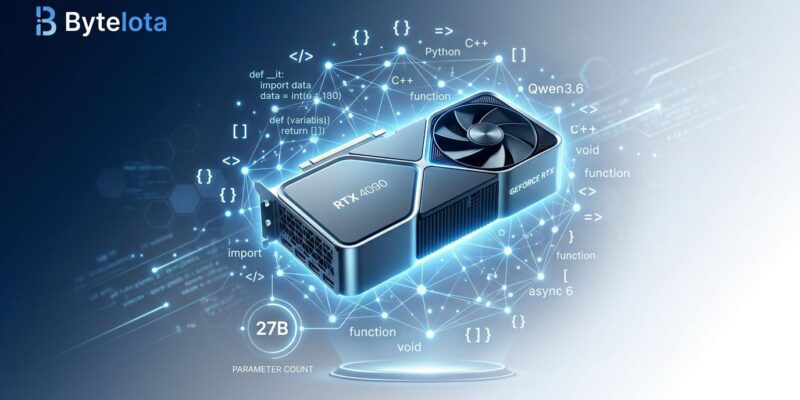
Alibaba’s Qwen team released Qwen3.6-27B today (April 22, 2026), a dense 27-billion parameter model claiming flagship-level coding performance while running locally on consumer GPUs. The model hit #2 on Hacker News within hours, trending alongside discussions about WiFi-based pose estimation and tractors without electronics. With 262K native context extensible to 1M tokens, 78.8% performance on SWE-bench Verified, and the ability to run on a single RTX 4090 with 24GB VRAM, Qwen3.6-27B signals a shift in AI economics: flagship coding assistance without flagship API bills.
This matters because local deployment changes the cost equation entirely. After a $1,600 hardware investment (RTX 4090), every token processed costs effectively nothing—no $2.50-$5 per million token API fees, no rate limits, and proprietary code never leaves your machine.
Local Deployment Economics Beat API Pricing After 500M Tokens
The break-even math is straightforward. An RTX 4090 with 24GB VRAM costs $1,600. GPT-4 charges $2.50 per million input tokens. Process 640 million tokens and you’ve paid for the GPU. Everything after that is free compute (minus negligible electricity costs of ~$0.05/hour).
This transforms coding assistance from an ongoing operational expense into a capital investment. Startups refactoring legacy codebases, teams generating documentation at scale, or developers building autonomous coding agents all hit break-even within months if processing more than 500M tokens. Claude Opus at $5 per million input tokens makes local deployment even more attractive—the same RTX 4090 pays for itself after just 320 million tokens.
However, the quality trade-off is real. Qwen3.6-27B scores 78.8% on SWE-bench Verified according to the Qwen team, competitive but not leading. Claude Opus 4.6 holds the top spot at 80.8%. GPT-5.4 trails at 57.7%. For teams requiring absolute frontier quality on every code generation task, API pricing might be worth it. For everyone else, “good enough” at zero marginal cost changes the calculus.
Dense vs MoE: Why Alibaba Released Both Architectures
Qwen3.6 comes in two flavors: 27B dense (all parameters active) and 35B-A3B MoE (35B total with 3B active per token). This isn’t product line bloat—it’s an admission that neither architecture dominates all use cases.
Dense models like Qwen3.6-27B activate all 27 billion parameters for every token. This means higher per-token compute cost but simpler deployment. No gating networks. No expert routing logic. No load balancing headaches. You install vLLM, point it at the model, and it works. Latency is predictable because the same parameters handle every request.
MoE models promise better parameter efficiency—35B total capacity with only 3B active delivers lower per-token compute. But that efficiency comes with complexity. Both architectures still require loading all parameters into VRAM (the gating network needs access to all experts), so memory savings don’t materialize. Performance becomes sensitive to routing efficiency and expert load balance. Serving MoE models at scale is objectively harder.
The lesson: dense models haven’t lost to MoE despite the industry’s 2024-2025 obsession with mixture-of-experts. For local deployment where simplicity matters more than absolute parameter efficiency, dense architectures remain competitive. Qwen’s dual release acknowledges this reality.
Benchmark Claims Require Independent Validation
Qwen’s official benchmark shows 78.8% on SWE-bench Verified, positioning Qwen3.6-27B as competitive with frontier models. The Hacker News community isn’t buying it wholesale. One commenter noted that “comparing to Opus 4.5 instead of the current 4.6 and other last-gen models is clearly an attempt to deceive.” Another offered pragmatic advice: “The best tests are your own custom personal-task-relevant standardized tests.”
This skepticism is warranted. The model released today. Zero independent validation exists. No community benchmarks. No hands-on reviews from developers who’ve tested it on real codebases. The 78.8% claim might hold under scrutiny, or it might crumble when evaluated on tasks Qwen didn’t specifically optimize for.
The smart play: treat official benchmarks as directional guidance, not gospel. Qwen3.6-27B is likely competitive with mid-tier proprietary models (it’s a 27B dense model, not a frontier-scale MoE). It probably beats GPT-3.5-level performance. It almost certainly lags Claude Opus and the best of GPT-4. Run your own tests. Evaluate on your stack, your languages, your coding patterns. Benchmarks provide comparisons. Your codebase provides truth.
Privacy Advantages Unlock Regulated Industry Use Cases
Local deployment solves a problem API-based coding assistants can’t: keeping code on-premises. Banks processing proprietary trading algorithms can’t send code snippets to OpenAI’s servers. Defense contractors working on classified systems can’t use cloud-based AI. Healthcare platforms can’t risk HIPAA violations by transmitting patient data through coding assistants.
Qwen3.6-27B runs entirely offline after the initial ~54GB model download from HuggingFace. No network calls during inference. No telemetry. No data leaving your infrastructure. This isn’t just privacy theater—it’s compliance by design. GDPR data residency requirements? Satisfied automatically. Air-gapped environments? Deploy locally and disconnect the internet.
Contrast this with GitHub Copilot, Claude, or GPT-4, all of which require sending code to third-party cloud infrastructure. For individual developers, this might be acceptable. For regulated enterprises, it’s a non-starter. Qwen3.6-27B enables coding assistance in contexts where API-based tools are categorically prohibited.
Deployment in Three Commands
Setting up Qwen3.6-27B locally takes minutes, not hours. Install vLLM (v0.19.0 minimum for Qwen3.6 support), pull the model from HuggingFace, start the server:
# Install vLLM with Qwen3.6 support
pip install vllm>=0.19.0

# Start local inference server
vllm serve Qwen/Qwen3.6-27B \
  --tensor-parallel-size 1 \
  --max-model-len 262144 \
  --dtype bfloat16
This assumes you have 24GB VRAM minimum. RTX 4090 works. RTX 6000 Ada works. A100 40GB works. Anything with less than 24GB requires quantization (INT8 or INT4), which degrades quality noticeably. If you’re running 16GB hardware (RTX 4080), the quality hit from aggressive quantization might negate the benefits of local deployment.
Framework choice matters. vLLM optimizes for throughput via PagedAttention and continuous batching—best for bulk processing or serving multiple users. SGLang (v0.5.10+) offers better support for complex agentic workflows with built-in control flow. HuggingFace Transformers provides the simplest setup but worst performance. Choose based on your use case: prototyping, production serving, or autonomous agents.
When to Choose Local vs API
The decision framework is simpler than vendor marketing suggests. Choose Qwen3.6-27B (local) if you process more than 100M tokens monthly, have privacy requirements that prohibit cloud AI, or need offline capability. Choose GPT-4 or Claude (API) if you process fewer than 50M tokens monthly, require absolute frontier quality where the 2-point SWE-bench gap matters, or prefer zero infrastructure management.
The middle ground (50-500M tokens monthly) depends on your DevOps capacity and quality tolerance. If you have GPU infrastructure and can tolerate “competitive but not leading” performance, local wins on economics. If you’re a small team without ML ops expertise or your code quality requirements are strict, API services remain worthwhile despite higher costs.
Many teams will land on hybrid architectures: Qwen for bulk processing (refactoring legacy code, generating documentation, analyzing dependencies) and Claude or GPT-4 for critical features where quality is non-negotiable (complex algorithmic work, security-sensitive code, production-facing logic). This splits the difference between cost optimization and quality maximization.
Key Takeaways
- Qwen3.6-27B runs on RTX 4090 (24GB VRAM) and becomes cost-effective after processing 500M-1B tokens, making flagship-level coding assistance accessible beyond enterprise API budgets
- Dense architecture (27B all-active) offers deployment simplicity vs MoE complexity—simpler routing, predictable latency, easier production operations at cost of higher per-token compute
- Official benchmarks (78.8% SWE-bench Verified) require independent validation—competitive with mid-tier models but lags Claude Opus 4.6 (80.8%) on published metrics
- Local deployment keeps code on-premises, enabling coding assistance in regulated industries where cloud APIs are prohibited (GDPR, HIPAA, classified environments)
- Hybrid approach likely optimal for most teams: local Qwen for bulk processing, API models for critical quality-sensitive tasks
Released today, Qwen3.6-27B signals that the dense model architecture isn’t dead despite the MoE trend. For teams prioritizing cost control, privacy compliance, or offline capability over absolute frontier performance, local deployment on consumer GPUs is now viable. Test it on your codebase before committing—benchmarks lie, but your compiler doesn’t.