 By ByteBot
Factory AI just raised $150 million at a $1.5 billion valuation, hitting unicorn status three years after a UC Berkeley PhD student cold-emailed Sequoia Capital. The Series C led by Khosla Ventures comes with bragging rights: Revenue has doubled every month for the past six months. Hundreds of thousands of developers at Nvidia, Adobe, EY, and Palo Alto Networks already use Factory’s “Droids” – AI agents that don’t just suggest code, but handle testing, code review, documentation, and deployment without human intervention.
The funding validates a market shift from AI assistants to autonomous agents. GitHub Copilot still dominates with 42% market share and 4.7 million paid subscribers, but Factory’s growth and enterprise customer list signal that developers want more than autocomplete.
Droids Handle What Copilot Doesn’t
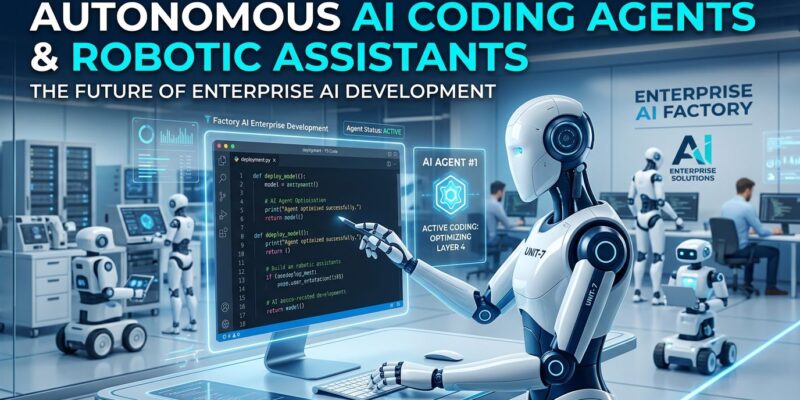
Factory’s pitch isn’t better code suggestions – it’s removing developers from implementation entirely. The company’s specialized Droids automate the full software lifecycle:
- CodeDroid implements features and refactors
- Review Droid analyzes pull requests and leaves inline comments
- QA Droid writes and maintains unit and integration tests
- DroidShield catches security vulnerabilities and bugs before commit
The difference between Factory and GitHub Copilot is scope. Copilot completes lines and functions. Factory’s new “Missions” feature handles weeks-long workflows – migrations, refactors, and feature implementations that span hundreds of files. Factory Desktop gives agents system-level access to run builds, fix errors, and deploy autonomously. The company claims customers have saved over 500,000 engineering hours and millions in costs.
That’s not assistance. That’s delegation.
Model-Agnostic Wins When Models Commoditize
Factory founder Matan Grinberg told TechCrunch the company’s “key differentiator” is switching between foundation models – Anthropic’s Claude, China’s DeepSeek, and others as they emerge. GitHub Copilot ties developers to OpenAI. Factory doesn’t care which model wins.
This matters more in 2026 than it did in 2024. Two years ago, GPT-4 dominated and model choice was obvious. Today, Claude excels at reasoning, DeepSeek undercuts on price, and new models launch monthly. Performance parity means differentiation comes from orchestration, not model quality.
Factory can route complex refactors to Claude and repetitive tasks to DeepSeek. GitHub users get whatever OpenAI ships. When the next breakthrough model drops, Factory users get access immediately. GitHub users wait for Microsoft’s integration timeline.
Enterprise Adoption Crossed the Chasm
Factory’s customer list reads like a Fortune 500 directory: Nvidia uses AI to build AI products, Adobe automates creative software development, EY and Palo Alto Networks run Droids in production. MongoDB, Adyen, Bayer, and Zapier all rely on autonomous agents for daily development work.
The broader market confirms this isn’t early adopter experimentation. Stack Overflow’s 2026 survey found 84% of developers now use or plan to use AI coding tools. GitHub reported 51% of all code in early 2026 was AI-generated or AI-assisted. The AI coding market hit $7.37 billion in 2025 and projects to $26 billion by 2030.
Factory’s revenue doubling monthly for six months means enterprise customers found ROI. Companies don’t renew and expand contracts for experimental tools – they expand when agents demonstrably save 500,000 engineering hours.
Copilots Assist, Agents Execute
GitHub Copilot pioneered AI coding as an assistant: Developers write, AI suggests, developers decide. Factory pitches autonomous execution: Developers define goals, agents implement, agents decide. The difference reshapes the developer role.
Copilot makes you faster at writing code. Factory removes you from writing code. With autonomous testing, review, documentation, and deployment, developers shift from implementers to orchestrators. You don’t write the feature – you validate that the agent wrote it correctly.
This explains Factory’s enterprise traction. Individual developers paying $10/month want better autocomplete. Enterprises paying for hundreds of thousands of seats want 500,000 hours back. Assistance improves productivity incrementally. Autonomy changes what developers do.
Factory’s $1.5 billion valuation after three years signals VCs believe autonomous agents will dominate enterprise development. Whether “agent-native development” becomes the standard or remains a premium enterprise tool depends on how comfortable developers become reviewing agent work instead of writing it themselves. Based on 84% adoption rates and 51% AI-generated code, that comfort is arriving faster than anyone predicted in 2024.