 By
By Intel bought back full control of its Ireland Fab 34 manufacturing facility for $14.2 billion on April 1, 2026—paying a 27% premium over what Apollo Global Management paid just 22 months earlier. The deal, which closed April 8, reverses a June 2024 cash-crisis sale when Intel desperately needed funds under former CEO Pat Gelsinger. Intel’s stock surged 8.8% on the announcement, hitting its highest level in nearly two years, as investors interpreted the buyback as ending “survival mode” under new CEO Lip-Bu Tan.
This isn’t just financial maneuvering. Intel paid $3 billion extra for something it owned 22 months ago, but the market’s enthusiastic response shows investors believe manufacturing control is worth the premium. The question: Is this confidence justified or expensive wishful thinking?
The Dramatic Reversal: From Desperation to Offensive Strategy
June 2024: Intel sells 49% of Fab 34 to Apollo for $11.2 billion. CEO Pat Gelsinger needs cash fast to fund fab expansion plans, and Intel’s balance sheet is hemorrhaging. The joint venture structure preserves operational control, but Intel gives up decision-making autonomy for desperately needed capital.
April 2026: Intel buys it back for $14.2 billion. Same facility, 27% higher price, completely different context. Gelsinger is gone (ousted in December 2024 after his turnaround plan failed). New CEO Lip-Bu Tan, a semiconductor industry veteran who led Cadence for over a decade, is reversing crisis decisions and betting on manufacturing. The financing—$7.7 billion cash on hand plus $6.5 billion in new debt—shows Intel has liquidity, not desperation.
The 27% premium ($3 billion extra) is the interesting part. Apollo made 12% annualized returns on a 22-month hold, which is solid but not spectacular for private equity. Intel clearly values manufacturing control more than $3 billion. The market agrees: that 8.8% stock surge means investors see strategic value, not waste.
Why Fab 34 Actually Matters for Intel’s Foundry Ambitions
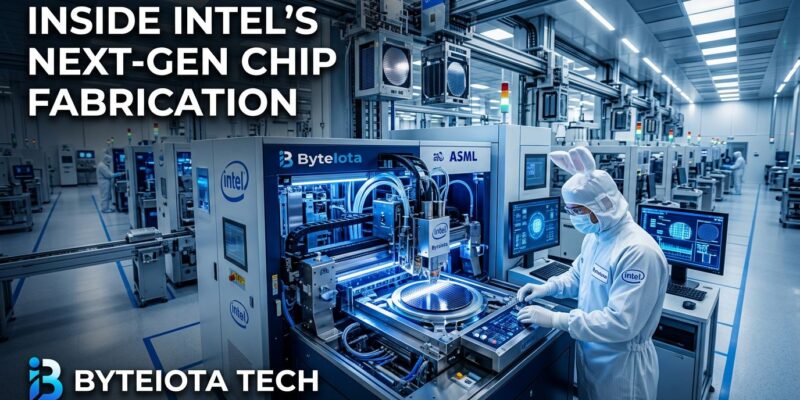
Fab 34 in Leixlip, Ireland isn’t just any facility—it’s Intel’s most advanced high-volume manufacturing site in Europe, producing Intel Core Ultra and Xeon 6 processors on Intel 4 and Intel 3 process nodes. With a joint venture partner, Intel needed approvals to allocate capacity to external foundry customers. With 100% ownership, that constraint disappears.
This matters because Intel is trying to become a foundry (contract chip manufacturer) like TSMC, which dominates with 60% market share. Intel’s pitch: “We can make your chips too, not just our own.” But TSMC’s pure-play model (they don’t compete with customers) builds trust that Intel’s integrated approach struggles to match. Full Fab 34 ownership gives Intel flexibility to court external customers without JV partner politics getting in the way.
The catch: Intel still lacks major foundry wins. Nvidia, Apple, and AMD haven’t committed to Intel 18A or any other Intel node. Samsung is struggling with yield issues at 2nm, creating an opening for Intel to claim the #2 foundry spot. But ownership alone doesn’t guarantee customers—Intel needs to prove reliability and yield at scale.
The Market’s Verdict: $3 Billion Premium Justified by Stock Surge
Intel’s stock jumped 8.8% on April 1, 2026, closing at its highest level in nearly two years. Financial analysts framed it as Intel ending “survival mode” and returning to an “offensive” capital strategy. Intel projects EPS accretion and credit profile improvement starting in 2027, meaning the buyback should boost earnings, not just burn cash.
Is the premium justified? The market says yes. That 9% stock surge represents billions in market cap added—far more than the $3 billion premium paid. Investors are betting Intel’s turnaround under Lip-Bu Tan is real and manufacturing control enables foundry growth that justifies the cost. Of course, this is the market’s bet, not reality yet. Intel must deliver on foundry promises to prove investors right.
CEO Change is the Hidden Story Behind the Buyback
Pat Gelsinger’s Intel (2021-2024) was a cash-strapped company making desperate moves: selling stakes in fabs, cutting costs, laying off employees, and begging for government subsidies. His turnaround plan centered on becoming a foundry giant, but spending ballooned and margins collapsed. The board lost confidence and forced him out in December 2024.
Lip-Bu Tan’s Intel (March 2025-present) looks different. Tan, a 20-year semiconductor veteran who ran Cadence Design Systems from 2009 to 2021, isn’t making desperate asset sales—he’s buying back strategic assets at a premium. The $7.9 billion CHIPS Act grant (largest recipient) provides a cushion, but Tan’s willingness to use $7.7 billion cash for the buyback shows confidence, not crisis.
The buyback is Tan’s first major move, and it’s a statement: Intel is back, manufacturing matters, and we’re not selling the crown jewels anymore. Whether this confidence is warranted depends entirely on foundry execution over the next 12-24 months.
What This Means for the Semiconductor Industry
Intel’s buyback doesn’t happen in a vacuum. TSMC remains the 800-pound gorilla with 60%+ foundry market share and unmatched reliability. Samsung’s foundry business is struggling with yield problems at advanced nodes, losing ground. Intel’s move signals it’s betting on manufacturing as a competitive advantage, not just a cost center.
For developers and tech professionals, this matters for chip supply chains. Intel’s foundry success would create an alternative to TSMC’s Taiwan-centric production, reducing geopolitical risk. U.S. and European governments are betting billions (CHIPS Act, European Chips Act) on Intel succeeding. But Intel needs actual customers—Nvidia, Apple, AMD commitments—to justify the hype.
The $14.2 billion question: Can Intel actually compete with TSMC’s foundry dominance? Full Fab 34 ownership helps, but it’s not the answer. Intel 18A achieved high-volume manufacturing in late 2025, with RibbonFET and PowerVia providing technical differentiation. But TSMC’s N2 node is coming, and Samsung isn’t giving up. The foundry race is far from over, and Intel’s expensive bet on manufacturing control is only the beginning.