 By ByteBot
A developer migrated from DigitalOcean to Hetzner and cut monthly infrastructure costs from $1,432 to $233—saving $14,388 per year with zero downtime. The migration story, trending on Hacker News today, isn’t an isolated case. Despite Hetzner raising prices 30-37% in April 2026, it remains 60% cheaper than DigitalOcean for equivalent hardware specs. With 86% of CIOs planning cloud workload migrations to reduce costs, the question isn’t whether alternative clouds make sense—it’s when the trade-offs justify the switch.
The Cost Reality: 60% Savings Despite April 2026 Price Increase
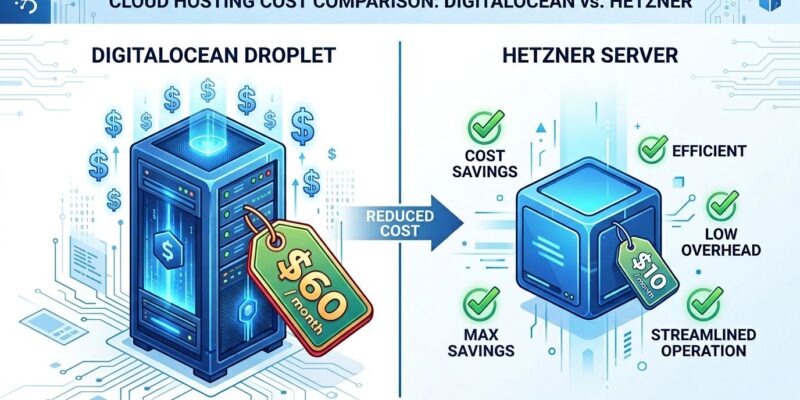
Hetzner is 60-84% cheaper than DigitalOcean for equivalent hardware even after April 2026 price increases. The real migration case study tells the story: A production stack running on a $1,432/month DigitalOcean droplet (192GB RAM, 32 vCPU) moved to a $233/month Hetzner AX162-R server with better specs (256GB DDR5 RAM, 96 logical CPUs). That’s 84% cost reduction while upgrading hardware.
The pricing gap is structural. A Hetzner CPX22 (2 vCPU, 4GB RAM) costs €7.99/month (~$9.49) post-April increase. The equivalent DigitalOcean Basic Droplet costs $24/month. Moreover, Hetzner’s European data centers include 20TB monthly bandwidth versus DigitalOcean’s 4TB. For bandwidth-heavy applications, this cost line effectively disappears from your infrastructure bill.
Talk Python moved after nearly a decade with DigitalOcean, saving $1,500/year. Another developer reported monthly bills dropping from $340 to $127 for equivalent compute power. This isn’t niche optimization—it’s systematic cost reduction for teams running production workloads.
Related: Cloud Repatriation 2026: 80% Bring Workloads Back On-Prem
Zero-Downtime Migration: 24 Hours, Real Techniques, Real Gotchas
The migration stack included 30 MySQL databases (248GB data), 34 Nginx virtual hosts, GitLab EE (42GB), Neo4J (30GB), Supervisor background workers, and several mobile apps serving hundreds of thousands of users. Total migration time: 24 hours with zero minutes of downtime. The six-phase approach is repeatable: complete stack installation on new hardware → rsync file synchronization → MySQL master-slave replication → DNS TTL reduction → Nginx reverse proxy conversion → DNS cutover and decommissioning.
Phase three is critical. MySQL master-slave replication using mydumper with 32 parallel threads reduced database export from days to hours. However, MySQL 5.7 to 8.0 compatibility issues surfaced immediately. The mysql.user table schema changed (45 vs 51 columns), causing export/import failures. Replication error 1062 (duplicate key conflicts) required IDEMPOTENT mode configuration. Most surprising: application database users had SUPER privilege, bypassing read-only restrictions during cutover. This required revoking privileges across 24 database users manually.
The post-migration gotcha nobody warns you about: GitLab project webhooks still pointed to old server IPs. This required writing a script to scan all projects via the GitLab API and bulk-update webhook URLs. As the migrator noted, “everything is scattered in million places, there’s barely any information for your specific problems.” The happy-path migration guides skip this reality.
The Trade-Off Reality: When to Migrate, When to Stay
Hetzner wins on raw compute cost and bandwidth. DigitalOcean wins on managed services and operational simplicity. This isn’t a universal recommendation—it’s a trade-off analysis.
Hetzner has no managed databases, no container registry, no PaaS deployment layer, and no integrated CDN. DigitalOcean’s managed PostgreSQL starts at $15/month. On Hetzner, you’re self-hosting PostgreSQL on a €7.99/month VM plus your operational time. The ROI calculation matters: If managed services save you 3+ hours of ops work per month and your time is worth $50/hour, DigitalOcean’s premium pays for itself. If you’re comfortable self-managing infrastructure and have the Linux admin capacity, Hetzner’s 60% cost reduction is pure savings.
Documentation gap is real. DigitalOcean tutorials are top Google results for common Linux administration questions. Hetzner’s official documentation covers core topics but lacks the depth and breadth of DigitalOcean’s community library. For teams without strong Linux admin skills, this operational friction adds hidden costs.
Choose Hetzner if you’re cost-conscious, comfortable self-managing infrastructure, serving primarily European users, or running bandwidth-heavy applications. Choose DigitalOcean if you depend on managed databases, need PaaS workflows (App Platform), lack ops capacity, or value comprehensive documentation over raw cost savings. The migration makes sense when you’re saving $500+/month ($6,000+/year) and have the operational capacity to self-manage. Below that threshold, DigitalOcean’s managed services premium is probably worth paying.
The 2026 Context: Cloud Cost Crisis Meets Alternative Momentum
This migration aligns with the broader 2026 cloud repatriation trend. 86% of CIOs are moving workloads off hyperscalers to reduce costs. Organizations waste 27-32% of cloud spend on idle or overprovisioned resources. The cost optimization imperative is industry-wide, not anecdotal.
Real-world examples validate the pattern. 37signals saved $10 million over five years leaving AWS. Dropbox saved $74.6 million over two years with colocation. GEICO cut compute costs 50% per core through repatriation. Broadcom saved $10 million moving critical databases off public cloud. These aren’t cost-cutting exercises during downturns—they’re strategic infrastructure decisions driven by hyperscaler pricing models that no longer make economic sense for many workloads.
Hetzner’s April 2026 price increase context matters. DRAM prices surged 171% year-over-year through 2025, forcing infrastructure providers to raise prices 30-37% across the board. Even alternative clouds face cost pressures. Yet Hetzner still beats DigitalOcean by 60%+ for equivalent hardware. The cost gap is structural, not temporary arbitrage.
ROI Reality Check: When Does Migration Pay For Itself?
Migration ROI depends on three variables: monthly cost savings, migration time investment, and operational overhead changes. The break-even calculation is straightforward. If you’re saving $500/month and migration takes 40 hours at $50/hour opportunity cost, your ROI is four months. If you’re saving $1,000/month, ROI is two months. Cloud migrations typically achieve ROI within 2-3 years and deliver 20-40% ongoing savings.
Run the scenarios. High ROI: $1,432 → $233/month ($14,388/year savings), 24-hour migration (experienced team) equals ROI in less than one week. Medium ROI: $340 → $127/month ($2,556/year savings), 40-hour migration equals ROI in 4-5 months. Low ROI: $100 → $40/month ($720/year savings), 40-hour migration equals ROI in 33 months. That last scenario isn’t worth it. The hidden cost: self-managing databases adds 2-5 hours ops time per month. Factor that into your calculation.
The migration isn’t free, and ongoing operational overhead isn’t zero. However, when you’re saving $1,000+/month and you have the operational capacity, the ROI is undeniable. When you’re saving $100/month and lack Linux admin skills, stick with DigitalOcean’s managed services. The difference is knowing which scenario describes your situation.
Key Takeaways
- Hetzner is 60-84% cheaper than DigitalOcean for equivalent hardware even after April 2026 price increases (€7.99/month vs $24/month for 2 vCPU / 4GB RAM specs)
- Zero-downtime migration is achievable using MySQL master-slave replication, rsync file transfers, and DNS cutover—24 hours for complex production stacks with experienced teams
- The trade-off is raw cost savings versus managed services convenience: Hetzner has no managed databases, PaaS, or integrated CDN; DigitalOcean charges 2-3x more for operational simplicity
- Migration makes economic sense when saving $500+/month ($6,000+/year) and you have operational capacity to self-manage infrastructure; below that threshold, managed services premium is worth paying
- Real gotchas include MySQL version incompatibility (5.7 → 8.0 schema changes), application webhooks hardcoded to old IPs, SUPER privilege users bypassing read-only mode, and scattered documentation across dozens of sources
- This aligns with the 2026 cloud repatriation trend: 86% of CIOs moving workloads off hyperscalers, organizations wasting 27-32% of cloud spend, and alternative clouds offering structural cost advantages despite price increases
The DigitalOcean to Hetzner migration isn’t a universal recommendation. It’s a trade-off decision that makes sense for specific workload profiles, team capabilities, and cost thresholds. Know your numbers, understand your operational capacity, and make the decision that optimizes for your actual constraints—not theoretical best practices.