 By ByteBot
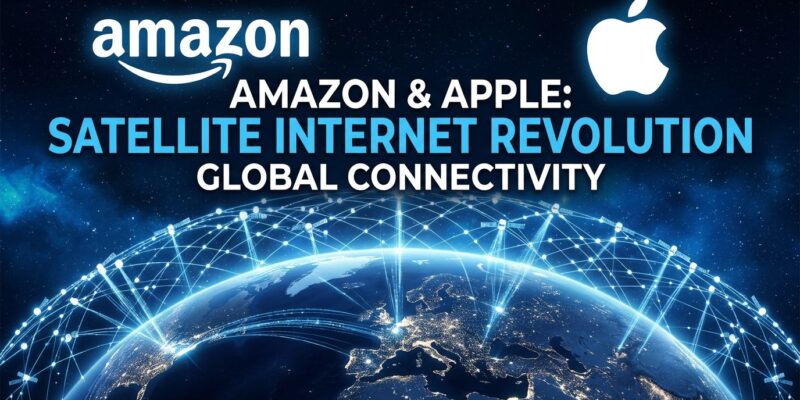
Amazon announced on April 14 it’s acquiring satellite operator Globalstar for $11.57 billion—its largest acquisition since Whole Foods in 2017—while simultaneously striking a long-term partnership with Apple to power satellite connectivity for future iPhones and Apple Watches. The dual announcement marks a rare infrastructure collaboration between two tech giants that typically compete, and escalates the satellite internet space race with SpaceX’s Starlink.
The deal isn’t about satellites. It’s about spectrum.
Spectrum is the Real Prize
Globalstar’s 24 aging satellites aren’t particularly valuable. What Amazon is really buying: exclusive access to Band 53/n53 spectrum (2483.5-2495 MHz), L-band and S-band frequencies, and FCC-approved licenses to operate mobile satellite services in most countries globally. This is “digital real estate” that would take years to acquire independently, assuming it’s even available.
Amazon outbid SpaceX for this spectrum. Elon Musk’s space company explored acquiring Globalstar in November 2025 but lost out. That should tell you something about the value here—when SpaceX, which already dominates satellite internet with 10 million customers and 10,200 operational satellites, wants your spectrum, you’re sitting on gold.
The spectrum enables direct-to-device (D2D) satellite connectivity, meaning smartphones can connect directly to satellites without specialized hardware. Amazon faces a July 30, 2026 FCC deadline to launch half of its planned 3,232-satellite constellation. Globalstar’s licenses help Amazon meet that requirement while building out its direct-to-phone capabilities planned for 2028 deployment.
The Surprising Apple Partnership
Here’s where it gets interesting. Amazon Leo will inherit and expand Globalstar’s relationship with Apple, where 85% of network capacity currently serves iPhone Emergency SOS and satellite messaging features for iPhone 14 and newer models, plus Apple Watch Ultra 3. The long-term agreement ensures Amazon continues providing these services while adding future iPhone and Apple Watch models to the network.
This is a marquee customer deal that provides instant validation and revenue from Day 1. Apple’s satellite features—Emergency SOS, Find My location sharing, roadside assistance—will be powered by Amazon’s infrastructure. It’s a rare case of Amazon and Apple collaborating on critical infrastructure instead of competing.
The partnership also signals that satellite connectivity is transitioning from premium feature to standard smartphone capability. When Amazon and Apple jointly commit to satellite infrastructure, the message is clear: direct-to-device is coming whether carriers like it or not.
Amazon is Still Massively Behind SpaceX
Let’s be honest about where Amazon Leo stands. SpaceX Starlink has launched 11,800+ satellites with about 10,200 currently operational, serves 10 million customers worldwide, and generates billions per year in revenue. Amazon Leo has approximately 240 operational satellites, zero customers pre-launch, and won’t deploy D2D until 2028.
The gap is staggering, and SpaceX has an unfair advantage: it owns the launch provider. SpaceX launches its own satellites at cost, while Amazon pays third-party providers market rates. That cost difference compounds across thousands of satellites. Industry insiders call Globalstar a “strategic necessity”—Amazon had to make this move to remain viable against SpaceX dominance.
The satellite internet market is consolidating into a duopoly: Amazon and SpaceX will own the infrastructure, spectrum, and customer relationships. Everyone else is fighting for scraps or looking for an exit.
Profitability Remains Unproven
Here’s the uncomfortable question: can satellite internet companies actually make money? Historical precedent is grim. Iridium spent $5 billion developing its constellation, went bankrupt, and sold for $25 million. The pattern repeats: first-generation satellite companies burn capital, fail, then get acquired for pennies on the dollar by second-round investors.
SpaceX broke that pattern by owning its launch costs and achieving massive scale (10 million subscribers). Amazon is betting $11.6 billion that it can replicate that success without owning a rocket company. The Apple partnership provides a revenue baseline, but it’s unclear if that covers the infrastructure costs of launching and maintaining thousands of satellites.
The deal is expected to close in 2027 pending regulatory approvals. Amazon Leo’s early consumer broadband service is slated for 2026, with direct-to-device deployment in 2028 and the full 3,232-satellite constellation by July 2029. That’s a long timeline with significant execution risk.
Regardless of Amazon’s ultimate success, the stakes are clear: tech giants are racing to control global connectivity infrastructure. Satellite spectrum is scarce, launch windows are limited, and whoever dominates this layer controls how billions of devices connect when terrestrial networks aren’t available. Amazon just spent $11.6 billion to stay in that race.