 By ByteBot
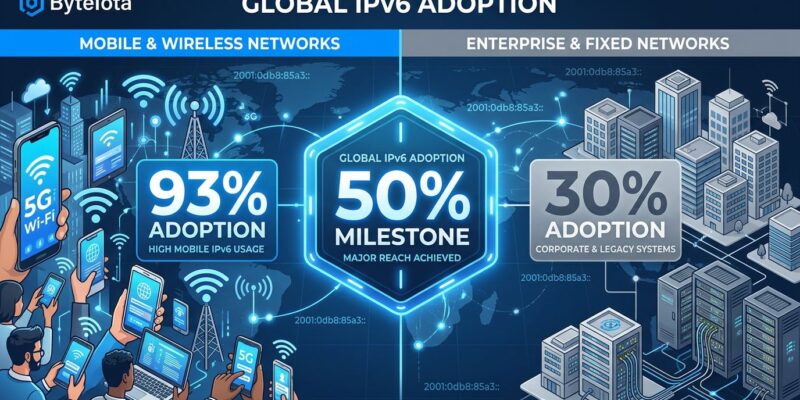
On March 28, 2026, IPv6 usage hit a historic milestone: 50% of worldwide users accessed Google services over IPv6 for the first time. This marks the tipping point in a 28-year journey since the protocol was designed in 1998. Google’s statistics now show IPv6 hovering at 45-50% of global traffic depending on the day of the week, with the inflection point finally reached after nearly three decades of slow adoption.
For developers, this milestone signals a fundamental shift. Your application is likely already serving 50% IPv6 traffic without you realizing it, NAT-based security assumptions are obsolete, and the IoT future now has the addressing infrastructure it needs—though device compatibility remains a glaring problem.
Mobile Carriers Hit 93%, Enterprises Stuck at 30%
T-Mobile USA leads at 93% IPv6 adoption with Verizon at 84%, while enterprises remain stuck at 20-30% adoption. The reason is simple: mobile carriers had no choice. Billions of phones and IoT SIMs exhausted IPv4 addresses, forcing carriers to adopt IPv6 or face address scarcity. Corporate networks, meanwhile, still rely on “IPv4 works fine” inertia.
All major US carriers average 87% IPv6 deployment, with T-Mobile approaching an IPv6-only mobile network by actively turning off IPv4. Verizon reports 90% of its traffic already using IPv6. In contrast, enterprises face $2.4 million average migration costs with 3-5 year ROI timelines, which explains why they’re dragging their feet.
Developers building mobile apps are already serving 90%+ IPv6 traffic from carriers, even if they don’t realize it. This explains why the 50% milestone happened—mobile-first killed IPv4, not enterprise adoption. If your app is mobile-heavy, you’re in the IPv6 future whether you planned for it or not.
France 86%, China <5%: Regional IPv6 Adoption Varies Wildly
France leads global adoption at 86%, with Germany and India at 75%, and the U.S. at 52%. Meanwhile, China remains below 5% despite government policy pushing IPv6. The global average masks extreme regional variations driven by policy, infrastructure investment, and ISP willingness.
Europe dominates the leaderboard with Belgium at 65% joining France and Germany. In Asia, India’s 74% adoption contrasts sharply with China’s sub-5% performance, revealing that government mandates alone don’t guarantee adoption. North America hovers around 50%, with Canada trailing the U.S. at approximately 45%.
There’s also a weekend effect: IPv6 usage spikes 5-10% higher on weekends when residential traffic dominates. This pattern reveals that corporate networks are the bottleneck—residential and mobile users lead adoption, while businesses lag behind. If you’re building for global audiences, you can’t assume uniform IPv6 support. A French developer sees 86% IPv6 traffic, while a Chinese developer sees less than 5%. Testing in one region doesn’t predict behavior in another.
NAT Is Dead: Zero Trust Security Mandatory in IPv6 Era
IPv6 eliminates NAT (Network Address Translation), exposing devices directly to the internet with globally routable addresses. Developers can no longer rely on “private IP ranges” (192.168.x.x, 10.x.x.x) as a security layer. Every device needs explicit firewall rules and Zero Trust architecture. This isn’t theoretical—the security model you learned is obsolete.
Here’s the security shift in concrete terms:
IPv4 with NAT (Old Security Model):
Private: 192.168.1.5
Public: 203.0.113.1 (NAT hides internal devices)
Firewall: Implicit deny inbound (NAT provides obscurity)

IPv6 without NAT (New Security Model):
Public: 2001:db8::1 (globally routable)
Firewall: Explicit deny all inbound (Zero Trust required)
No "hiding" behind NAT—every device exposed by default
IPv6 includes built-in IPsec for encryption and authentication by default, which is an improvement over IPv4’s retroactive security bolt-ons. However, there’s a critical tooling gap: 91% of security tools have better IPv4 support, and IPv6 has only 8-12 threat intelligence sources compared to 80+ for IPv4. Security teams resolve IPv4 incidents 40% faster due to mature tooling.
Most developers learned networking in the NAT era and have muscle memory around “private IP = safe.” IPv6 breaks that mental model. Accidental exposure of devices is a real risk, and misconfigured IPv6 firewalls are already causing production incidents. The community needs to catch up, fast.
Protocol Designed for IoT, But Only 8.6% of Devices Work
IPv6 was designed to enable the IoT explosion with unlimited addressing—340 undecillion addresses, enough for every grain of sand on Earth. Yet peer-reviewed academic research from IMC 2024 found that only 8.6% of consumer IoT devices function properly in IPv6-only networks, despite 80% claiming IPv6 support.
The study tested smart home devices in IPv6-only networks and found that while 20.4% transmit data to IPv6 destinations, only 8.6% remain fully functional. This creates a paradox: the protocol designed for IoT’s future isn’t compatible with IoT’s present. Dual-stack networking isn’t a transition strategy—it’s permanent for IoT environments.
If you’re building IoT products or smart home integrations, you can’t go IPv6-only yet. Your devices will break for 90%+ of users. Edge AI in smart homes promises local processing to reduce cloud dependency, but IPv6 readiness lags far behind the architectural vision. This explains why dual-stack will persist for 10+ years despite hitting the 50% adoption milestone.
The 28-Year Overnight Success
IPv6 was designed in 1998 and took 28 years to reach 50% adoption. That’s not a typo—28 years. The primary barrier was lack of backward compatibility, which forced dual-stack complexity, high migration costs ($2.4M average for enterprises), and persistent “if IPv4 works, why migrate?” inertia.
IPv4 addresses now cost $18-$45 per IP to buy, or $0.38-$0.50 per IP per month to lease, up from roughly $10-$15 in 2020. All Regional Internet Registries exhausted their free IPv4 pools by 2019, yet enterprises still hesitate to migrate. Dual-stack overhead doubles everything—configuration, troubleshooting, and monitoring.
Understanding why adoption was slow explains why it’s accelerating now. IPv4 scarcity finally matters, mobile carriers forced the issue, and cloud providers like AWS, Azure, and GCP made dual-stack easy. The next 25% (from 50% to 75%) will likely take 5 years, not 28 years. The inflection point has passed.
Key Takeaways
- Your mobile app likely serves 50%+ IPv6 traffic already—T-Mobile is at 93%, Verizon at 84%, and carriers are driving adoption whether enterprises follow or not.
- Regional disparities are massive: France 86%, U.S. 52%, China <5%. Test explicitly across regions, don't assume uniform support.
- NAT is dead in IPv6—implement Zero Trust security with explicit firewall rules. The “private IP = safe” mental model is obsolete and dangerous.
- Don’t go IPv6-only yet. Only 8.6% of IoT devices function properly in IPv6-only networks despite manufacturer claims. Dual-stack is permanent for the foreseeable future.
- The 28-year journey to 50% is over, but the next 25% (to 75%) will come faster. Cloud providers made dual-stack easy, mobile carriers forced the issue, and IPv4 scarcity finally matters.
The 50% milestone is both an achievement and a warning. IPv6 is no longer optional for new deployments, but the ecosystem—especially IoT devices and security tooling—has serious catching up to do. Plan for dual-stack for the next decade, test explicitly, and secure everything without assuming NAT will save you.