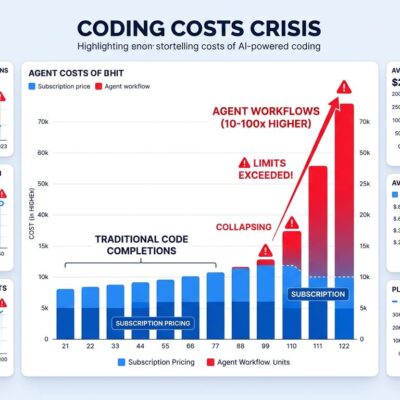
On April 4, 2026 at 12:00 PM PT, Anthropic cut off OAuth access for Claude Pro and Max subscribers using third-party automation tools like OpenClaw, forcing over 135,000 instances and thousands of developers onto pay-per-token API billing that costs 10-50x more than their flat-rate subscriptions. The company cited “outsized strain” on infrastructure, but the timing—one week after a high-severity security vulnerability was disclosed for OpenClaw—raises questions about whether this was about costs or control.
This is the fourth major platform to restrict developer API access in 18 months, following Twitter, Reddit, and GitHub Copilot. Developers are already migrating to OpenAI, Google Gemini, and DeepSeek in what community leaders call Anthropic’s “huge mistake.” The era of using consumer AI subscriptions for automation is ending.
What Changed: From Flat Subscriptions to Pay-Per-Token
Anthropic revoked OAuth authentication for third-party tools, effective immediately. Developers who used Claude Pro ($20/month) or Max ($100-200/month) subscriptions to run OpenClaw agents now face three options: pay per token via “extra usage” at API rates, purchase separate Claude API access, or migrate to competing providers. For heavy users, this means $500-2000/month instead of $20-200/month flat rate—a 10-50x cost increase.
The economic impact is driving rapid migration. One developer documented rebuilding their $200/month OpenClaw setup for just $15 by switching to DeepSeek API and local LLaMA models, achieving a 92.5% cost reduction. When costs increase 10-50x overnight, the rational choice is migration, not compliance.
The Suspicious Timing: CVE-2026-33579 One Week Before
The policy change came exactly one week after CVE-2026-33579 was disclosed on March 28—a high-severity (CVSS 8.6) privilege escalation vulnerability in OpenClaw that allowed any user with pairing access to silently gain full admin control. The vulnerability’s root cause: the /pair approve command path failed to forward the caller’s security scopes into authorization checks. An attacker with operator.pairing scope could approve device requests asking for operator.admin scope, bypassing authorization entirely.
More alarmingly, 63% of 135,000+ publicly exposed OpenClaw instances ran without any authentication layer, meaning any network visitor could request pairing and escalate to admin privileges. Anthropic hasn’t publicly connected the vulnerability to their policy change, but the timeline is damning: March 28 disclosure, April 4 cutoff. If 63% of OpenClaw instances are wide open, Anthropic may have decided the security liability of supporting an exploited ecosystem outweighed the business value. The “infrastructure strain” narrative feels incomplete.
Community Reaction: “Customer Hostile” and “Huge Mistake”
The Hacker News discussion garnered 684 points and 563 comments—massive engagement signaling strong negative sentiment. David Heinemeier Hansson (DHH), creator of Ruby on Rails, called the decision “very customer hostile.” George Hotz, founder of Comma.ai, warned: “Anthropic is making a huge mistake. This will not convert people back to Claude Code, you will convert people to other model providers.”
Peter Steinberger, OpenClaw’s creator, revealed he and Dave Morin tried to “talk sense into Anthropic,” delaying the move by one week. He warned them “we have many users who only signed up for their sub because of OpenClaw and that it’d be a loss if they cut them off.” Steinberger noted Anthropic tried to “bury the news on a Friday night”—a classic damage control tactic that backfired spectacularly. The community’s verdict: “The Claude ecosystem—fragile, weeks-old, built by enthusiasts who chose Claude because they genuinely believed it was the best model—is scattering.”
Part of a Larger Pattern: The API Restriction Playbook
Anthropic’s move is the fourth major platform to restrict API access in 18 months. Twitter/X (2023-2026) went from free API to $100-42,000/month tiers, killing third-party clients. Reddit (2023) moved from free to $12,000/month for high-volume, killing Apollo and RIF. GitHub Copilot (2024) restricted model access to first-party tools only. Now Anthropic revokes OAuth for third-party agents.
The pattern is clear: infrastructure costs are real, LLM inference is expensive at scale, and platforms are optimizing revenue by forcing heavy users onto higher-priced tiers while maintaining control to prevent fragmentation. The underlying drivers transcend individual companies—this is a systemic shift across platforms. Developers should expect OpenAI, Google, and others to follow suit by enforcing strict boundaries between consumer subscriptions and programmatic access.
Where Developers Are Migrating: Multi-Provider Hedging
Developers have five primary migration paths. OpenAI’s GPT-5 series offers similar reasoning capabilities with a larger ecosystem ($15/M tokens for GPT-5.2). Google Gemini Flash provides exceptional multimodal support and speed-to-cost ratio. DeepSeek delivers 90% cost reduction at $0.50/M tokens versus Claude’s $15. Local LLMs via Ollama offer free, privacy-preserving compute with no rate limits. Finally, multi-provider tools like Aider support 75+ models and eliminate vendor lock-in.
The migration tool landscape favors vendor diversification. Aider combines CLI-native interface, full model support (Claude, GPT, Gemini, DeepSeek, local LLMs), and robust Git integration. OpenCode is free, open-source, and works with over 75 AI providers. Gemini CLI brings Gemini 2.5 Pro to terminal with built-in Google Search grounding. The diversity of viable alternatives means Anthropic’s leverage is limited. Claude Opus quality advantage is narrow enough that 10-50x cost increases flip the equation. The real winner is multi-provider tools that let developers mix and match models, using Claude for critical quality tasks while routing bulk work to DeepSeek or local LLMs.
Key Takeaways
- Anthropic’s April 4 OAuth cutoff forces 135K+ OpenClaw instances onto 10-50x more expensive API billing, driving mass migration to OpenAI, Gemini, and DeepSeek
- The timing—one week after CVE-2026-33579 disclosure affecting 63% of OpenClaw instances without authentication—suggests security liability accelerated the decision beyond “infrastructure strain”
- This is the fourth platform to restrict API access in 18 months (Twitter, Reddit, GitHub Copilot, Anthropic), signaling a systemic shift ending the era of consumer AI subscriptions for automation
- Adopt multi-provider strategy using tools like Aider to hedge vendor risk—mix Claude for quality-critical tasks with DeepSeek or local LLMs for bulk processing
- Expect OpenAI, Google, and other providers to follow suit with strict boundaries between personal subscriptions and programmatic access