 By ByteBot
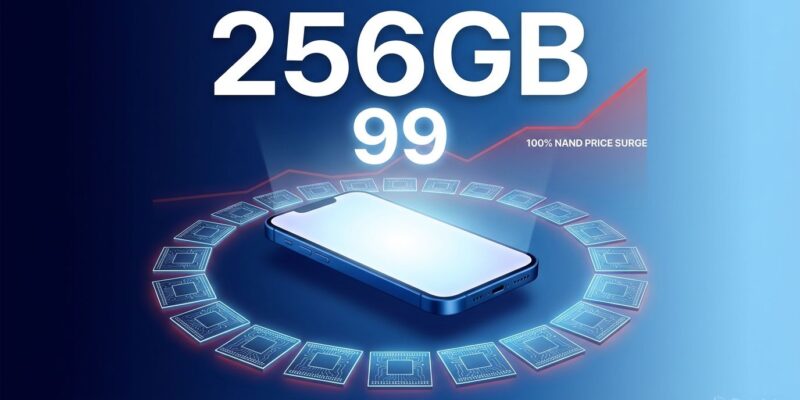
Apple launched the iPhone 17e on March 28-29, 2026, at $599 with 256GB base storage—double the previous generation’s entry capacity at the same price. The timing is remarkable: NAND flash memory prices surged 100% in Q1 2026, meaning Apple is absorbing massive cost increases to maintain competitive pricing. The 17e features the latest A19 chip and positions Apple aggressively in the $500-700 mid-range market against Google Pixel 9a ($499) and Samsung Galaxy A55 ($550).
Storage Doubled as NAND Prices Surge 100%
Apple’s decision to double base storage to 256GB isn’t just generous—it’s strategic defiance of market trends. TrendForce reports NAND flash prices increased 55-60% in Q1 2026, with Samsung preparing to double prices again in Q2. Competitors are downgrading from TLC to cheaper QLC storage or reducing capacity altogether. Memory now represents 15-20% of smartphone manufacturing costs, exceeding processor prices for the first time.
The iPhone 16e started at 128GB for $599. The iPhone 17e doubles to 256GB at the same price point while absorbing a 100% NAND cost increase. This is either Apple eating significant margin or leveraging long-term supply contracts negotiated before the price surge. Either way, it’s a bold bet that competitors can’t easily match given current memory economics.
Meanwhile, Android manufacturers are making painful compromises. Smartphone memory costs jumped 90% in 2026, forcing brands to reduce base storage or swap to lower-quality NAND. Apple’s willingness to absorb these costs signals serious intent to defend mid-range market share rather than cede it to Android.
256GB Baseline Changes iOS App Development
For developers, 256GB as the entry-level iPhone storage fundamentally changes assumptions. The historical pain point of designing for 64GB or 128GB constrained devices is eliminated. Apps can now ship larger on-device ML models, cache aggressively, and support offline-first experiences without storage anxiety.
Consider local ML models: Meta’s Llama 3.1 8B parameter model is roughly 8GB when quantized. Small Language Models add 500MB to 1.5GB to app downloads. These workloads were impractical for entry-level iPhones with 64-128GB storage. The 256GB baseline makes them viable for a wider user base, expanding the addressable market for AI-powered mobile apps.
Media applications benefit similarly. 4K 60fps video recording, RAW photo processing, and large media libraries become practical for all users, not just Pro buyers. Developers can design richer experiences knowing storage won’t be the limiting factor on entry-level devices.
Apple’s Aggressive Mid-Range Play
The iPhone 17e positions Apple directly against Google Pixel 9a ($499 with 256GB) and Samsung Galaxy A55 ($550 with 256GB) in the $500-700 segment, which represents roughly 35% of the global smartphone market. This is a strategic shift from premium-only positioning to aggressive mid-range competition.
The competitive landscape is tight. Google’s Pixel 9a offers Tensor G4 processing, superior computational photography, and 7 years of OS updates—but no wireless charging and a less powerful chip. Samsung’s Galaxy A55 provides a 120Hz display and triple-camera system but delivers only 4 years of updates and weaker performance. The iPhone 17e counters with flagship-class Apple Silicon and ecosystem integration, albeit at $50-100 premium over competitors.
John Gruber of Daring Fireball calls the 17e “Apple’s strategic anchor in the mid-tier segment, bridging performance, longevity, and accessibility.” Apple is no longer ceding mid-range to Android. The 17e with latest-gen A19 chip shows Apple will compete on price, not just premium positioning.
A19 Chip with a Caveat: 4-Core GPU
The iPhone 17e uses the same A19 chip as the standard iPhone 17—with one fewer GPU core. CPU performance is identical: 12% faster single-core and 18% faster multi-core than the A18, with benchmarks hitting roughly 2,300 single-core and 5,600 multi-core on Geekbench 6. The Neural Engine’s 16 cores remain intact for on-device AI workloads.
The GPU trade-off matters for graphics-intensive users. Four cores instead of five means roughly 10-15% reduced graphics performance compared to the standard iPhone 17. Mobile gamers running demanding titles like Genshin Impact or AR developers building resource-heavy experiences should be aware of this limitation. For most users, the difference won’t matter—the 4-core GPU still delivers flagship-class performance and remains significantly more powerful than mid-range Android competitors.
Other specs hold up well. The 48MP Fusion camera provides optical-quality 2x telephoto (cropped from the main sensor), next-generation portrait mode, and 4K Dolby Vision video at 60fps. Ceramic Shield 2 offers 3x better scratch resistance. The C1X modem delivers 2x faster connectivity than the iPhone 16e. MagSafe supports 15W wireless charging, and battery life hits 26 hours of video playback. Available colors are black, white, and soft pink with a matte finish.
Key Takeaways
- Apple doubled storage during a memory price crisis—NAND costs surged 100% in Q1 2026, yet the iPhone 17e maintains $599 pricing with 256GB base storage. Competitors are downgrading storage while Apple upgrades, signaling strategic investment in mid-range competition.
- 256GB baseline fundamentally changes iOS app development—developers can design for richer local experiences including larger ML models (500MB-8GB), offline-first apps, and 4K video workflows without worrying about storage constraints on entry-level devices.
- Apple competes aggressively in the $500-700 mid-range market—the iPhone 17e with latest-gen A19 chip positions Apple directly against Pixel 9a ($499) and Galaxy A55 ($550), representing a strategic shift from premium-only positioning to defending market share against Android.
- The 4-core GPU trade-off won’t matter for most users—CPU performance matches the standard iPhone 17, but graphics performance is roughly 10-15% lower due to one fewer GPU core. Mobile gamers and AR developers should note this limitation, but mainstream users won’t see a difference.
- Mid-range competition intensifies as premium markets saturate—Apple’s aggressive move signals market maturity. Watch for competitor responses as Google and Samsung face pressure to match 256GB baseline storage during ongoing memory price volatility.