 By ByteBot
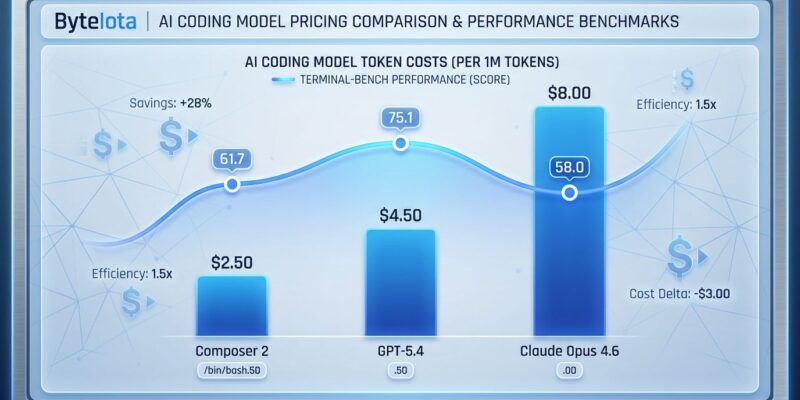
On March 19, Cursor launched Composer 2, its third-generation AI coding model, priced at $0.50 per million input tokens and $2.50 per million output tokens—roughly 10x cheaper than Anthropic’s Claude Opus 4.6 ($5/$25) and 5-7x cheaper than OpenAI’s GPT-5.4 ($2.50/$15). The model delivers frontier-level performance on coding benchmarks, beating Claude Opus 4.6 on Terminal-Bench 2.0 (61.7 vs 58.0) while trailing only GPT-5.4 (75.1). For Cursor’s 1 million daily users and 50,000 enterprise customers, this isn’t just a product launch—it’s a pricing war that could reshape the AI coding market.
The Economics: $12,960 Annual Savings Per Developer
The pricing disruption is stark. A typical coding request costs roughly $0.08 on Composer 2 Fast versus $0.80 on Claude Opus 4.6. For a developer making 50 requests daily, that’s $36 in daily savings—$12,960 annually per seat.
Scale this across enterprises. A company with 5,000 developers using AI coding tools could save $64.8 million annually by switching from Claude to Composer 2. Moreover, this explains Cursor’s explosive growth: Bloomberg reported $2 billion in annualized revenue as of February 2026, up from zero three years ago. At this scale, aggressive pricing isn’t customer acquisition burn—it’s margin protection against API costs that would otherwise crush profitability.
The question isn’t whether Cursor can sustain these prices. It’s whether OpenAI and Anthropic will respond with cuts, or if this represents the new normal as vertical AI companies build specialized models on open-source foundations.
Performance Trade-offs: Good Enough vs Best
Composer 2 doesn’t claim absolute supremacy. On Terminal-Bench 2.0, which tests AI agents on command-line tasks, Composer 2 scores 61.7—beating Claude Opus 4.6’s 58.0 but trailing GPT-5.4’s 75.1 by 13 points. Furthermore, on CursorBench and SWE-bench Multilingual, Composer 2 posted 61.3 and 73.7 respectively—solid frontier performance, but not best-in-class.
Here’s the trade-off: Composer 2 delivers roughly 90% of GPT-5.4’s performance at 20% of the cost. For most enterprise coding tasks—multi-file refactors, feature implementation, debugging across large codebases—that’s sufficient. Composer 2 is purpose-built for these workflows, with a 200,000-token context window that can handle entire mid-sized projects in a single session.
Developer reactions split predictably. Early adopters on the Cursor forums praise tangible improvements on “long-horizon” tasks requiring hundreds of sequential actions. Meanwhile, Reddit skeptics question self-benchmarking: CursorBench is Cursor’s own metric, and the most upvoted comment in the launch thread asked, “So you created your own benchmarking tool and rated yourselves higher than Opus 4.6?” Fair criticism, but it doesn’t negate the cost advantage.
Strategic Independence: From API Customer to Model Builder
Composer 2 is built on Moonshot AI’s open-source Kimi K2.5—a 1 trillion parameter Mixture-of-Experts model—with Cursor’s continued pretraining and reinforcement learning on top. Cursor co-founders stated that roughly 75% of total compute came from their training, making performance “very different” from the Kimi base.
The launch hit a transparency snag. However, Cursor’s initial March 19 announcement didn’t credit Kimi K2.5, leading to a TechCrunch exposé on March 22. Cursor acknowledged they “missed mentioning” the base model but confirmed an authorized commercial partnership via Fireworks AI. The controversy highlights tensions in open-source AI attribution, but doesn’t change the core value proposition: vertical SaaS companies at scale can build proprietary models more cheaply than paying API fees forever.
This is the strategic shift every vertical AI company will face. When you hit 1 million daily users, API dependency becomes untenable. Your margins compress as usage grows, and you’re at the mercy of provider pricing and rate limits. Building specialized models on open-source foundations (Kimi, Llama, Mixtral) allows cost control. The lesson: at scale, build beats buy.
What’s Next: Commoditization or Unsustainable Burn?
Composer 2 accelerates AI coding commoditization. Every major player now races to “agent mode”: GitHub Copilot added Agent Mode, Windsurf shipped Cascade, Google launched Antigravity with multi-agent orchestration, and OpenAI released Codex as a standalone app. Pricing pressure is mounting: GPT-5.4 already costs 50% less than Claude Opus 4.6, and Composer 2 undercuts both by another 5-10x.
Two futures are possible. First: Cursor’s pricing is unsustainable customer acquisition, OpenAI and Anthropic respond with cuts, and margins collapse industry-wide. Second: this is the new normal—vertical AI companies unbundle general models, frontier performance becomes cheap, and developers choose based on trade-offs: absolute best performance (GPT-5.4) versus cost efficiency (Composer 2) versus IDE flexibility (GitHub Copilot).
Fortune’s March 21 analysis captured the uncertainty: “rapid rise, very uncertain future.” Cursor faces real risks. Consequently, OpenAI could slash GPT-5.4 prices and erase Composer 2’s advantage overnight. For the hardest coding tasks, GPT-5.4’s 13-point lead on Terminal-Bench 2.0 matters. And Reddit reports ongoing reliability concerns—code reversion bugs as of March 2026—that could undermine trust.
But here’s the bet: for most developers, most of the time, Composer 2 is good enough. And at 10x cheaper than Claude, “good enough” at scale beats “best” at prices that prohibit broad adoption. If Cursor holds this position, the AI coding market just shifted from expensive scarcity to affordable abundance.
Key Takeaways
- Composer 2 offers frontier AI coding at 10x less than Claude’s cost, 5-7x less than GPT’s cost
- Beats Claude Opus 4.6 (61.7 vs 58.0 on Terminal-Bench 2.0), trails GPT-5.4 (75.1)—sufficient for most enterprise tasks
- Signals shift: vertical AI companies building specialized models on open-source bases (Kimi K2.5)
- $12,960 annual savings per developer switching from Claude to Composer 2
- Key question: will OpenAI/Anthropic respond with price cuts, or is this the new normal?