 By ByteBot
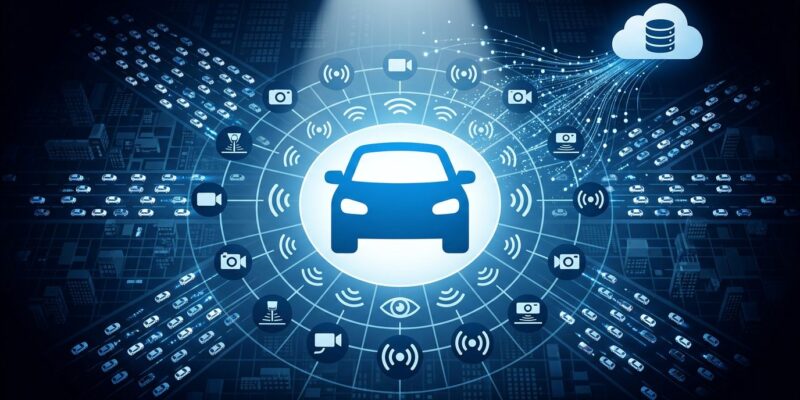
On May 1, Uber CTO Praveen Neppalli Naga revealed at TechCrunch’s StrictlyVC event that Uber plans to equip millions of its drivers’ vehicles with sensors—cameras, lidar, and radar—to create a massive data collection network for autonomous vehicle companies. The pitch is straightforward: AV companies desperately need real-world training data but can’t afford to deploy enough test vehicles. Uber has millions of drivers already on the road. Why not turn them into a sensor grid?
This isn’t innovation. It’s surveillance capitalism meeting gig economy exploitation. Drivers already face constant tracking through Uber’s app. Now they become unpaid data collection infrastructure, with sensors capturing everyone around them—pedestrians, other drivers, entire neighborhoods—not just Uber customers. And if Uber succeeds, every gig platform will copy the model.
Millions of Drivers, Petabytes of Data
Uber operates millions of drivers globally across 2,500 cities in 25 countries. The autonomous vehicle industry, by contrast, operates hundreds to thousands of test vehicles. Waymo’s fleet is measured in thousands. Cruise operates hundreds. Uber is proposing millions. The scale advantage is staggering.
Moreover, the economics work in Uber’s favor. AV companies spend enormous capital deploying dedicated test fleets. Industry guidelines call for 2 petabytes of data storage per test vehicle per year. Uber’s approach avoids that cost entirely—drivers already own the vehicles, pay for gas, and handle maintenance. Uber just adds sensors and sells the data.
The company’s current AV Labs program, launched in January, operates a small test fleet starting with a single Hyundai Ioniq 5 equipped with full sensor suites. That fleet has collected over 100,000 hours of footage. Scale that to millions of vehicles, and the data collection dwarfs anything individual AV companies can build.
The “AV Cloud”: Queryable Surveillance for Sale
Uber isn’t just collecting random driving data. The company is building what CTO Naga calls an “AV cloud”—a centralized database of labeled sensor data that autonomous vehicle companies can query for specific scenarios. Need data from school intersections at 3pm on rainy days? Query the AV cloud. Want footage of construction zones during rush hour? It’s in there.
Naga explained the value proposition at the StrictlyVC event: “In San Francisco, ‘At this school intersection, I want some data at this time of day so I can train my models.’ The problem for all these companies is access to that data, because they don’t have the capital to deploy the cars and go collect all this information.” Uber already has 25 AV company partnerships, including Wayve in London.
Here’s what that means in practice: drivers do the work—driving the routes, navigating traffic, encountering edge cases—and Uber sells access to the data those drivers generate. There’s zero mention of driver compensation. Uber captures the value. AV companies get cheaper data than building their own fleets. Workers get nothing.
Gig Workers as Data Infrastructure
Gig workers already face pervasive surveillance. Platform apps track driver location, monitor productivity, score performance algorithmically, and share data with 60+ third parties according to recent privacy research. That surveillance happens without meaningful worker consent—agree to the terms or lose access to work.
Uber’s sensor grid escalates that surveillance from internal monitoring to external data collection. Research published in ACM CHI 2022 found that gig workers perceive platform companies as sources of “unnecessary and opaque data collection” that threatens their “privacy, safety, and economic outcomes.” The study noted that data usage remains opaque, leaving workers with “no room to challenge the process.”
Now Uber proposes transforming drivers from tracked workers into active surveillance infrastructure. The sensors don’t just monitor the driver—they capture everyone within range. Uber monetizes that captured data. The pattern is clear: extract labor, extract behavior data, extract surveillance data. Each layer increases platform control and profit.
Everyone Gets Filmed, Not Just Uber Users
Uber’s sensor kits capture multi-angle camera footage, lidar 3D mapping, radar data, and GPS coordinates. That means everyone within sensor range—pedestrians crossing streets, people in other vehicles, children walking to school, neighbors in driveways—becomes training data for autonomous vehicle companies. These aren’t Uber customers who agreed to terms. They’re bystanders who never consented.
Platform terms of service don’t apply to people who never signed them. When you open the Uber app, you consent to tracking—however buried in legalese. But pedestrians, other drivers, and anyone captured by these sensors made no such agreement. This is mass surveillance disguised as technological progress.
The CTO acknowledged regulatory uncertainty, noting they must “ensure that each state has clarity on what the sensors mean, and what their data transmission entails.” Translation: the legal framework doesn’t exist yet, but Uber plans to move forward anyway. There’s no mention of privacy filtering, opt-out mechanisms, or data retention limits.
The Precedent: When One Platform Profits, Others Follow
Uber is testing whether gig platforms can turn workers into surveillance infrastructure without facing legal or public relations consequences. If the model works—legally and financially—DoorDash, Instacart, Lyft, and every other gig platform will deploy the same approach. Food delivery drivers could collect restaurant and neighborhood data. Package delivery could map homes and warehouses. The entire gig economy could become distributed sensor networks.
Platform companies copy successful revenue streams rapidly. When Uber introduced surge pricing, competitors adopted it. When algorithmic dispatch proved profitable, everyone implemented it. Worker surveillance follows the same pattern. One company establishes the precedent, others follow, and suddenly the practice becomes industry standard.
The regulatory landscape remains fractured. State-by-state data transmission laws vary widely, and the CTO’s comments suggest Uber doesn’t have clear answers yet. That regulatory uncertainty won’t stop deployment—it just determines which markets move first.
What This Means
For developers building autonomous vehicle systems, the question is ethical: are you comfortable training models on data collected from workers who see zero compensation and bystanders who never consented? The data is cheap because Uber offloaded the collection costs onto drivers. That’s not innovation—it’s exploitation.
For gig workers, this represents another layer of value extraction without compensation. Uber already takes a cut of fares. Now the company will monetize the data generated during those fares. Workers absorb the costs—vehicle ownership, maintenance, gas, time—while platforms capture profits from both labor and data.
For everyone else, mass surveillance is becoming normal infrastructure. Millions of sensor-equipped vehicles will capture public spaces continuously, feeding data to companies building AI models. The question isn’t whether this violates privacy—it does. The question is whether anyone will stop it before it becomes standard practice.
Uber’s sensor grid isn’t about autonomous vehicles. It’s about establishing the precedent that gig workers are fair game for surveillance infrastructure deployment. Pay attention.