 By
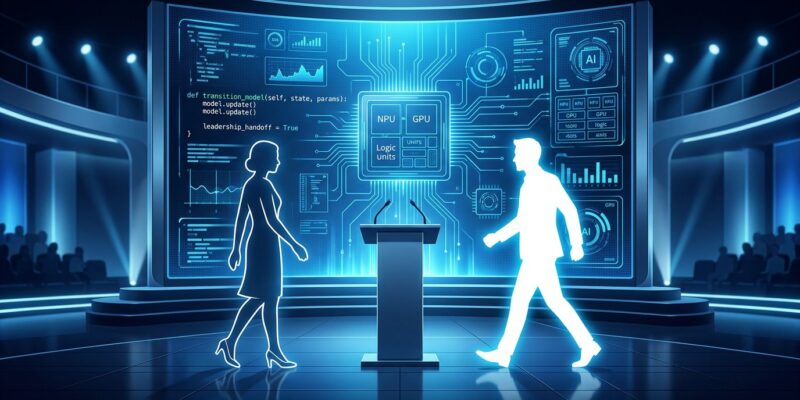
By Tim Cook walks onto the WWDC stage on Monday for the last time as Apple’s CEO. After fifteen years, he hands the company to John Ternus on September 1. You probably already know about the Gemini-powered Siri rebuild, the multimodal Foundation Models rumors, the Core AI framework replacing Core ML. What gets less attention is what this leadership transition means for the developers who actually build on Apple’s platform — and that is the more consequential story.
Who Ternus Is (The Short Version)
John Ternus has been at Apple for 25 years. He’s not a software person or a services person. He is the engineer who built the M1 chip — the silicon that quietly made on-device AI possible for every iOS and macOS developer. The Neural Engine inside Apple Silicon, which powers Foundation Models and local inference today, exists because of work Ternus led. He is, in that sense, the person who built the hardware foundation that everything developers are now being asked to build on top of.
Cook’s successor is not an outsider making bets he doesn’t understand. He understands the substrate. The open question is whether a hardware-first CEO can drive the software ecosystem with the same intensity that Cook brought to Services — a business Cook grew to over $100 billion annually. The Next Web’s profile of Ternus puts it plainly: he built Apple’s hardware for 24 years, and now he has to figure out AI.
The Bets Being Made Now — That Ternus Will Have to Own
WWDC 2026 is placing a set of bets that won’t fully play out until well into Ternus’s tenure. Developers should understand what they’re inheriting:
- Core AI replaces Core ML. Apple is retiring Core ML in favor of a new framework designed for generative workloads, third-party model integration, and MCP-adjacent capabilities. 9to5Mac has the details on the Core AI migration. Migration guidance matters. If it’s thin, that’s a signal.
- Foundation Models going multimodal. The iOS 26 Foundation Models framework is text-only for third-party apps. iOS 27 is expected to add image input — which would turn the 1-2GB vision model libraries most apps bundle by hand into a system API call. That’s a big deal if it ships.
- Siri as an actual platform. The Extensions API opens Siri to Claude, Gemini, and ChatGPT. For developers who build AI assistants, this is distribution access to over a billion active Apple devices. That surface area is either a gold rush or a policy minefield, depending on how Apple manages it.
- The foldable iPhone is coming in September. iOS 27 is building in split-view multitasking support designed for a form factor that doesn’t exist yet in Apple’s lineup. What Apple previews at this WWDC is the SDK for hardware Ternus’s team built — shipping two months after he takes the CEO chair.
These bets were designed under Cook. Execution, iteration, and developer trust-building belong to Ternus.
The Risk Worth Naming
Leadership transitions during platform pivots are historically where companies stumble. Nokia had smart people and bad timing. BlackBerry understood enterprise before it understood touch. Apple is currently mid-transformation on at least four fronts simultaneously — silicon AI integration, a new Siri architecture, a new developer framework stack, and a new device category. That’s a lot to hand to anyone on day one.
The mitigating factors are real. Ternus is not new to Apple. Cook becomes Executive Chairman, not an absentee. Johny Srouji — the architect of Apple’s custom chip strategy — steps into a Chief Hardware Officer role, keeping silicon continuity intact. And the bets Ternus is inheriting are bets he helped make possible with the chips he built.
But the risk is still worth naming. A hardware CEO running a platform that developers depend on is not guaranteed to prioritize developer relations, API stability, or App Store policy in the same way a services-oriented CEO might. CNBC notes that Apple is trying to convince developers and investors it has a clear road map for agentic, on-device AI — precisely at the moment it’s changing who’s in charge. Watch the first year.
What to Watch in Monday’s Keynote
If you’re tuning in with a developer lens, these are the signals that matter beyond the consumer features:
- Does Ternus take the stage, and for how long? The amount of time he gets is a deliberate signal about continuity and who’s driving Apple’s platform direction.
- Is multimodal Foundation Models an official announcement or a preview? The difference between “coming later this year” and “in the beta today” is the difference between a roadmap and a deliverable.
- How clear is the Core ML to Core AI migration path? Vague documentation here means developer friction for the next two years.
- Any movement on App Store policy? New CEO, new potential for reform — or entrenchment. Either answer tells you something.
The Bottom Line
Build for the platform, not the CEO. That’s the right instinct. But knowing who’s steering matters when the platform is in the middle of the most consequential transformation it’s seen since the App Store launched in 2008.
The man taking over on September 1 built the chips that made on-device AI viable. Apple’s official announcement frames this as a smooth handoff. Whether Ternus can build the ecosystem around the hardware is the question developers will be answering for the next several years. WWDC 2026 is the first data point.