 By
By Supabase closed a $500M Series F at a $10.5B valuation on June 4, 2026, and launched Multigres on the same day. The funding headline will dominate the coverage. But for developers who have hit Postgres’s scaling ceiling, Multigres is the announcement worth reading.
What Multigres Actually Is
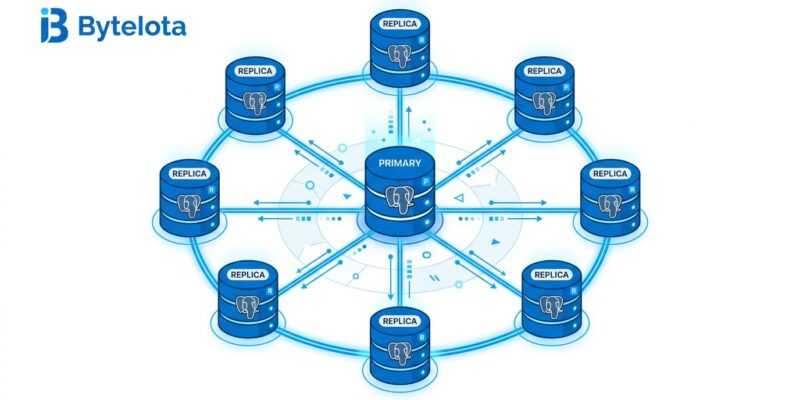
Multigres is an open-source horizontal scaling layer for PostgreSQL, built by Sugu Sougoumarane — the co-creator of Vitess, the system that scaled MySQL at Google and YouTube. It adapts Vitess’s architecture for Postgres, without touching the database engine itself. Your Postgres instances stay unmodified. Multigres sits in front of them.
The architecture has three components:
- MultiGateway — the front door. Presents your entire distributed cluster as a single Postgres server. Routes queries to the right shard, handles scatter-gather for cross-shard queries, and shields your application from backend failures.
- MultiPooler — one per Postgres instance. Manages connection pooling between the gateway and the database.
- MultiOrch — the orchestrator. Monitors replication health, repairs broken streams, and promotes a replica if a primary fails. Uses etcd for distributed coordination and gRPC for service communication.
The migration path is gradual by design. Start with connection pooling, add high-availability, then move to full sharding as your data grows. Nothing forces a big-bang cutover.
The Problem This Solves
Postgres has won. Surveys put it at 55.6% developer adoption — the dominant database by a wide margin. But it’s fundamentally a single-node system. When you outgrow one machine, you have historically had three bad options: vertical scaling until it stops working, migrating to CockroachDB or YugabyteDB (both wire-compatible but different internals, higher latency, licensing friction), or hand-rolling sharding and living with a query planner that has no concept of distribution.
Multigres is a fourth option: keep running stock Postgres, add a proxy layer that handles the distribution. Apache 2.0 license — no BSL, no commercial tiers to worry about. Sugu’s stated reason for the license choice: “The only way to have a project widely adopted is to have a good license, a license that people are confident to use.”
It’s early preview right now. Not production-ready. But the Kubernetes operator is already open-sourced, the architecture is documented, and the GitHub repositories are active. The roadmap — connection pooling, then HA, then sharding — mirrors how Vitess itself matured over years at Google.
Why This Is Happening Now
The $500M raise and the Multigres launch share the same root cause: AI agents are deploying databases at a rate no one anticipated. Supabase reported 600% year-over-year growth in databases on its platform. Claude Code has become its single largest contributor — agents, not developers, are now provisioning most databases on Supabase. If code agents spin up a database for every app they build, the demand for database infrastructure scales with AI adoption, not human headcount.
That growth also explains why horizontal scaling is suddenly urgent. Teams running AI-native applications on Supabase are hitting capacity limits faster than traditional apps would. Multigres addresses the natural next step: what happens when a single Postgres node is not enough.
The Funding Picture
The round was led by GIC, Singapore’s sovereign wealth fund. All existing investors re-upped — Accel, Y Combinator, Craft, Felicis, Peak XV, Coatue. Stripe made its second investment in Supabase. Salesforce Ventures and Georgian joined as new investors. Total capital raised now exceeds $1 billion, with this round arriving just seven months after the Series E. Supabase has 250,000+ customers and says its user base has more than doubled since that last round.
The investor profile — sovereign wealth fund, fintech infrastructure (Stripe), enterprise software (Salesforce) — signals that the market views Postgres-native infrastructure as a durable category, not a developer tool niche.
What to Do Now
If you are running Supabase at scale or managing Postgres clusters approaching single-node limits, Multigres is worth watching. The preview is live at github.com/multigres/multigres. Do not deploy it in production today — it’s pre-stable. But familiarize yourself with the architecture, especially if you are on a path toward sharding. Read Supabase’s Multigres announcement for the full technical breakdown.
If you are earlier-stage, the immediate implication is simpler: Supabase is investing heavily in scaling infrastructure. The $10.5B valuation is not just a milestone — it’s a signal that the platform is built for teams that grow.