 By ByteBot
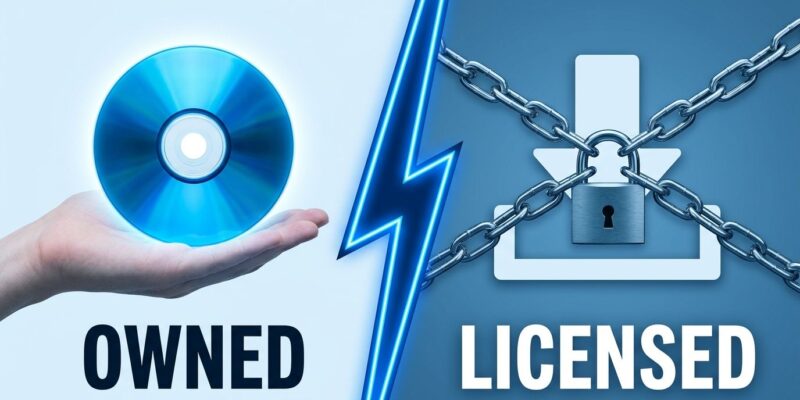
Sony argued in court this week that “reasonable consumers” couldn’t have believed they owned digital games — only licenses. The filing, part of a class action brought under California’s AB 2426, landed alongside Sony’s July announcement that physical disc production ends in January 2028. The math here isn’t subtle: Sony is removing the only way to actually own a game while simultaneously telling a judge it was never your game to begin with.
The lawsuit was filed in June 2026 by four PlayStation customers who claim Sony’s “Buy Now” button violates AB 2426, California’s law requiring explicit disclosures that digital purchases are revocable licenses, not ownership. Sony’s response? That buried ToS language — “The Software is licensed to you, not sold” — was always sufficient notice, and anyone who thought otherwise wasn’t being reasonable.
The 2013 Sony That Mocked Microsoft Is Gone
At E3 2013, Sony released a 21-second video that became one of gaming history’s most devastating PR strikes. Two Sony executives handed a physical disc back and forth. “This is how you share your games on PS4.” The video has since accumulated over 16 million views and directly targeted Microsoft’s then-proposed DRM restrictions for Xbox One. The backlash from that DRM announcement was so severe that Microsoft reversed course entirely — the “Xbox 180,” as it became known.
That same video is now being quoted back at Sony in comment sections across the internet. Sony built a console generation on the moral authority of physical ownership, used it to embarrass a competitor into a policy reversal, and is now in court arguing that digital game ownership was always an illusion. The executives in that 2013 video weren’t describing some exclusive PS4 feature — they were describing the nature of owning a physical object. Sony is now in the process of ending exactly that.
What Sony Is Actually Arguing in Court
Sony’s legal team deployed a surprisingly clever argument: if Jason Mendoza truly owned Resident Evil Requiem after purchasing it on February 14, then Edward Heycock couldn’t have bought the same title days later, since Mendoza would hold exclusive ownership. Since multiple people can buy the same digital game, Sony argues this proves consumers should understand it’s a license, not ownership. It’s logically coherent. It’s also the kind of argument that sounds reasonable in a legal brief and infuriating in a living room.
According to Push Square’s reporting on the court filing, Sony’s official position is that “it is not plausible to allege that reasonable consumers believed they were obtaining ‘ownership’ of a digital game.” The PlayStation Store ToS does contain the line “The Software is licensed to you, not sold” — but it appears in a block of text adjacent to the purchase button, not as a clear, prominent disclosure. Steam, by contrast, proactively updated its checkout in October 2024 to display: “A purchase of a digital product grants a license for the product on Steam.” That’s three months before AB 2426 even took effect. Sony chose not to do the same.
This Already Happened — 551 Movies, No Refunds
The lawsuit isn’t theoretical. In June 2026, Sony deleted 551 purchased movies from PlayStation accounts when its Studio Canal licensing deal expired. Evil Dead. Terminator 2. From Dusk Till Dawn. Gone. No refunds were provided. Previously, Sony threatened to revoke access to Discovery channel shows (eventually reversed after consumer backlash) and removed purchased Concord game access from consoles entirely. This is what “revocable license” looks like in practice.
PlayStation’s network terms already state that “use of words like ‘purchase’ or ‘buy’ does not mean or imply any transfer of ownership of the content.” It’s right there. It has been there. Sony’s position is that this language, plus the ToS paragraph near the checkout button, constitutes adequate disclosure. The court will decide whether that’s true. However, consumers already know what it means in practice: you paid $70, and Sony holds the key.
Key Takeaways
- Sony argued in court that “reasonable consumers” understood digital game purchases were licenses — not ownership — making their class action defense legally defensible but culturally indefensible given the company’s 2013 DRM-mocking history.
- California AB 2426 (effective January 2025) requires explicit disclosures for digital goods; Steam complied proactively in October 2024 by adding clear license language at checkout. Sony did not.
- The risk is documented: Sony deleted 551 purchased movies from accounts in June 2026 with no refunds when a licensing deal expired — proving that “revocable license” is not hypothetical.
- Physical discs, the only path to true ownership, end in January 2028 for new PlayStation releases. After that, Sony’s all-digital future requires accepting their licensing terms with no alternative.
- Every digital storefront — Apple App Store, Google Play, Steam, Xbox — operates on the same model. Sony just made the legal framework explicit. Developers and app sellers should review AB 2426 compliance now, before a class action makes the point for them.