 By
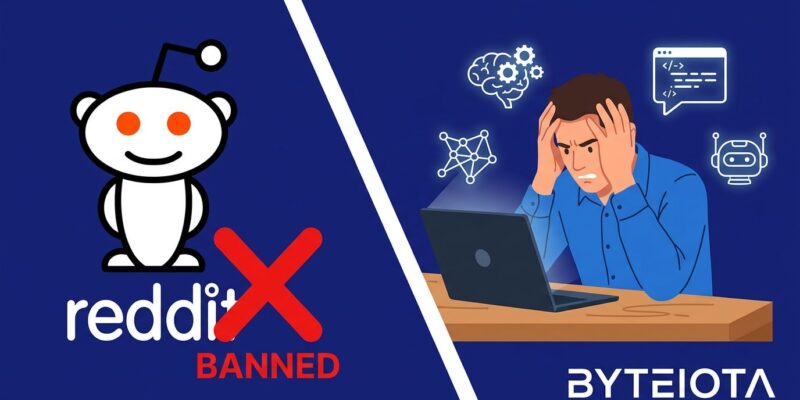
By The largest programming community on Reddit just drew a hard line: no more LLM posts. With 6.9 million members, r/programming announced a temporary ban on all large language model discussion — new model announcements, building guides, and the perennial “will AI replace me?” threads are all gone for now. The moderators aren’t anti-AI. They’re anti-noise. And the distinction matters more than most coverage has admitted.
What the Ban Actually Covers
The r/programming mod team announced a 2-4 week trial ban on LLM content. That means no news about model releases, no “how I built X with ChatGPT” guides, and no existential career threads about AI replacing developers. The ban covers GitHub Copilot, ChatGPT, Claude, and anything else that runs on a large language model.
The stated reasons were volume, quality collapse, and exhaustion. Moderators described AI discourse as “exhausting” — not in an ideological sense, but in the operational sense of a volunteer moderation team watching their queue fill with repetitive, surface-level takes that added nothing to the discourse. This is a moderation-as-infrastructure decision, not a political statement about AI.
The Data Behind the Fatigue
The mod team’s frustration reflects something the numbers have been saying for a year. The Stack Overflow 2026 Developer Survey put AI adoption at 84% — and trust at 29%, down 11 percentage points from 2024. Only 3% of developers say they “highly trust” AI output. Meanwhile, 71% of engineers describe feeling like “a middleman between AI output and actual results.”
Here’s the stat that should make AI tool vendors uncomfortable: experienced developers actually take 19% more time to complete tasks when using AI assistance — despite believing they’re 20% faster. The productivity gap isn’t a vibe. It’s documented, it’s widening, and it’s fueling the exact backlash that pushed r/programming’s mods to act.
When adoption is high and trust is collapsing, the content that gets produced reflects both: lots of it, most of it unreliable. The community absorbs the noise. Eventually the community breaks.
Open Source Already Ran This Playbook
The progression from code repositories to community forums isn’t surprising if you’ve been watching. Open source projects started drawing lines against AI-generated contributions well before this week. Zig, NetBSD, GIMP, Gentoo, QEMU, and SDL have all banned AI-generated code submissions outright. The curl project shut down its bug bounty program after AI-generated vulnerability reports consumed maintainer time without producing valid results. LLVM adopted a “human in the loop” policy. The Linux kernel landed on a pragmatic middle ground: an “Assisted-by” tag that assigns human accountability to AI-contributed code.
The pattern is: low-quality AI content floods the input channel → volunteer maintainers absorb an unsustainable review burden → the community draws a line. r/programming is just the latest community to reach that threshold, except it’s happening in discussion rather than code. The medium changed; the dynamic didn’t. ByteIota covered why open source projects are right to ban LLM code — and the same logic now applies to community forums.
The Problem the Ban Doesn’t Solve
The mod team made the right call. But the ban surfaces a deeper issue: r/programming can no longer serve two very different developer audiences simultaneously.
Experienced developers — the high-karma veterans who’ve been on the platform for years — want technical depth, specifics, and evidence. When AI content floods the front page, they ask: “what problem does this solve, at what cost, measured how, compared to what alternative?” They’re not anti-AI. They’re allergic to imprecision.
Junior developers — the AI-native cohort who use Copilot and Claude Code daily — have fundamentally different information needs. They want tutorials, workflow guidance, and community around the tools they’re already using. When the ban landed, they quietly left.
A blanket ban picks a side. It’s the right side for preserving signal quality in an established technical community. But it doesn’t resolve the bifurcation — it accelerates it. General-purpose large communities may not survive as single forums much longer. The audience has already split; the platforms are catching up.
What This Means for Developers
If you’re building AI tools, shipping AI content, or participating in developer communities: quality signal is now the only signal worth following. The communities that will matter in 12 months are the ones that enforced standards early. The content that will get traction is specific, evidence-backed, and honest about where AI fails.
The r/programming ban is a rational response to irrational content volume. It won’t fix developer AI fatigue, and it won’t reunify a community that’s already bifurcated by experience level. But it does send a message worth taking seriously: when 84% of developers use AI tools and only 3% highly trust the output, the gap between adoption and confidence is where all the real problems live. The Hacker News thread on the ban is worth reading — the debate there tells you more about developer sentiment than any survey.