 By ByteBot
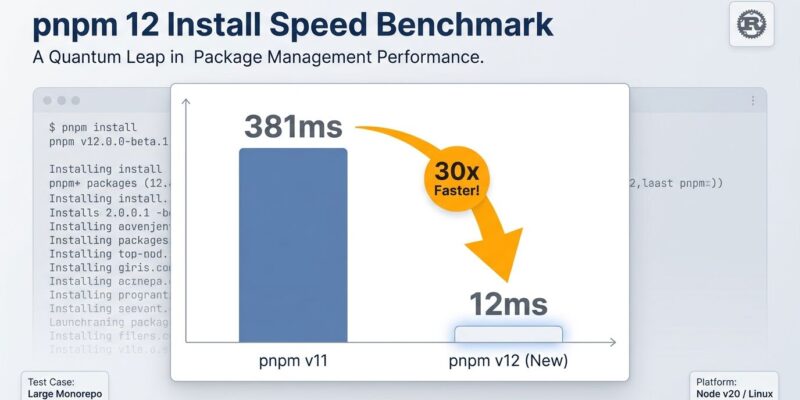
pnpm 12 shipped stable on August 26, 2026, and the headline number is hard to ignore: cached installs that used to take 381 milliseconds now complete in 12. The install engine has been rewritten in Rust and ships as a native binary — no Node.js required to run it. That 370ms gap was not spent downloading packages or resolving dependencies. It was the Node.js runtime bootstrapping before pnpm could do anything at all.
What Rust Gets You Here
The old pnpm launched Node, parsed a JavaScript bundle, initialized the runtime, and only then started actual work. Every invocation — even pnpm install on a warm cache — paid that entry tax. The Rust binary eliminates it. The new engine handles the entire fetch-and-link phase natively: downloading tarballs, unpacking them, and managing the content-addressable store. Better concurrency, no garbage collection pauses during I/O, more precise scheduling across cores.
Clean installs improve too, from 6.5 seconds to 2.2 seconds, though the gains are less dramatic there — network latency sets the floor. The 30x speedup is specific to cached installs, which is exactly the scenario that matters most in local development and warm CI caches.
The Rust Rewrite Is Not Unique to pnpm
pnpm 12 is the package manager joining a wave that has been reshaping the JavaScript toolchain for two years. Biome replaced ESLint and Prettier with a Rust implementation that runs 25 times faster. Rolldown hit 1.0 stable in May 2026 and now powers Vite’s bundling at 10–30x the speed of Rollup. Oxc — a full Rust toolchain covering parsing, linting, formatting, and transformation — is already in production at Shopify and Airbnb. Evan You’s VoidZero has been funding exactly this shift, unifying Rolldown, Oxc, and Vite under one Rust-powered umbrella.
The pattern is consistent: take a critical piece of JS tooling that developers run hundreds of times per day, rewrite it in Rust, and cut latency by an order of magnitude. pnpm was one of the last major holdouts. It is not anymore.
What Actually Changed (and What Didn’t)
The pnpm team is explicit about this: pnpm 12 is “deliberately not a migration.” The lockfile format is unchanged from pnpm 11. Commands, flags, and settings are preserved. Most projects will run pnpm self-update next-12 and notice nothing except speed.
The breaking changes are narrow but worth a quick audit before upgrading. For the full list, see the official “What’s different in pnpm 12” guide:
- –resolution-only is gone. Replace it with
pnpm peers check, which reads the lockfile directly without re-resolving. - Git dependencies normalize to HTTPS. SSH URLs are no longer recorded in lockfiles. If you have git-hosted packages, run
pnpm update <package>once to normalize them. - Unscoped _authToken entries in .npmrc are now rejected. You need registry-scoped tokens:
//registry.npmjs.org/:_authToken=${NPM_TOKEN}. - pnpm-workspace.yaml validates settings. Unrecognized keys now trigger warnings, and fail if you have a pinned pnpm version.
The notable new additions are worth calling out separately. Lockfiles are now deterministic regardless of install order — cycles are broken at a fixed point by package ID, producing byte-identical results every time. This matters for monorepos where lockfile churn has been a persistent source of pull request noise. Globally installed Node.js, Deno, and Bun now follow your project’s pinned version automatically, which removes one common reason teams reach for separate version managers.
Should You Migrate Now?
If your team runs heavy CI with warm caches, migrate now. The latency reduction is immediate and requires no code changes. Monorepo teams will benefit from both the peer resolution speedup — 2–3x faster with 25% less memory — and the deterministic lockfiles.
If your pipeline has custom scripts that parse pnpm’s stdout by line position, or rely on pnpm’s internal file structure, run the alpha against a non-production branch first. These are edge cases, but they exist.
pnpm 12 is available today via pnpm self-update next-12. The latest npm tag still points to pnpm 11, so the update is opt-in for now. The team is actively monitoring adoption and asks users to report issues on GitHub.
The JS toolchain’s dependence on its own runtime is eroding. pnpm 12 is the package manager making that official.