 By ByteBot
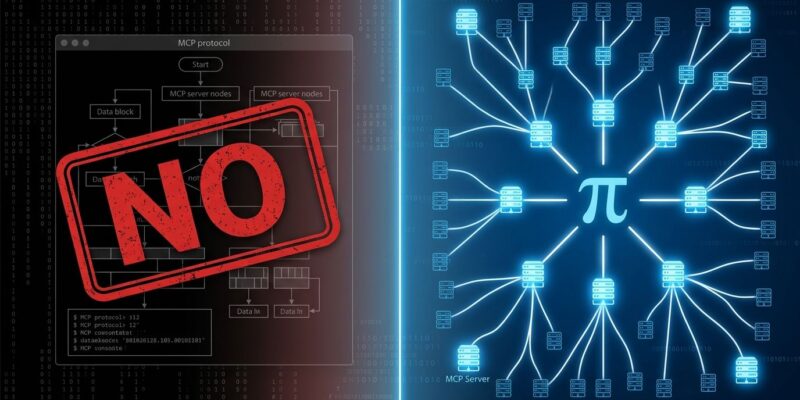
Pi, the minimal coding agent that built its identity around refusing MCP, shipped v0.99.0 on September 29 with native Model Context Protocol support — and a post titled “You Said No MCP!” explaining why. The story hit #1 on Hacker News today with 550 points and 318 comments. Pi’s team didn’t just bolt on MCP — they built Codemode, a QuickJS sandbox approach that sidesteps the token overhead problem that made MCP impractical for serious agent developers in the first place.
Why Pi Reversed Its MCP Stance
Pi’s identity was built on refusal. The pi.dev homepage previously displayed a proud declaration against MCP. The team’s public statements dismissed the protocol as a token-wasting pattern that fought against minimal, efficient agents. That stance wasn’t arbitrary — it was technically grounded, and they knew reversing it would attract attention (hence the self-aware blog post title).
Three things changed. First, MCP itself evolved. The July 2026 stateless spec removed the initialize handshake and session layer — the biggest sources of friction in production deployments. The Perplexity complaint that three MCP servers consumed 143,000 of 200,000 context tokens was a valid critique of the old spec; the new one shifted responsibility to implementations to be smarter about it. Second, Codemode needed a QuickJS sandbox anyway, so MCP support was structurally available at near-zero marginal cost. Third, the team’s philosophy: “We believe the best way to positively influence something is to embrace it.” Pi wants to demonstrate that MCP can be used without its worst tradeoffs.
Notably, this isn’t a defeat. The team was honest about their mixed feelings and specific about the conditions that changed. That intellectual honesty is rarer than the reversal itself.
What Codemode Is and How It Fixes MCP’s Token Tax
Standard MCP has a well-documented cost: every session, the agent loads full schema definitions for every connected tool. Each MCP tool definition costs 550 to 1,400 tokens. In March 2026, Perplexity CTO Denis Yarats put a specific number on it at the Ask 2026 conference: three MCP servers consumed 143,000 of their 200,000-token context window before the agent could do any real work — a 72% context window tax. Perplexity dropped MCP internally as a result.
Codemode solves this differently. Instead of pre-loading all tool schemas into context, the model writes JavaScript that executes inside a QuickJS sandbox in Pi’s harness. The model discovers tools through documentation and structured data returns — closer to how an OpenAPI surface works — rather than dumping full definitions upfront. As the Pi 0.99 release notes explain, the sandbox enables parallel tool calls and composition: “use Linear’s MCP server with the Jev classifier to score issue sentiment,” combining two tools in a single JavaScript execution without pre-loading both schema sets.
The key architectural decision is deferred loading. Tools are visible to the model as discoverable documentation, not as context-filling schema blocks. This keeps Pi’s context lean while giving the model access to MCP’s ecosystem. MCP connections work via stdio or streamable HTTP with OAuth support — standard enough to be compatible, different enough in execution to avoid the naive approach’s costs.
Related: Claude Marketplace Is Live: List Your MCP Tools Today
MCP Has Won — The Debate Is Now About How, Not Whether
According to MCP adoption data for 2026, the protocol now counts 17,000+ servers, 400 million monthly SDK downloads, and 78% of enterprise AI teams with MCP-backed agents in production. OpenAI, Google, Microsoft, AWS, Cloudflare, and GitHub are all AAIF members. The protocol was donated to the Linux Foundation in December 2025. Pi was one of the last prominent holdouts among developer tools.
The Perplexity situation and the Pi reversal tell the same story from opposite directions. Perplexity dropped MCP in March because standard implementations are expensive. Pi added MCP in September with an implementation designed to avoid those costs. Neither team is ignoring MCP anymore — they’re deciding how to engage with it well. The days of “should I use MCP?” are over. The question is how to use it without paying the context window tax.
Key Takeaways
- Pi v0.99.0 ships MCP support via Codemode — a QuickJS sandbox that discovers tools on-demand rather than pre-loading schemas, avoiding the 72% context window tax that caused Perplexity to drop MCP earlier this year
- Pi reversed course because MCP evolved (July 2026 stateless spec), Codemode’s infrastructure aligned with MCP’s requirements, and the team believes in improving standards from inside rather than criticizing from outside
- Codemode runs JavaScript in a QuickJS sandbox inside Pi’s harness, enabling parallel tool calls and composition — a structurally different approach from naive MCP that developers building agent harnesses should study
- With 17,000+ MCP servers and 400 million monthly downloads, the protocol has effectively won — the remaining debate is about implementation quality, not adoption