 By ByteBot
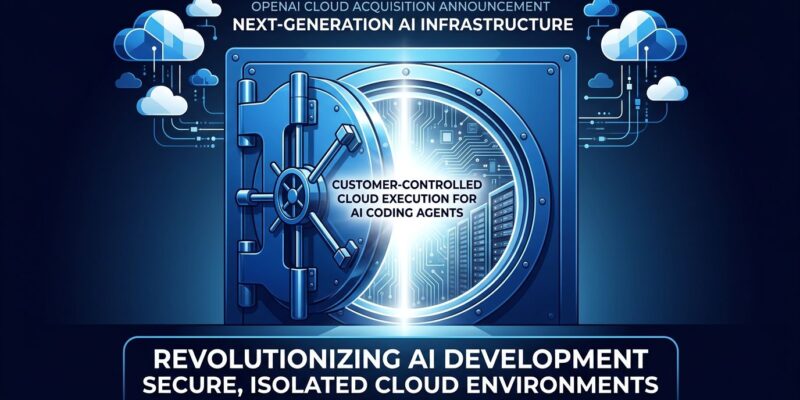
On June 11, 2026, OpenAI announced plans to acquire Ona — the cloud execution platform formerly known as Gitpod — to give Codex agents persistent, customer-controlled environments where they can keep running after a developer closes their laptop. Codex just crossed 5 million weekly active users, up 400% since January. The model is no longer the bottleneck. The runtime is.
Enterprise developers have been stalling on Codex for months — not because they doubt the model, but because they cannot allow an AI agent to touch production data on OpenAI’s servers. Ona changes that equation. With this acquisition, Codex agents run inside the customer’s own cloud, with audit trails, role-based access control, and full VPC isolation. This is OpenAI’s move to close the one gap Anthropic and GitHub have been quietly exploiting.
Why AI Agents Keep Dying — And What the OpenAI Ona Acquisition Fixes
Close your laptop. Watch your agent die. That is the session-boundary problem every AI coding tool has right now, and it is not a minor inconvenience — it is the reason enterprises will not hand agents anything time-consuming. A 5-minute code review survives a session. A 6-hour dependency migration does not.
Ona — which rebranded from Gitpod in September 2025 and rebuilt entirely around AI agents — solves this with three layers. Sandboxed Firecracker microVM environments that survive disconnects through automatic 10-minute checkpointing, turning tasks into durable jobs rather than sessions. Background agent workflows triggered by tickets, webhooks, or CI/CD pipeline events, with no developer present required. And kernel-level enforcement for execution, file access, network connections, and memory, with every action logged and auditable.
The Ona CEO framed it well: “Agents need more than intelligence; they need a trusted workspace.” That is not marketing copy. It is a genuine architectural observation about why impressive demos consistently fail to translate into production deployment.
Customer-Controlled Execution Is the Real Announcement
The persistence story is compelling. However, the governance story is what actually moves enterprise procurement. Ona’s architecture lets agents run inside the customer’s own VPC — OpenAI provides the model intelligence and orchestration, the customer owns the runtime. That is the sentence regulated industries needed to hear before opening production systems to an AI agent.
In practice, this means RBAC, SSO and OIDC integration with short-lived tokens rather than static credentials, and full audit trails for SOC 2 compliance. The near-term use cases write themselves: CVE remediation, dependency upgrades, test-failure triage, documentation updates — structured tasks with clear success conditions where the agent works overnight and presents results in the morning.
The phrase “customer-controlled execution” still deserves scrutiny. OpenAI’s intelligence layer is processing requests. The data stays in the customer VPC; the reasoning does not. For most enterprise teams, that is an acceptable tradeoff given Ona’s architecture. For the most sensitive regulated environments, that conversation remains open. Ask explicitly before signing anything.
Related: Microsoft ACS: Open Standard for AI Agent Governance
What Changes in the Codex Agent Race
Claude Code’s strongest enterprise argument has been local execution — agents run on the developer’s machine, data never leaves the building. GitHub Copilot leans on Microsoft’s cloud trust relationships built over decades. With Ona, Codex now has a third path: cloud execution, but in your cloud. That meaningfully narrows the gap without requiring enterprises to trust OpenAI as a cloud provider.
Independent sandbox providers — E2B, Daytona, Modal — now face a first-party player with tight model-to-runtime integration. Their genuine advantage is model-agnosticism: they work with Claude, GPT, and open-weight models alike. According to a 2026 sandbox comparison from Northflank, Daytona just raised 4M in February on exactly this compliance-first positioning. If you are building a multi-vendor AI agent infrastructure, neutral sandboxes remain the more portable bet. If you are all-in on Codex, Ona’s integration depth is the obvious choice.
The coding agent race has moved past “whose model is better.” The new competition is about who owns the execution stack, the orchestration layer, and the enterprise trust relationship. OpenAI just answered all three for its ecosystem — at the cost of locking you further into it.
Related: GitHub Copilot App Is Now GA: Run Multiple AI Agents in Parallel
Four Questions Before You Commit
The acquisition closes in Q4 2026, pending regulatory approval. Until then, Ona and OpenAI remain independent. What happens to Ona’s independent enterprise contracts and pricing after close is undefined. According to OpenAI’s own Codex knowledge work announcement, Codex now has 5 million weekly users and is growing fast — the integration will happen quickly. Before committing your agent infrastructure to Codex and Ona, get clear answers to these:
- What happens to Ona’s independent enterprise contracts? Pricing and support terms may change after the deal closes.
- What does OpenAI’s intelligence layer actually see? Clarify exactly where model inference happens relative to your VPC boundary.
- Will Ona environments remain model-agnostic after close? Or does Ona become Codex-exclusive infrastructure?
- How does this affect your multi-vendor agent strategy? Tight integration is only valuable if you are staying in one ecosystem.
Key Takeaways
- OpenAI acquired Ona (formerly Gitpod) on June 11 to give Codex agents persistent, customer-controlled cloud execution — directly addressing the session-boundary problem that has blocked enterprise adoption.
- Ona’s Firecracker microVM environments with 10-minute checkpointing let agents run for hours or days without a developer present, inside the customer’s own VPC.
- “Customer-controlled execution” is genuine architecture — but OpenAI’s intelligence layer is still in the loop. Ask hard questions before committing production data.
- For teams with multi-vendor AI strategies, model-agnostic sandboxes (E2B, Daytona, Modal) remain the more portable option. Codex and Ona is the right call only if you are committed to the OpenAI stack.
- The acquisition closes Q4 2026 pending regulatory approval. Clarify Ona’s independent enterprise contract terms before signing anything new.