 By ByteBot
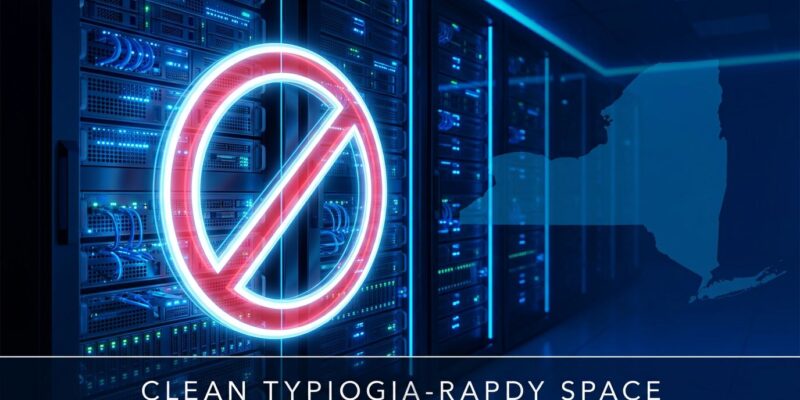
New York Governor Kathy Hochul signed Executive Order No. 62 today, making New York the first state to impose a statewide moratorium on hyperscale data centers. Any new facility consuming 50 megawatts or more is blocked from receiving state environmental permits for up to one year. Maine moved first in April with a stricter 20MW threshold, but New York is a different order of magnitude. When the Northeast’s largest economy freezes data center permitting, the cloud capacity picture changes.
What the Moratorium Does
The 50-megawatt threshold is the first number worth understanding. It is not a ban on enterprise data centers, small colocation providers, or the server closets your organization runs in New York. It targets hyperscale facilities — the kind that only four companies build at scale: AWS, Google, Microsoft Azure, and Meta.
For context: a typical enterprise data center draws 1–10MW. A mid-size colocation campus sits at 5–20MW. A single AWS or Google hyperscale campus consumes 100–500MW. The 50MW line cuts squarely through hyperscale territory.
The Department of Environmental Conservation stops issuing discretionary permits for new projects above the threshold immediately. Projects with construction already underway are grandfathered. The pause runs until the Department of Public Service completes a Generic Environmental Impact Statement (GEIS) — a process that will take up to one year. The GEIS will assess energy demand, water use, air quality, noise, and community impacts. Once it is done, permitting resumes under whatever new standards emerge.
Your Existing Workloads Are Fine — For Now
No immediate action required. AWS us-east-1, Google us-east1, Azure East US and East US 2 — they are all operational and unaffected. This is a construction moratorium, not a shutdown order. Current production workloads in New York-based cloud regions see zero disruption today.
The risk horizon is 18 to 36 months out. That is how long it takes a hyperscale data center campus to go from planning to operational. Cloud providers had projects in the pipeline for New York. Those projects are now blocked until the GEIS completes and new standards are published.
When capacity growth is constrained in a region while demand keeps rising, pricing follows. It will not happen overnight, but Northeast cloud regions are worth monitoring on spot capacity and reserved instance availability over the next two years.
Why New York Reversed Course
Hochul was previously a vocal advocate for data center investment — courting hyperscalers with tax incentives and positioning New York as a tech hub. The reversal is driven by polling, not ideology. A March 2026 Quinnipiac University survey found 65% of Americans oppose building AI data centers in their communities, against just 24% in support. Those are not numbers a governor ignores.
The Governor’s framing is worth noting: “Technology should make our lives better, not pollute our water, strain our energy grid, or drive up our utility bills.” This is AI infrastructure reframed as a ratepayer problem — and that framing will travel to other state legislatures watching the same poll numbers.
Digital Realty, one of the largest data center operators in the state, did not soften its response. The company said the moratorium will push investment out of New York. That is not a negotiating position — it is a business decision that will be made dozens of times over the next twelve months.
This Is a Trend, Not an Anomaly
Maine enacted a 20-megawatt, 18-month data center ban in April 2026. Now New York. The National Conference of State Legislatures is tracking at least twelve similar bills across other states, with Vermont, New Hampshire, and others reportedly advancing comparable legislation.
Congress has not passed federal data center regulations. States are filling that vacuum at the infrastructure level — targeting energy, water, and permitting rather than AI models or data handling. The result is a fragmenting regulatory map for where cloud capacity can legally be built.
Cloud providers will accelerate buildout in states that remain open: Northern Virginia’s Data Center Alley, Texas, Ohio, and Georgia. That concentration carries its own risks — geographic clustering of critical infrastructure is not a resilience strategy.
What Developers Should Do Now
Existing workloads need no changes. But several steps are worth taking proactively:
- Review multi-region architecture. If your production stack depends on a single Northeast region, document and rehearse failover to a secondary region. Geographic redundancy is now also regulatory risk management.
- Set pricing alerts. Monitor Northeast cloud region spot pricing and reserved instance availability. If capacity growth is constrained, pricing signals will come first.
- Flag data residency requirements. If you have compliance obligations that require Northeast US data residency, document the requirement and flag the regulatory risk. New standards may redefine what “compliant” means in New York.
- Track the GEIS process. New York’s Department of Public Service will publish the GEIS timeline. The resulting standards will shape data center development for years — and influence what other states adopt.
Infrastructure regulation has historically been invisible to most developers. That era is ending. What states allow to be built — and where — now shapes the cloud map that everything else runs on. New York just drew the first significant line.