 By
By Moonshot AI’s Kimi K3 landed on HuggingFace on July 27 with 2.8 trillion parameters and full open weights — the largest open-source model ever released. Before you spin up a download: the weights are 1.56 terabytes and serving the model requires a 64-GPU cluster. The gap between “open” and “accessible” is the entire story here, and it is worth understanding both sides of it.
It’s a Sparse Model — That’s the Point
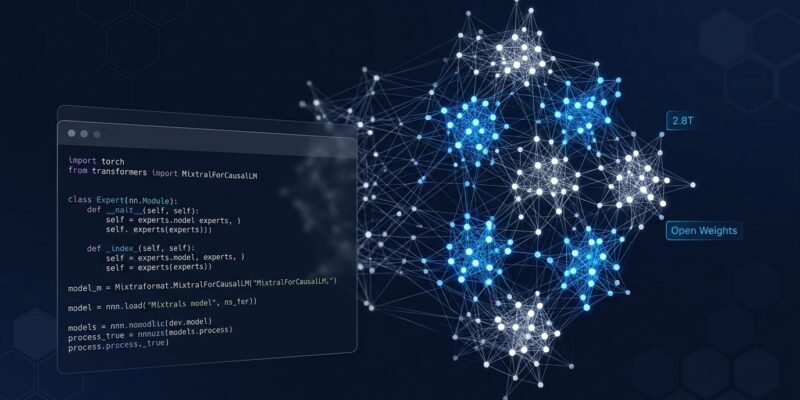
K3 is a Mixture-of-Experts (MoE) architecture. Of the 2.8 trillion total parameters, only 104 billion are active on any given token. Moonshot uses 896 experts, selecting 16 per forward pass via their Stable LatentMoE framework. The sparsity is under 2% of the model firing per token — but that is how you build a frontier model without the inference cost of a dense 2.8T network.
The other architectural piece worth knowing is Kimi Delta Attention (KDA). Standard transformer attention scales quadratically with context length. KDA replaces it with a hybrid linear attention mechanism that delivers up to 6.3x faster decoding on million-token contexts. K3’s 1M-token context window is operationally real: KDA reduces KV cache usage by 75% versus full attention, making the memory overhead manageable at datacenter scale.
One more thing: the released MXFP4 weights are the trained weights, not a lossy post-hoc compression. Moonshot ran quantization-aware training from the supervised fine-tuning stage onward, so the model learned to compensate for quantization error during training. MXFP4 models from other labs often suffer quiet degradation on edge-case inputs. K3’s does not.
The Benchmarks: One Surprising Result
On Artificial Analysis’s intelligence index, K3 scores 57 — the highest any open-weight model has ever achieved. Claude Fable 5 scores 69, GPT-5.6 Sol scores 65. So K3 is not the best model available. It is, however, the best open model by a meaningful margin, and the gap to closed frontier models has compressed considerably from where it stood a year ago.
The surprising result is SWE Marathon. This benchmark measures sustained multi-step software engineering over long task horizons — the kind of work agentic coding pipelines actually do. K3 scores 42%, beating Claude Fable 5 (35%) and GPT-5.6 Sol (39%). On long-context reasoning (AA-LCR), K3 leads at 74.7%. If you are building autonomous coding agents, those are the two metrics that matter most, and K3 is first on both.
| Metric | Kimi K3 | DeepSeek V4 Pro | Claude Fable 5 |
|---|---|---|---|
| Open weights | Yes | Yes (MIT) | No |
| API input price (per 1M tokens) | .00 | /bin/bash.18 | 0.00 |
| AA Intelligence Index | 57 | 44 | 69 |
| SWE Marathon | 42% (#1) | — | 35% |
| Self-host GPU requirement | 64+ H100s | 32+ H100s | N/A |
You Cannot Self-Host This — and That’s Fine
Running K3 requires either 64 H100 80GB GPUs for full precision, or 8x H200 accelerators with the MXFP4 weights. vLLM needs approximately 1.68 TB of VRAM for the weights alone. There is no path to a consumer GPU setup; the KTransformers team is experimenting with more aggressive quantization, but nothing production-ready is released yet.
The practical options are: use the API, or deploy a smaller open-weight model where you need direct access. GLM-5.2 at 753B parameters runs on roughly 8x H100. DeepSeek V4 requires 32+. For most teams building on K3, the API is the product. Serving stacks for those who do have the hardware: vllm/vllm-openai:kimi-k3 (KDA support shipped with the weights) or lmsysorg/sglang:kimi-k3 (423 tokens per second reported on DSpark).
API Pricing and Compatibility
The Kimi API charges .00 per million input tokens and 5.00 per million output tokens. Cached input drops to /bin/bash.30 per million — a 90% discount. This puts K3 roughly on par with Claude Sonnet and at about 30% of Claude Fable 5’s rate. The endpoint is OpenAI-compatible, so migration from GPT or Sonnet is a base URL swap:
from openai import OpenAI

client = OpenAI(
    base_url="https://api.kimi.ai/v1",
    api_key="YOUR_KIMI_API_KEY"
)

response = client.chat.completions.create(
    model="kimi-k3",
    messages=[{"role": "user", "content": "Your prompt here"}]
)
For long-context workloads — large codebases, multi-document synthesis, extended agentic sessions — K3’s 1M context window at Sonnet-equivalent pricing is genuinely competitive. For short-context, high-volume tasks, DeepSeek V4 Pro at /bin/bash.18 per million tokens is the harder choice to justify avoiding.
The License Has Teeth at Scale
The Kimi K3 License permits use, modification, distribution, and commercial deployment. The catches: if your business earns over $20 million in annual recurring revenue from K3-powered products, you need a separate agreement with Moonshot. Above 100 million monthly active users, you must display “Powered by Kimi K3” attribution. Both thresholds are high enough that they will not affect most developers, but enterprise legal teams should read the full license before shipping.
For comparison, DeepSeek V4 and GLM-5.2 are MIT-licensed — no revenue caps, no attribution requirements. If license freedom is a hard requirement, those are the cleaner options at lower capability.
The Bigger Picture
K3 demonstrates that the open-weight frontier is real and closing. As Nathan Lambert at interconnects.ai notes, Chinese AI labs — Moonshot, DeepSeek, Zhipu — are shipping models at scales that compress the gap to proprietary offerings. For developers and enterprises in regulated industries who need the control that comes with model weights, the options at the top of the capability ladder just got meaningfully better.
The self-hosting narrative is hype for most teams. The capability story — and the agentic coding results in particular — is not.