 By
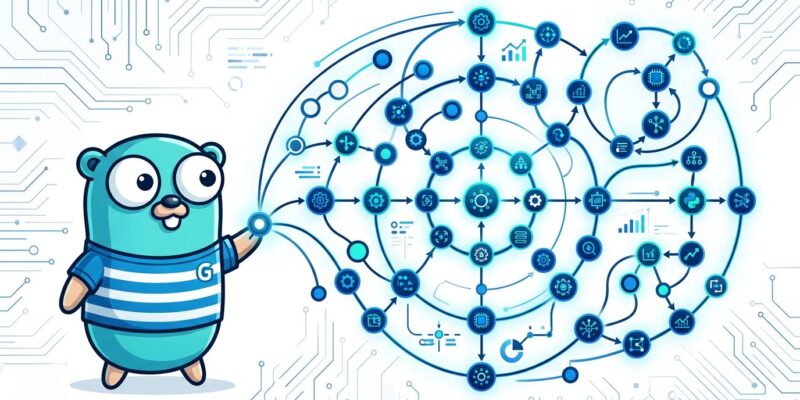
By Microsoft dropped a public preview of Agent Framework for Go on July 10 — bringing its production-grade agentic AI platform to Go developers for the first time. Until now, the framework only had SDKs for Python and .NET, both of which hit 1.0 GA in April. The Go SDK means you can now build tool-calling agents, multi-agent workflows, and human-in-the-loop pipelines in the language already running your Kubernetes operators, cloud workers, and microservices.
Worth noting: both Microsoft and Google now back Go natively for AI agents. OpenAI and Anthropic still do not have official Go agent SDKs. The New Stack put it plainly: the two biggest frontier AI labs are lagging on the language that runs most of cloud-native infrastructure.
What MAF Is (Quick Context)
Microsoft Agent Framework is the product of merging AutoGen — Microsoft Research’s multi-agent orchestration library — with Semantic Kernel, their enterprise AI plumbing layer. The merger was announced in October 2025; 1.0 shipped for Python and .NET in April 2026. If you’ve been using either library, MAF 1.0 is the migration target. AutoGen is now in maintenance mode: bug fixes and security patches only.
The framework’s core proposition is explicit control over multi-agent execution. You define how agents coordinate — sequentially, concurrently, with conditional branches — rather than hoping the LLM figures it out. Sessions manage state across turns. Middleware intercepts and gates actions. It’s closer to a distributed systems framework for AI than a chat wrapper.
What the Go SDK Gives You
The public preview ships with most of what you need for production agent services:
- Tool calling — function tools and an MCP client for connecting agents to external tool servers
- Middleware pipeline — logging, OpenTelemetry tracing, approval gates, custom interceptors
- Graph-based workflows — sequential, concurrent, conditional routing, subworkflows, and group collaboration patterns
- Human-in-the-loop — tool approval gates that pause agent execution until a human approves the next action
- Checkpointing and streaming — resume long-running workflows after interruption; stream results as they are generated
- A2A and AG-UI protocols — the two emerging interoperability standards for multi-agent systems
- Foundry and Azure OpenAI integration — first-class support for Microsoft’s model hosting
OpenTelemetry is baked in. If your team already runs Go microservices with OTel traces, agent observability costs you nothing additional to configure. The framework propagates trace context automatically through MCP tool calls.
A minimal agent looks like this:
import (
    "github.com/microsoft/agent-framework-go/agent"
    "github.com/microsoft/agent-framework-go/foundryprovider"
)

a := agent.New(
    agent.WithInstructions("You are a helpful assistant"),
    agent.WithTools(myTool),
    agent.WithProvider(foundryprovider.New(cfg)),
)
response, _ := a.Run(ctx, "What is the status of order #1234?")
What’s Missing
The Go SDK does not yet match the .NET and Python releases. Missing features include:
- RAG — no built-in retrieval-augmented generation pipeline
- CodeAct — agents that write and run code (marked coming soon in the repo)
- Declarative agents — YAML-based agent definitions
- Handoff orchestration — structured passing of control between specialized agents
- Foundry-hosted deployment — cloud-managed agent endpoints
If your use case is a tool-calling worker, an orchestration pipeline, or a backend service that coordinates agents in response to events — the current feature set is sufficient. If you need RAG or CodeAct specifically, stick with the Python SDK for now and watch the GitHub repo for updates.
Why Go for Agent Services
Python dominates AI research and model training for good reason — the ML ecosystem lives there. But production agent services are a different problem. A Go-based agent service typically uses 3–5x less memory than an equivalent Python service. Compiled binaries start fast, which matters for serverless patterns and Kubernetes sidecar deployments. Goroutines map naturally to multi-agent fan-out: spin up concurrent agent instances without threading overhead.
You also stop fighting Python in containers. No virtualenv management, no dependency resolution at startup, no size-bloated images from transitive ML dependencies. A Go agent binary in a scratch container is production-operable in a way Python rarely is without significant effort.
The Bigger Picture
Microsoft and Google are making a coordinated — if separate — bet on Go for the agent infrastructure layer. Google shipped ADK for Go earlier in 2026. Microsoft followed with MAF-Go on July 10. The pattern mirrors what happened with cloud-native tooling: Kubernetes, Terraform, Docker — all Go. If the same gravity pulls AI agent infrastructure toward Go, having first-party framework support now is meaningful.
OpenAI and Anthropic still have not released Go agent SDKs. That is not fatal — both have strong Python SDKs and the ecosystem is Python-centric — but it does leave a gap for Go teams that want to build agent services without wrapping Python microservices or writing their own orchestration layer from scratch.
Verdict
If you build Go services and have been waiting for a production-ready way to add agentic AI, this is close enough. The core features — tools, workflows, streaming, OTel, human-in-the-loop — cover the majority of real-world agent service requirements. Start with the announcement post and the GitHub repo for examples. The Microsoft Learn overview covers the full architecture if you want to understand the framework before diving into code.
Public preview means APIs can still shift. Build on it, but pin your dependency version and review the changelog before updating.