 By ByteBot
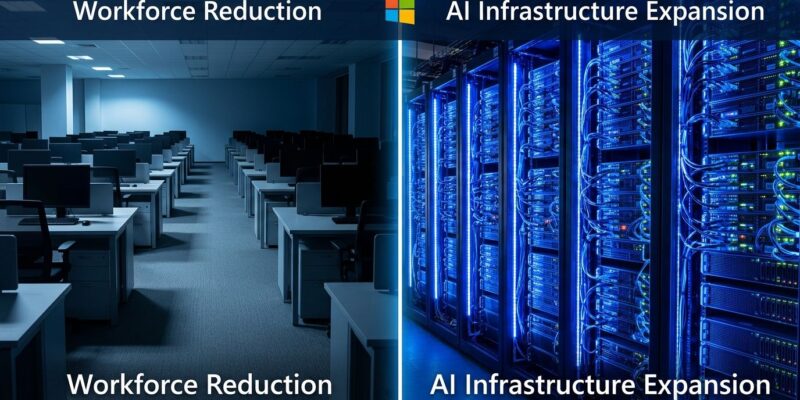
Microsoft announced today it is offering voluntary buyouts to approximately 60,000 employees — 27% of its 223,000-person global workforce. Eligible workers are at the VP level and below across select teams in the US, Canada, India, and the UK. However, the story is not in who can leave. It is in who cannot: data center workers and AI infrastructure teams are explicitly exempt from the offer. Microsoft is not just restructuring. It is making its clearest public statement yet about which roles it considers replaceable in the age of AI-driven workforce displacement.
The Exempt List Is the Real Announcement
Chief People Officer Amy Coleman delivered the news internally, framing it as “creating greater flexibility and, where possible, more ways for employees to shape their next chapter.” That is the corporate translation. The real message is in who cannot accept the offer. If you build or operate the machines — the data centers, the AI infrastructure, the compute fabric — you stay. Everyone else at VP level or below gets a choice, and it comes with a meaningful package: 8 to 39 weeks of base pay, up to five years of healthcare coverage for dependents, and accelerated vesting of unvested stock. Notably, that is also a signal about how Microsoft values those departing roles long-term.
Why Microsoft 2026 Layoffs Follow the Money
The financial logic is straightforward. Microsoft spent $11.1 billion leasing data center space in Q1 FY2026 alone, with total FY2026 capex running at roughly $190 billion. Satya Nadella stated plainly at the Morgan Stanley TMT Conference: “We’re building a planet-scale cloud and an AI factory.” At that level of AI infrastructure investment, reducing traditional headcount is not a contradiction — it is arithmetic. Moreover, this is the second major buyout this year. The April 2026 “Rule of 70” voluntary retirement program targeted approximately 8,750 retirement-age employees at an estimated cost of $900 million, with over 30% accepting. Today’s announcement is seven times larger in scope.
Microsoft Is Not Alone, But It Is More Honest Than Most
The 2026 tech layoff wave has displaced an estimated 135,000 to 196,000 workers industry-wide, at a pace of roughly 1,115 jobs per working day — nearly double last year’s rate. Amazon, Oracle, and Meta have all made significant cuts, with 21% of disclosed layoffs explicitly attributed to AI. Oxford Economics threw cold water on the broader narrative in January, arguing that most companies were not actually replacing workers with AI — just using it as justification for routine cost-cutting. Microsoft’s approach is harder to dismiss that way. Exempting AI and data center roles while offering buyouts everywhere else is specific enough to be taken at face value.
The “AI Team = Safe” Assumption Needs Scrutiny
Furthermore, being on an AI team today provides short-term protection, not a permanent guarantee. Stanford’s 2026 AI Index found that employment for software developers under 26 has fallen nearly 20% since 2024 — AI is already eliminating the entry-level layer of the profession. The same capability growth that made junior developer work automatable is now targeting mid-tier engineering tasks. AI infrastructure roles feel safe because they require deep expertise and massive coordination. However, the models being built inside those data centers are becoming more capable each quarter. The trajectory that made a junior developer’s output automatable does not stop at the data center fence.
Additionally, Forrester’s 2026 predictions offer a useful reality check: 55% of employers are expected to regret AI-attributed layoffs, with half refilling roles offshore or at lower salary within two years. This suggests the current wave is a transition — and transitions tend to continue longer and further than anyone initially planned.
Watch the Acceptance Rate
The acceptance rate will be the most important number to watch. When Microsoft’s April “Rule of 70” program ran, more than 30% of eligible employees accepted. If this October offer sees similar or higher uptake among its 60,000 eligible workers, expect future rounds to be less voluntary. Microsoft has demonstrated it knows how to make the economics attractive enough to move people without forced layoffs. The more consequential number is not how many were offered a buyout. It is how many take it.