
 By ByteBot
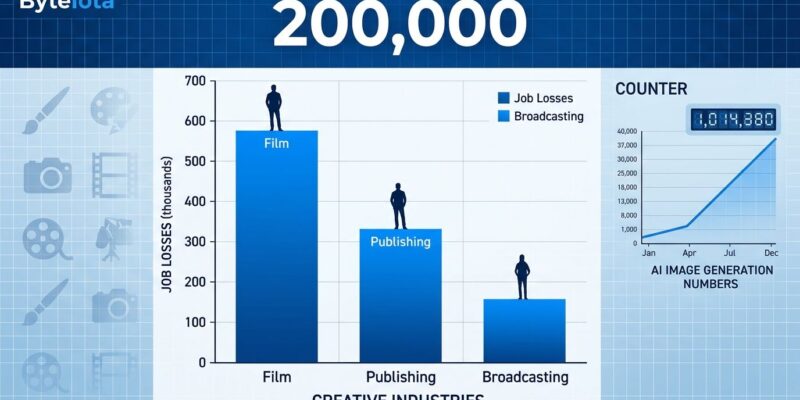
The United States has lost more than 200,000 creative industry jobs since generative AI went mainstream in late 2022. That figure comes from four years of Bureau of Labor Statistics data analyzed by economist Joseph Politano. It places this stretch in the same tier as the 2001 dot-com crash and the 2008 Great Recession — measured by the scale and speed of job loss. The difference: the rest of the economy is doing fine. This disruption is surgical.
Which Industries Got Hit
The losses are not spread evenly. Film and sound recording shed 120,000 jobs over four years — a 27% decline. Publishing lost more than 70,000 positions. Broadcasting and streaming providers cut 29,000. Together, these three sectors account for the bulk of the 200,000 figure.
What makes the data genuinely unsettling is what is not declining: in-person creative work. Performing arts employment is growing. Museums are growing. The pattern is specific — work that can be digitized can be automated. Work that requires a physical presence, a live performance, or a human in a room is holding up. That selectivity makes the “AI is not the cause” arguments harder to sustain.
Stock Photography Makes the Mechanism Visible
If you want a case study in what AI displacement looks like at the market level, stock photography delivers it plainly. Getty Images’ subscriber base fell 25% in a year. Shutterstock’s revenue dropped 17% year-over-year in Q2 2026. The two companies attempted a $3.7 billion merger to survive the consolidation — UK regulators terminated it in July 2026.
Meanwhile, Adobe Firefly generated 22 billion creative assets in its first two years. ChatGPT users produced 700 million images in a single week. The economics of generic licensed images have collapsed. What is holding up: photography that requires a specific human being in a specific place at a specific moment. The mechanism is not speculative — it is showing up in quarterly earnings reports.
The Causation Debate Is Honest, but It Does Not Exculpate
Politano is careful about causation. Media consolidation, offshoring, and social media competition all pressured these industries before 2022. Proving that AI specifically caused each job cut is genuinely difficult — companies do not publish breakdowns of which roles were eliminated because of Midjourney.
But ChatGPT launched in November 2022. All three major sectors began declining in lockstep within months. That is correlation, not proof — and it is also not nothing.
Richard Florida, the urbanist who coined the term “creative class,” argues that AI is targeting the “grind-out jobs” — repetitive production work, not high-judgment creative direction. He has a point. Taste, originality, and genuine imagination are harder to automate than stock image generation. Performing arts are growing, not shrinking.
The counterargument is the pipeline problem. The entry-level work Florida dismisses as “grind jobs” is how creative professionals develop judgment. A graphic designer who spent three years in production before moving to creative direction did not skip that phase by choice — it built the discernment that makes senior creative work possible. Eliminating the training ground does not just cut junior jobs; it removes the supply line for future senior talent.
This Is Not Just a Creative Industry Problem
McKinsey’s September 2026 report estimated that 11 million Americans may need to change occupations by 2035. The pace of transition would be three to four times the historical average. Only one in seven displaced workers has a direct path to a growing occupation without retraining.
The developers building these tools are not outside the pattern. Stanford data from earlier this year showed entry-level hiring for developers aged 22 to 25 declining. The dynamic of AI absorbing the work that was previously how you learned the trade is not unique to film or graphic design.
Politano called this one of the worst stretches for media employment in American history. The creative industry took the first wave. It will not be the last.


