 By ByteBot
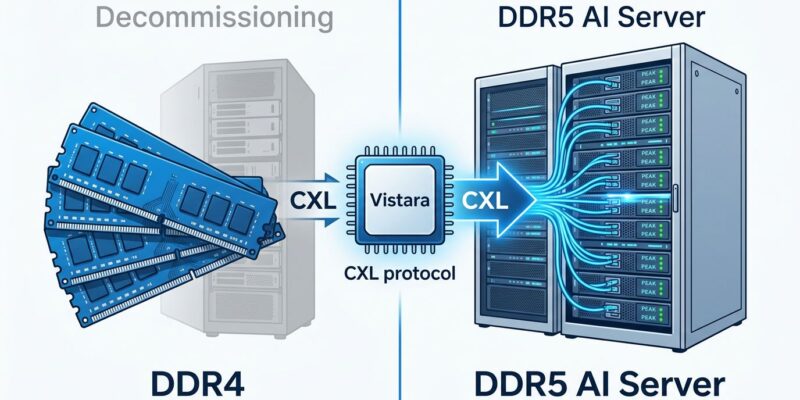
Meta’s custom Vistara ASIC — a CXL 2.0 memory expander chip built entirely in-house — is already running across millions of production servers, pulling DDR4 memory from decommissioned machines and putting it to work inside new DDR5-only AI infrastructure. Presented at ISCA 2026 on June 27, the results from production are concrete: AI inference server counts dropped by up to 25%, out-of-memory job failures fell 33%, and distributed cache latency improved by 29%. Memory, it turns out, outlives the machines it came from.
The Memory Mismatch Behind Vistara
Around 40% of Meta’s server fleet couldn’t expand memory — not because memory was unavailable, but because the wrong generation was available. Server hardware has a three-to-five year service life. Memory is useful for seven to ten years. When Meta’s DDR5-only AI servers arrived, vast quantities of perfectly functional DDR4 DIMMs had nowhere to go.
The economics made the problem worse. The ongoing memory shortage has DRAM demand growing at 35% per year against 16% supply growth, with prices up roughly 30% in 2026 and no supply relief forecast before 2027. Simply buying more DDR5 to expand AI infrastructure was expensive and constrained by availability. Meta needed a different answer — and it built one in silicon.
How Vistara Bridges DDR4 and DDR5
Vistara is a CXL 2.0 Type-3 memory expander ASIC. Each chip integrates two independent 72-bit DDR4 memory channels, supports speeds up to 3,200 MT/s, and can hold up to 256 GB using 64 GB DIMMs. The chip connects to host servers via a PCIe Gen5 x16 interface and is driven by custom RISC-V processors. Each production MemServer pairs a 158-core AMD EPYC Turin CPU with 768 GB of native DDR5-6400 and two Vistara ASICs carrying 256 GB of DDR4 — nearly 1 TB of total memory per server.
The Linux CXL driver presents DDR4 as a “distinct, CPU-less NUMA node” separate from the local DDR5 pool. Meta’s Transparent Page Placement (TPP) software layer handles data routing: latency-sensitive applications see CXL memory disabled entirely, while cold pages and batch inference buffers get routed to the DDR4 pool. The OS manages memory tiers without application-level changes.
The Performance Trade-off That Makes This Work
CXL-attached DDR4 carries a real bandwidth penalty. DDR5-6400 delivers around 614 GB/s; DDR4-2400 via CXL lands at roughly 76 GB/s — about ten times lower. Latency is approximately 60% higher than local DRAM. For any workload where bandwidth is the bottleneck, this is a disqualifying trade-off.
However, for memory-capacity-constrained workloads, the math inverts. Embedding tables in recommendation systems need enormous memory pools but don’t push bandwidth limits. Distributed caches suffer more from out-of-memory evictions than from DDR4-level latency. In production, Meta measured a 29% improvement in cache latency — not despite the slower DDR4, but because eliminating OOM-driven restarts and cache fragmentation outweighed the raw memory speed difference. The right workloads see gains. The wrong workloads should never touch CXL memory, and Meta’s TPP layer ensures they don’t.
The same logic applies across Meta’s other deployed workloads: big data processing, databases, CI/CD build systems, and distributed inference. None push DDR5-class bandwidth requirements. All benefit from expanded capacity.
Linux Kernel Contributions and What Comes Next
The Vistara story doesn’t end at Meta’s data centers. All Linux kernel CXL driver code used in the deployment is either already upstream or actively being contributed to the kernel codebase. Meta has validated CXL memory disaggregation at hyperscale in production, and the kernel infrastructure that makes it work will be available to everyone.
Meta is not alone in this direction. Google and NVIDIA are exploring CXL memory architectures. The CXL memory market is estimated at $1.8–2.5 billion in 2026, growing as AI infrastructure demand outpaces DRAM supply. Commercial CXL memory modules from Samsung and SK Hynix are already available, and CXL 3.0 — which enables memory pooling across multiple hosts — pushes the architecture further. What Meta proved at scale this year, smaller organizations will be able to implement as the ecosystem matures.
Related: SK Hynix’s $28B Nasdaq IPO: What Developers Must Know
Key Takeaways
- Meta’s Vistara ASIC bridges DDR4 and DDR5 via CXL 2.0, deployed across millions of production servers as of June 2026
- Production results are verified: 25% fewer AI inference servers, 33% fewer OOM failures, 29% lower distributed cache latency
- CXL DDR4 bandwidth is roughly 10x lower than local DDR5 — it is a new memory tier, not a drop-in replacement; workload selection is critical
- Meta’s TPP software layer manages memory placement automatically, routing cold data and batch inference loads to DDR4 while protecting latency-sensitive workloads
- All Linux kernel CXL driver code is being upstreamed, meaning the broader ecosystem will benefit from Meta’s production validation