
 By ByteBot
Liquid AI dropped LFM2.5-24B-A2B this week — a 24-billion-parameter open-weight reasoning model that activates only 2.45 billion parameters per token. That design choice is the whole story: it runs at 184 tokens per second on an Apple M5 Max, fits inside 16 GB of memory, and beats Qwen3.6-35B-A3B on five out of eight agentic tool-use benchmarks. The weights are free to download today.
A Sparse Architecture Built for Developer Hardware
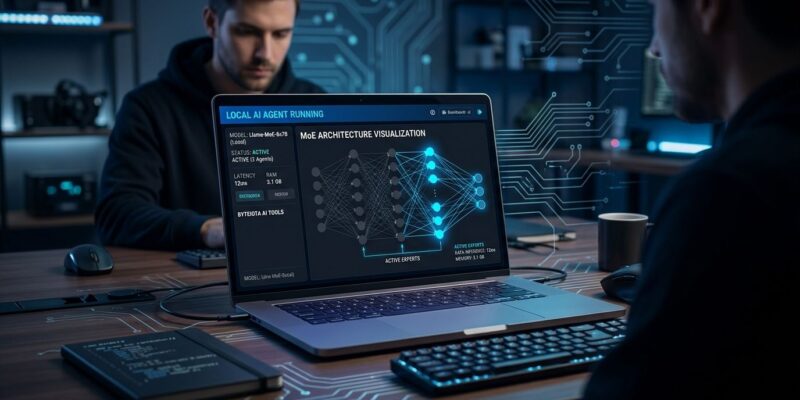
LFM2.5-24B-A2B uses a mixture-of-experts (MoE) design with 64 experts per block and top-4 routing — meaning only about 2.45 billion of its 24 billion parameters activate for any given inference pass. The model stacks 40 layers: 30 gated short convolution layers plus 10 grouped-query attention layers. Context window is 131,072 tokens. Vocabulary: 128,000 entries.
The practical result is a memory footprint of 15–16 GB, compared to 22–23 GB for Qwen3.6-35B-A3B on the same hardware. It decodes 56% faster than Qwen on an M5 Max (184 vs 118 tokens per second). If you have a Mac with 32 GB of unified memory, this model runs on it without configuration gymnastics.
Where It Wins and Where It Does Not
Liquid trained LFM2.5-24B-A2B specifically for tool calling and multi-step agent workflows, and the benchmarks reflect that focus. On AutomationBench it scores 27.69 — more than three times the next competitor. On LiveClaw it hits 48.09 against Qwen’s 38.19. On BFCLv4 the gap essentially disappears: 65.01 vs 65.00. Instruction following on IFEval comes in at 96.75 out of 100.
Coding is where the trade-off shows. On SWE-Bench Verified, LFM2.5-24B-A2B scores 51.0 against Qwen’s 66.2. If your agent workflow is primarily about writing or fixing code, Qwen wins that comparison. For knowledge-heavy tasks, Liquid’s own documentation recommends pairing the model with retrieval or web search — it is designed as an orchestrator, not a factual knowledge retrieval engine.
Community testing on Hacker News largely confirms the benchmarks: fast inference, solid tool calls on well-defined tasks, occasional stumbles on complex chained tool sequences. One developer reported 200–320 tok/s on a 5070 Ti with 131K context via llama.cpp. Another found it inconsistent when used as a planner in multi-agent pipelines. Benchmarks and real use cases align: this model is built for executing well-defined tool-calling tasks, not open-ended reasoning chains.
How to Run LFM2.5-24B-A2B
The fastest path on any platform is llama.cpp with the official GGUF checkpoint:
llama serve -hf LiquidAI/LFM2.5-24B-A2B-GGUF:Q4_K_MThat downloads the Q4_K_M quantized version (~14.5 GB) and starts a local server. On Apple Silicon the MLX 4-bit version (~13.6 GB) is faster. For Python integration, the model works with Hugging Face Transformers 5.0+ using standard AutoModelForCausalLM loading with device_map="auto" and dtype="bfloat16". You will need a free Hugging Face account and must accept Liquid’s license terms before the download starts.
If you do not want to run it locally, it is available via API on OpenRouter and nine other providers at $0.05 per million input tokens and $0.70 per million output tokens.
Why This Matters Now
Developer AI infrastructure in 2026 is moving toward local inference. Enterprise on-premise inference has grown from 12% of workloads in 2023 to 55% today, driven by cost (local inference is roughly 18x cheaper per token once hardware is amortized over 18–24 months) and by compliance requirements that prohibit sending data to third-party APIs.
The model size gap has been the bottleneck: 8B models are fast but not reliable enough for complex tool use; 70B models handle complex tasks but need server hardware. LFM2.5-24B-A2B sits in that gap — large enough for serious agentic workflows, small enough for a developer workstation. The sparse MoE architecture is how Liquid threads the needle: 24B parameters at rest, 2.45B in motion.
Liquid AI has now released 52 LFM models since founding in 2023. This is their largest on-device model to date. The official announcement includes the full benchmark breakdown and architecture details.


