 By
By Amazon Q Developer is dead. AWS killed new signups in May, locked its best models behind Kiro starting May 29, and put a hard end-of-support date on the calendar: April 30, 2027. In its place is Kiro, an agentic IDE that shipped version 1.0 on June 25. This is not a Q Developer upgrade, and it is not another Cursor clone. Kiro is structurally different — and developers who try to use it like a prompt-driven tool will bounce hard off what it actually requires.
The Spec Comes First. Always.
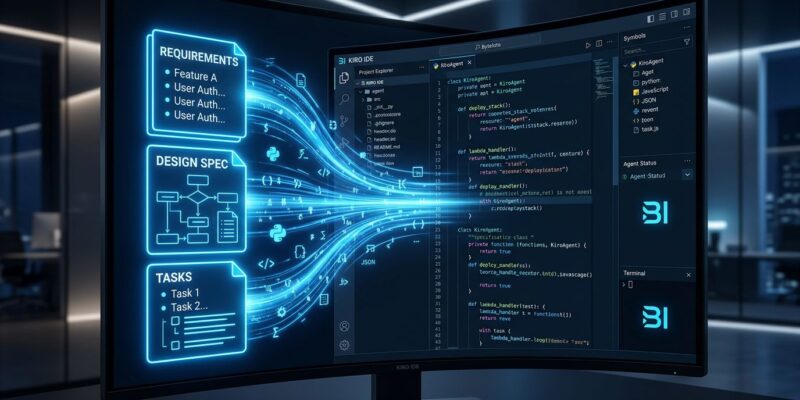
Every AI coding tool on the market lets you open a chat, describe what you want, and watch code appear. Kiro does not work that way. Before any code generation begins, Kiro requires three documents: a requirements.md capturing functional and non-functional requirements in structured natural language, a design.md describing architecture and component relationships, and a tasks.md breaking implementation into discrete, agent-executable steps.
This is not bureaucracy for its own sake. The spec requirement forces architectural decisions to happen before code exists — which is exactly when they are cheapest to make. Community feedback from teams using Kiro in production consistently says the same thing: design mistakes that would have surfaced in code review or production get caught at the requirements stage instead. One drug discovery team shipped a production agent in three weeks with three developers, with Kiro generating over 95% of the business logic code. The spec was the reason that scale was possible without chaos.
The downside is real: if you need a one-line fix or a quick script, generating three documents first is friction you do not want. Kiro supports freeform chat for small tasks. But the spec workflow is the product, and teams that resist it are missing the point.
Hooks: Where the Productivity Gap Opens
Once specs exist and code starts flowing, Kiro’s agent hooks become its most underrated feature. Hooks are event-driven automations stored as JSON in .kiro/hooks/ that fire on file saves, git commits, PR opens, spec task completions, and manual triggers. Practical examples from the official hooks documentation:
- Save a React component and the associated test file updates automatically with new cases for changed props and functions
- Modify an API endpoint and the README regenerates with updated parameter docs and response schemas
- A pre-commit hook scans for hardcoded credentials before anything reaches version control
- Update
design.mdand affected task entries intasks.mdcascade accordingly
Creating hooks does not require writing JSON by hand. In IDE 1.0, you can describe the automation in natural language — “when I save a Python file, scan for security vulnerabilities” — and Kiro generates the configuration. This removes the last significant barrier to adopting hooks for teams that were not ready to write JSON.
This is where Kiro pulls meaningfully ahead of tools that require you to manually prompt for every repetitive task. The hooks system makes your quality standards automatic rather than aspirational.
What IDE 1.0 Actually Ships
The June 25 release is the maturity milestone. Three additions in 1.0 change the day-to-day experience:
Agent Focus Mode (experimental) lets you direct multiple parallel agents from a single chat-first layout. You can launch sessions that work independently and in parallel, watch file changes appear as inline diffs, and start from structured workflows — Spec, Plan, Bug Fix, Quick Spec — or drop into freeform chat.
Capability-based permissions evaluate every file read, shell command, and MCP call against your defined rules. Kiro prompts for consent on anything you have not pre-approved and builds your policy incrementally from those decisions. No configuration required to start; the defaults are reasonable and your rules accumulate as you work.
Natural language hook creation rounds out the release. Describe what you want automated, Kiro generates the hook config.
The Migration Timeline Is Not Comfortable
If you are running Amazon Q Developer in production, the calendar is not your friend. New signups stopped May 15. The latest models — Opus 4.8 — became exclusive to Kiro on May 29, so Q Developer users are already running degraded model access. End-of-support hits April 30, 2027.
Twelve months sounds like time. Enterprise tooling migrations do not actually take twelve months — they take however long it takes plus six months of surprises. Teams that wait until late 2026 to start evaluating Kiro will be migrating under pressure. Start now, run Kiro in parallel on new features, and build familiarity before the forced transition.
Where Kiro Fits vs. the Field
The most common production AI coding stack in 2026 is three tools doing three different jobs: Cursor for daily editing and quick fixes, Kiro for planning and speccing new features, and Claude Code for complex autonomous operations spanning multiple repositories. They are not competing — they are covering different modes of work.
Kiro beats Cursor on structure and compliance. Cursor beats Kiro on raw speed — eight parallel agents at sub-200ms completions — and ecosystem maturity. Kiro and Claude Code are complementary: use Kiro’s spec workflow to plan a feature, then hand off to Claude Code for the large multi-file build.
Kiro is not the right tool for every task. It is the right tool for new feature work where architectural mistakes are expensive — which is most of the work that actually matters.
The Bigger Picture
Kiro’s spec-driven approach is not a quirk. It reflects where the industry is heading. Prompt-first, iterate-until-it-works has a ceiling: it produces code that solves the immediate problem and creates the next one. Structured specifications create a trail — requirements traceable to design, design traceable to tasks, tasks traceable to code — that teams can actually maintain and audit.
Kiro 1.0 is not perfect. The spec workflow has real overhead, the ecosystem is newer than Cursor’s, and the forced migration from Q Developer leaves a bad taste. But the underlying methodology is sound, and it is the most complete implementation of spec-driven agentic development available today. Worth evaluating now, before the April 2027 deadline turns evaluation into a scramble.