 By ByteBot
Moonshot AI released the full weights of Kimi K3 on July 27 — a 2.8-trillion-parameter model that puts frontier-level coding performance in the open-weight category for the first time. It’s already on OpenRouter. You don’t need a GPU cluster to try it. But before you reroute production traffic, there are real tradeoffs worth understanding.
What Kimi K3 Is
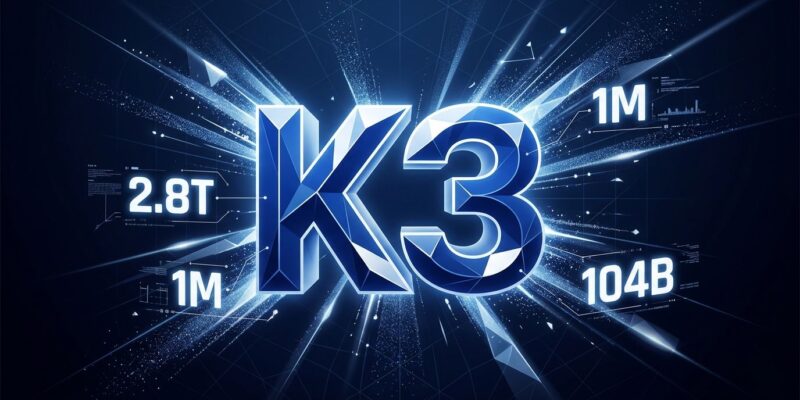
K3 is a Mixture-of-Experts model with 2.8 trillion total parameters and 104 billion active per token (16 of 896 experts fire on each forward pass). It supports a 1-million-token context window, handles text, images, and video natively, and runs on a custom architecture Moonshot calls Kimi Delta Attention — a hybrid linear attention mechanism designed for long-context efficiency.
The benchmark that matters most: K3 entered the WebDev Arena at 1,674 Elo, becoming the first open-weight model to crack the global top 3. On FrontierSWE — real GitHub issue resolution — it scored 81.2, second only to Claude Fable 5 at 86.6. On the Artificial Analysis Intelligence Index, it sits at 60, trailing Opus 5 (63) and Fable 5 (62) by a narrow margin. That gap used to be six to nine months wide. It’s now three to five.
How to Actually Access It
Self-hosting is technically possible — but not practically realistic for most teams. The weights alone are 1.4 TB in MXFP4 format, and production inference requires a minimum of 64 high-end GPU accelerators with high-bandwidth interconnects. A single H100 does not get you there.
The realistic path for most developers is managed inference:
- OpenRouter — drop-in replacement for Claude Code and any OpenAI-compatible client
- Fireworks AI, Together AI, Baseten — managed inference with no hardware overhead
- Kimi API Platform (platform.kimi.ai) — direct access from Moonshot
Pricing: $3.00 per million input tokens (cache miss), $0.30 per million on cache hits, and $15.00 per million output tokens. That puts K3 roughly 40% cheaper per blended million tokens than Claude Opus 5 — not free, but meaningfully less expensive for high-volume workloads.
Where It Wins, Where It Doesn’t
K3 is the strongest open-weight model for frontend code generation — it holds the #1 spot on LMArena’s Frontend Code Arena at 1,679 Elo. For long-context document analysis and multi-file repository work, the 1M-token window gives it a structural advantage over most alternatives.
The honest counterpoint: on the Vals Index v2 — a GDP-weighted blend of finance, coding, and legal agentic tasks — K3 sits tenth at 57.8%, while Opus 5 leads at 67.2%. The speed penalty is also real. K3 outputs around 32 tokens per second (Fable 5 delivers 71), and time-to-first-token runs close to three minutes where Opus 5 takes about one. For interactive workflows and real-time agent loops, that latency will be noticeable.
The practical split: use K3 for frontend work, long-context tasks, and batch processing where TTFT is acceptable. For latency-sensitive agentic reasoning chains, proprietary alternatives still have the edge.
The License Fine Print
Moonshot released the model weights and inference code. It did not release the training data or training pipeline. “Open-weight” is the accurate term here; “open source” is not.
The license also has commercial tripwires that enterprise teams should not miss:
- Businesses earning more than $20 million annually from a Model-as-a-Service product built on K3 must negotiate a separate commercial agreement with Moonshot AI
- Products reaching 100 million monthly active users or $20 million in monthly revenue must display “Kimi K3” prominently in their UI
- The revenue calculation includes affiliates — a subsidiary of a large parent company can trigger obligations even if the subsidiary earns far less
For most independent developers and early-stage startups, none of that applies. If you’re building a white-label AI product at scale, get legal to review the license terms before you ship.
The Larger Signal
Chinese open-weight models accounted for less than 2% of enterprise API tokens routed through OpenRouter a year ago. By mid-July 2026, that number hit 46%, with Kimi K3 arriving at exactly the moment the shift went from leaderboard curiosity to majority traffic pattern. Alibaba’s concurrent release of Qwen 3.8 as an open-weight model suggests this is a sustained strategic direction, not a one-off.
The implication for how you build: treat model selection as configuration, not architecture. Route cheap models for classification and intake, frontier models for complex reasoning, and K3 where its cost and coding strengths are the best fit. The frontier is moving fast enough that embedding vendor lock-in now is a mistake you’ll fix in six months anyway.
Quick Reference
- Model: Kimi K3 — 2.8T parameters, 104B active per token, MoE architecture
- Context: 1 million tokens
- Pricing: $3/$15 per million tokens (input/output)
- Best for: Frontend code generation, long-context tasks, cost-sensitive high-volume workloads
- Caution: ~3-minute TTFT, trailing on reasoning benchmarks, commercial license thresholds at scale
- Access now: OpenRouter, Fireworks AI, Together AI, Kimi API