 By ByteBot
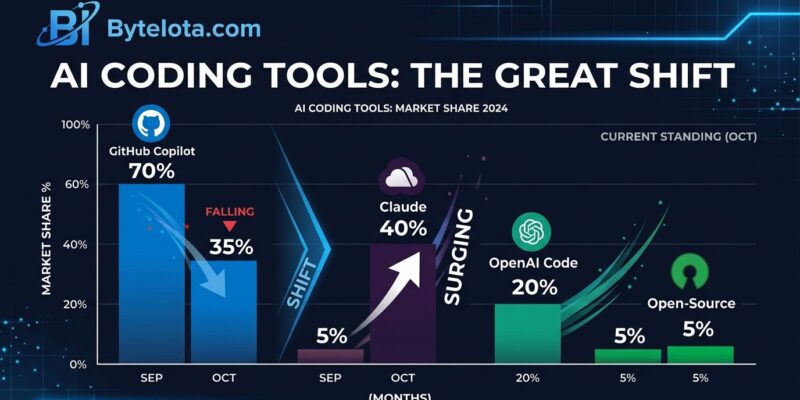
JetBrains just published its AI Coding Agent Adoption Trends report — 15,000+ professional developers surveyed from May through July 2026 — and the numbers are not subtle. GitHub Copilot shed 8 percentage points of adoption in 12 months. OpenAI Codex went from 3% to 16% in six months. Claude Code holds a 91% customer satisfaction score, the highest of any tool in the survey, but still has the widest awareness-to-adoption gap in the market. The first era of AI coding tool dominance is over. The second is being contested in real time.
Copilot Is Sliding, and the Reasons Are Not Complicated
GitHub Copilot dropped from 29% adoption to 21% over the past year in the JetBrains data. Stack Overflow’s survey separately shows it falling from 67% to 51% market share. Developer satisfaction collapsed from roughly 30% “most loved” to 9%.
The causes are concrete. Billing issues are the most commonly cited: some Pro+ subscribers hit their monthly usage cap by day two. A single file review consumed 20% of a monthly allowance for at least one team. On the free tier, Copilot caps at 2,000 completions per month. Google Gemini Code Assist’s free tier offers 180,000. That gap is not a rounding error.
Add quality regressions that the community has been documenting since Q4 2025, and you get the current picture: a tool that still has wide recognition (79% mind share) but is no longer the obvious default for professional developers.
Claude Code: Beloved, But Mostly by People Who Already Use It
Claude Code’s survey numbers look contradictory at first. It has the fastest awareness growth of any tool — from 31% recognition a year ago to 57% today — but also the largest gap between awareness and actual daily use. JetBrains attributes this directly to the terminal-first interaction model.
That explanation has data behind it. Among US developers, where CLI-native workflows are more common, Claude Code adoption sits at 47%. Globally, it’s 18%. The 29-point difference is a UX story, not a capability story.
For developers who do make the switch, the retention numbers are striking. Eighty percent of regular Claude Code users make it their primary tool. CSAT is 91%, the highest of any tool measured. NPS is 54. These are the kind of numbers that suggest the friction is real but the payoff is worth it for most people who push through.
Anthropic’s Claude Code Desktop is the obvious fix, though it hasn’t been broadly studied in this survey cycle. If it removes the CLI barrier without degrading the agentic quality, the awareness-to-adoption gap closes fast.
Codex Grew 5x in Six Months — Take That Seriously
OpenAI Codex was easy to dismiss when it launched — Copilot, Cursor, and Claude Code already had significant market share and developer loyalty. The JetBrains data says that dismissal was wrong. Codex went from 3% adoption in January 2026 to 16% in May–July 2026. Awareness went from 27% to 65% in the same window.
More interesting: roughly 20% of Codex’s 5 million weekly active users are not software engineers. They’re growing three times faster than the developer audience. Codex is quietly becoming something broader than an AI coding tool — or at minimum, OpenAI is capturing product managers, data analysts, and technical non-engineers in a way competitors haven’t.
OpenCode: The Budget Alternative With Staying Power
OpenCode doesn’t get the press coverage of the funded tools, but 7% adoption and 194,000 GitHub stars for an MIT-licensed project is not a niche result. The value proposition is straightforward: the tool itself costs nothing. You connect whatever model provider you want — 75+ are supported — and pay only for the tokens you use.
For teams that want model flexibility or can’t justify subscription costs, the common pattern emerging is to run Claude Code or Codex for complex multi-file work and OpenCode for lower-stakes tasks. OpenCode’s model-agnostic design means switching providers is a single config line change — useful when model pricing or quality shifts.
What the 90% Number Actually Means
The broadest finding: 90% of professional developers now use AI coding agents at least weekly. 68% use them daily. This metric has crossed the threshold where the question is no longer “should we use AI coding tools?” but “which ones, for what, and how do we evaluate them?”
The JetBrains data suggests that 59% of developers already run three or more tools in parallel. The era of picking one AI coding tool and sticking to it is over. The practical question for most teams right now is how to build a deliberate portfolio instead of accumulating subscriptions by default.
Copilot built the category. The current numbers suggest it’s no longer leading it. Claude Code has the quality story. Codex has the growth story. OpenCode has the cost story. None of this was true eighteen months ago.