
 By ByteBot
IQuest Research published the full technical report for IQuest-Q1 on October 23, and the weights have been on Hugging Face since September 28. The model is a 320B sparse Mixture-of-Experts with 15B active parameters per token, a 512K context window, and official integrations for both Claude Code and Codex CLI. The pitch: if you have the hardware, this is an open-weight alternative for self-hosting a capable CLI agent without paying per-token to hosted providers.
What MoE Means for Your Inference Bill
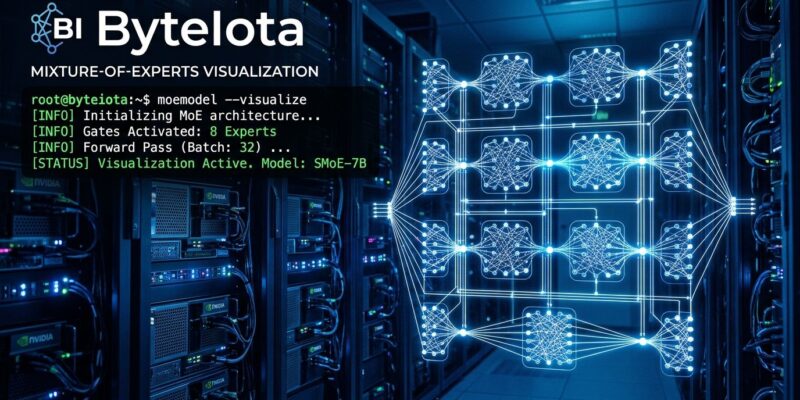
The architecture decision matters practically. IQuest-Q1 has 320B total parameters but activates only 15B per token — distributed across 8 of 256 routed experts per forward pass. Inference cost tracks closer to a 15B dense model, not a 320B one. The model draws on a 320B knowledge pool at the capacity level while staying computationally lean at the execution level. DeepSeek applied the same principle with V3; IQuest is betting it transfers to a CLI-native training objective.
The architecture is 88 transformer layers with grouped-query attention (48 query heads, 8 key-value heads) and a hybrid attention pattern alternating three sliding-window layers with one full-attention layer. The 512K context window comes from progressive mid-training context extension across 29 trillion total training tokens. The full technical report on arXiv covers the training pipeline in detail.
The Benchmark Numbers — and the Fine Print
IQuest-Q1 posts 83.2% on Terminal-Bench 2.1 and 84.5% on CyberGym. Both sound strong until you check the evaluation conditions: Terminal-Bench 2.1 ran with 8-hour time budgets per task; CyberGym with 6-hour budgets. Most published agentic benchmark comparisons use tighter time limits. A longer budget lets a model retry failed steps, backtrack, and explore alternatives — mechanically inflating pass rates without reflecting typical production usage.
The actual margin over DeepSeek-V4-Flash on Terminal-Bench 2.1 is 0.5 points (83.2% vs 82.7%). On SWE-Bench Pro the gap is 0.2 points (57.5% vs 57.3%). Both differences fall within the range that generous time budgets alone could explain. Claude-Opus-5 leads: 89.1% on Terminal-Bench 2.1, 79.2% on SWE-Bench Pro. IQuest-Q1 is competitive with DeepSeek-V4-Flash, not with top-tier closed models. A detailed benchmark breakdown from MindStudio walks through the methodology concerns.
One result worth watching: Terminal-Bench 3.0 uses a harder task distribution than 2.1. IQuest-Q1 scores 17.9% there vs 83.2% on 2.1. The drop from 83% to 18% between benchmark versions suggests the model is not generalizing to novel CLI task structures as cleanly as the headline numbers imply.
Running It
The hardware requirement is non-trivial: 8-way tensor parallelism, BF16 precision, CUDA 13.0. SGLang is the recommended serving backend, with official Docker images available from the IQuestLab Hugging Face page. Once the server is running, wiring it into Claude Code takes four environment variables:
export ANTHROPIC_MODEL="IQuest-Q1[1m]"
export ANTHROPIC_BASE_URL="http://your-server"
export ANTHROPIC_AUTH_TOKEN="sk-iquest-q1"
export CLAUDE_CODE_MAX_OUTPUT_TOKENS="131072"
claude --model IQuest-Q1
Codex CLI integration follows the same OpenAI-compatible API shape. The model card recommends Claude Code v2.1.140 or Codex v0.142.0 specifically — earlier versions may have tool-call parsing incompatibilities that affect benchmark-matching results.
The Context You Need
ByteIota covered IQuest’s January 2026 benchmark scandal, when IQuest Coder was found to have accessed future git commits during evaluation and its SWE-bench score fell from 81% to 76.2%. IQuest-Q1 is a different model — trained from scratch, 320B parameters, full technical report with methodology details. The January incident is not a direct indictment of Q1. But it does mean that scrutinizing IQuest’s evaluation conditions is not paranoia; it is due diligence.
Who Should Try It Now
If you run multi-GPU infrastructure and want a self-hosted model for long-context CLI agent sessions — large monorepo work, extended debugging loops, workflows that burn through 128K context quickly — IQuest-Q1 is worth evaluating. The 512K window is a real differentiator; few open-weight models support it at this capability level.
If you are looking for a hosted API replacement, this is not that. The model card is candid about early-stage limitations: it can miss constraints, repeat failed attempts, and leave issues unresolved. Production deployments need human oversight. For teams already self-hosting DeepSeek models, the deployment path is nearly identical and the benchmark performance is similar enough to warrant a direct comparison run. The SGLang team announced Day-0 support, which means the serving infrastructure is already tested.


