 By ByteBot
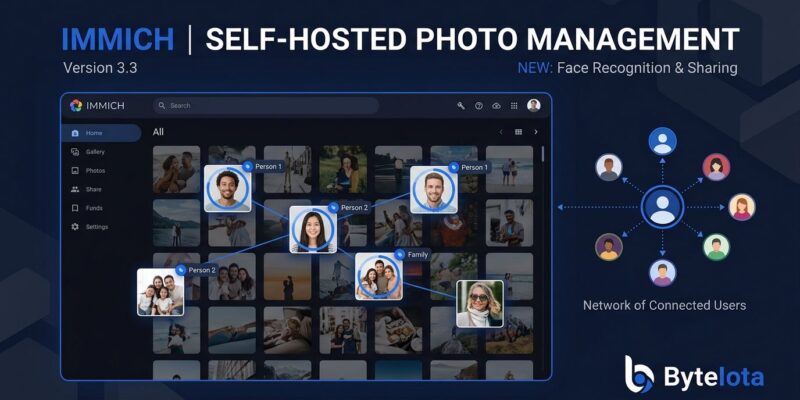
Immich 3.3.0 shipped October 7 with the feature self-hosters have been demanding since shared albums launched: cross-user people sharing. You can now share recognized faces with other users in your cluster group, merge face data across accounts, and manage names and birth dates collaboratively. That alone earns this release attention. But the bigger news is quieter — an opt-in environment variable that delivers meaningfully faster machine learning inference with no need to re-scan your library.
People Sharing Is Here, With One Caveat
Shared people now appear in both users’s asset viewers and people lists. Both users can edit the person’s name and birth date, with changes defaulting to “Everyone with shared access” — you can restrict updates to yourself if needed. Cross-user face merging works too: you can link faces identified in different users’ assets and treat them as the same person across the whole cluster.
The caveat is that sharing is unidirectional. If you share “Grandma” with your partner, that does not automatically make your partner share her back. Families running multi-user Immich instances need to set up sharing in both directions manually. A 3.3.1 patch shipped October 8 fixing a related UI bug where newly-added partners had no visible delete button — upgrade to 3.3.1 if you have not already.
For families that have been re-identifying the same faces across multiple accounts, this closes a real functional gap between Immich and Google Photos. It is not seamless yet, but it is here.
Enable MACHINE_LEARNING_MODEL_REVISION=v2
This is the change worth making immediately. Add one line to the environment block of your immich-machine-learning service:
MACHINE_LEARNING_MODEL_REVISION=v2The v2 models are faster and use less memory. The outputs are numerically equivalent to v1, so you do not need to re-run facial recognition, CLIP, or any other ML job on your existing library. It affects every backend: CPU inference, GPU, RKNPU (Rockchip), and TensorRT. For Ampere-generation NVIDIA GPUs (RTX 30xx and newer), TensorRT RTX support is now included, which is a significant performance win for home lab setups.
A community member in the Immich 3.3 discussion thread processed 11,000 assets in roughly 23 minutes with dramatically lower GPU utilization after switching. The variable will become the default in a future release — there is no reason to wait.
One important note: this was undocumented in 3.3.0. The docs PR landed in the 3.3.1 patch. If you upgraded on release day and missed it, you have something to do right now.
PP-OCRv6, Better Thumbnails, Birthday Memories
The OCR engine upgrades to PP-OCRv6, replacing v5. Three variants are available — tiny, small, and medium — with meaningfully better multilingual text detection. Worth switching in Administration > Machine Learning if you use Immich text search on documents or screenshots.
Image thumbnails and previews now use linear-light resampling, which preserves detail and brightness more accurately in high-contrast areas. Birthday memories is a new automatic feature: when it is someone’s birthday in your library, Immich surfaces a memory collection of photos from previous birthdays. One quirk: the memories generate in advance, so a birthday that falls today will not trigger until next year unless you manually regenerate memories.
OAuth Sync Is Now On by Default
If you run Immich with an external identity provider — Authentik, Keycloak, or similar — storage quotas, user roles, and preferred usernames now sync from your IDP on every login. This is a behavior change. User management can now flow entirely from your IDP without touching the Immich admin panel. The sync only fires when your IDP actively sends the relevant claims, so existing quotas will not be wiped unexpectedly. This cannot be disabled, so review your IDP claim configuration before upgrading if you run a tightly-controlled deployment. If you are still piecing together your self-hosted auth stack, unified auth for self-hosting is worth reading first.
That Three-Year-Old macOS Docker Bug
Issue #4318 — the oldest open issue in the Immich repository at the time — is resolved. Docker on macOS was using incorrect block size calculations, causing storage usage to display values off by up to a factor of 4096. If you have been running Immich on macOS with Docker Desktop and your storage widget looked wrong, it was. It is fixed now, with some caveats for non-standard filesystem configurations.
The complete details are in the official Immich 3.3.0 release blog and the full changelog on GitHub. Forty-eight contributors shipped this release, 21 of them for the first time.