 By ByteBot
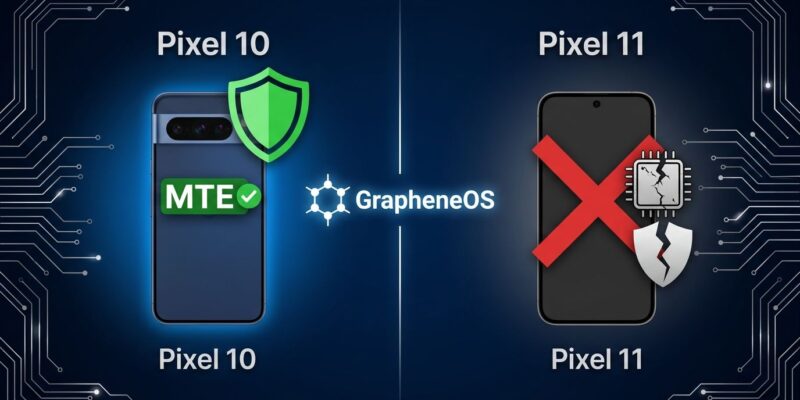
GrapheneOS announced on August 29 that it may skip the Pixel 11 entirely — because Google quietly removed ARM Memory Tagging Extension (MTE) from the Tensor G6 chip. Leaked internal documents later confirmed what the bootloader forensics already suggested: MTE was planned for Pixel 11 and deliberately cut, almost certainly to reduce chip manufacturing costs. For GrapheneOS, which integrates MTE throughout its kernel and hardened memory allocator, there is no workaround. Without functional hardware support, the security architecture simply does not work.
Google’s Deliberate Cut, Documented
This was not a missed feature or a disabled toggle. Internal Google “gChips” documents — leaked and reported by Notebookcheck — show MTE listed as a “top-priority feature” in the Tensor G6 architecture plans, with revision history tracing back to May 2022. At some point during development, the entry was struck through in red. Deliberately removed.
The bootloader forensics are even more damning. Pixel 10’s bootloader contains extensive MTE references: “gs_mte_enable,” debug messages, hidden fastboot commands. Pixel 11’s bootloader, by contrast, has been completely scrubbed of all such traces — code-level deletion, not deactivation. When a feature is disabled, you see stubs and conditionals. When it is deleted, the code is simply gone. Pixel 11 chose deletion.
Google has offered no public explanation. Even after GrapheneOS called this out on August 29 — and after the leaked documents surfaced — Google remained silent. That silence is its own statement.
Related: Google Kills Bug Bounty: AI Slop Breaks Open-Source Security
Why ARM MTE Is Non-Negotiable for GrapheneOS
ARM Memory Tagging Extension works by assigning a 4-bit tag to every 16-byte memory block, with a matching tag on every pointer that references it. On each memory access, hardware verifies the tags match. A mismatch means the pointer is accessing memory it should not — a use-after-free bug or a buffer overflow — caught at the hardware level before it becomes exploitable. This is the class of vulnerability behind most high-severity CVEs and the majority of serious Android exploits.
GrapheneOS has built MTE into its core since Pixel 8 in 2023. The hardened malloc tags and validates every heap allocation. The kernel integrates MTE across memory paths. System processes run with tagging enabled in production mode — not just as a developer diagnostic tool. MTE is not a feature GrapheneOS can simply disable and ship anyway; it is the foundation of the memory safety guarantee that differentiates it from stock Android.
As GrapheneOS stated in its August 29 announcement: “It appears Google cut an important security feature to reduce costs. We strongly recommend against buying Pixel 11 devices. Pixel 8, 9 and 10 have much better overall security for GrapheneOS, with Pixel 10 being cheaper with similar hardware and MTE.”
The Twist: Crippled, Not Gone
In September, GrapheneOS updated its analysis: “We have good news about the Pixel 11. It still has at least bare minimum support for MTE at a hardware level. We think they removed most of the hardware acceleration from the CPU cache to save money. They ruined the performance so it ended up being fully disabled in firmware.” The working hypothesis is that Google did not strip MTE silicon entirely, but removed the cache-level acceleration that makes MTE practical. Without it, performance penalties — up to 6.64x in strict mode — made firmware enablement untenable.
Testing with Android 17 QPR2 Beta 4 shows MTE in asymmetric mode carries approximately 5% overhead on Pixel 11. That may be workable. GrapheneOS is evaluating whether Pixel 11 support is viable under that constraint. However, there is no commitment and no timeline. The situation remains exploratory, and the current recommendation stands: do not buy Pixel 11 expecting GrapheneOS support.
What to Do Now
If you are a GrapheneOS user considering an upgrade, buy a Pixel 10. It is cheaper, has full MTE, and is actively recommended by the GrapheneOS team. If you have already bought a Pixel 11 specifically for GrapheneOS, the project’s own advice is to consider returning it. For stock Android users, this matters less — Pixel 11 ships with the new Titan M3 security chip (RISC-V architecture, post-quantum cryptography) and seven years of security updates. The MTE gap is specifically a GrapheneOS concern.
Looking further out, GrapheneOS is exploring Motorola’s upcoming “Wukong” flagship (Qualcomm Snapdragon 8 Elite Extreme Gen 6), which includes MTE. Qualcomm, it turns out, still ships the features Google decided were not worth the cost.
Key Takeaways
- Google deliberately removed ARM MTE from Pixel 11’s Tensor G6 chip — leaked internal documents and bootloader forensics confirm this was not an accident
- GrapheneOS integrates MTE throughout its kernel and memory allocator; without hardware support, completing a proper port is technically impossible
- A twist: bare-minimum MTE hardware capability may still exist in Pixel 11, crippled by the removal of cache acceleration — GrapheneOS is testing asymmetric mode (~5% overhead) but has made no commitment to support
- Current recommendation: Pixel 10 for GrapheneOS users, not Pixel 11; stock Android users are largely unaffected due to Titan M3 and seven-year updates
- Google’s continued silence — no explanation, no acknowledgment — is the trust problem that outlasts the technical issue