 By ByteBot
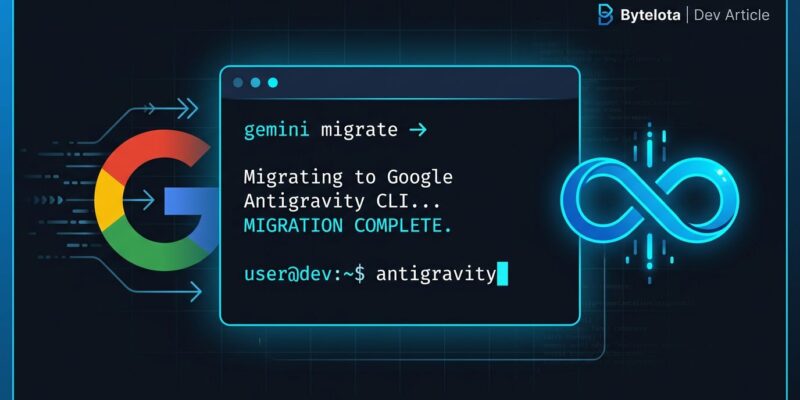
Gemini CLI stopped serving requests on June 18. If you woke up to broken CI pipelines, failed cron jobs, or automation scripts that suddenly couldn’t authenticate, Google’s forced migration to Antigravity CLI is your culprit. The replacement is faster, written in Go, and closed-source — and it’s missing a feature that every unattended workflow depends on.
Who Actually Needs to Migrate
This is where Google’s announcement buries the lede. If you use Gemini CLI with a free Google account, Google AI Pro, or Google AI Ultra, your access ended June 18. You need to switch to Antigravity CLI now.
If you’re on a Gemini Code Assist Standard or Enterprise license, or using a paid Gemini API key directly, nothing changed for you. You still have Gemini CLI access and can keep using it. The migration is optional and you can ignore most of this post.
Most individual developers fall into the first group. Most enterprise teams fall into the second.
How to Migrate (The Part That Actually Works)
The migration is three commands and four manual audits. Start with the install:
curl -sSL https://get.antigravity.dev | sh
agy auth login
agy plugin import gemini
The first command installs the Go binary. The second authenticates via browser OAuth — you must do this on a machine with a browser, not a server. The third migrates your Gemini CLI extensions into Antigravity plugins automatically, though workspace skill folders and inline MCP config in settings.json need to be moved manually since their canonical locations changed.
After that, audit your scripts for four breaking changes:
- Rename the environment variable.
GEMINI_API_KEYis nowAV_API_KEY. Every script, dotfile, and CI secret that sets the old variable is broken. - Default model changed. Antigravity CLI defaults to
gemini-3-proinstead ofgemini-1.5-flash. If your scripts relied on the lighter model for cost or speed, update the--modelflag explicitly. - Exit codes are stricter. Antigravity CLI returns non-zero exit codes on tool-use failures. If your CI scripts check exit codes, they may now fail on things that previously passed silently.
- The state directory moved.
~/.gemini/is now~/.antigravity/. Any paths hard-coded in scripts or configs need updating.
The Problem Nobody Is Documenting: Headless and CI
Here’s the thing Google isn’t saying clearly: Antigravity CLI has no headless mode, and no drop-in replacement for the google-github-actions/run-gemini-cli GitHub Action that many teams were using in CI.
Gemini CLI authenticated in headless environments by reading an environment variable — no browser needed, no OAuth flow. Antigravity CLI requires a browser OAuth session on first run. That’s fine on a developer laptop. It’s a hard blocker on a headless server, in a Docker container, or inside a GitHub Actions runner.
There’s a second issue that’s nearly impossible to find in the docs: agy --print (the flag for non-interactive output) drops the final response from stdout when run under a non-TTY. The tool changes behavior based on whether a human is watching the terminal. That behavior is fatal for unattended pipelines and barely mentioned officially. The New Stack’s feature comparison has the clearest breakdown of what’s missing at launch.
Google’s own comparison page lists headless mode as a Gemini CLI advantage with no Antigravity equivalent. If your workflows depend on this, hold off on migrating that part of your stack. The feature is on the roadmap but has no committed shipping date.
On the Open-Source Question
Gemini CLI was Apache 2.0 with 105,000 GitHub stars and contributions from more than 6,000 developers. Antigravity CLI is a closed-source Go binary. Google accepted thousands of community pull requests, pointed to community growth as evidence of success, then moved individual users to a proprietary replacement built on top of that community work.
The Linux Foundation flagged this exact pattern at Open Source Summit North America 2026. The Hacker News thread on the transition is titled “Google’s Antigravity bait and switch.” The reaction is proportionate. Free tier request limits also dropped from roughly 1,000 per day to approximately 20.
Antigravity CLI is genuinely faster (Go binary versus Node.js startup) and supports async agent workflows that don’t block the terminal. The capability improvement is real. The way Google handled the transition is not a model to follow.
Bottom Line
If you use Gemini CLI interactively on Pro or free, migrate now: three commands, four env variable audits, done. If you use Gemini CLI in headless or CI environments, do not migrate yet — Antigravity CLI will break those workflows and there is no supported workaround at launch. If you’re on Code Assist Enterprise, this doesn’t affect you.
The official Google migration announcement covers the basics. For what’s actually missing, the New Stack comparison is the most complete public resource right now.