 By
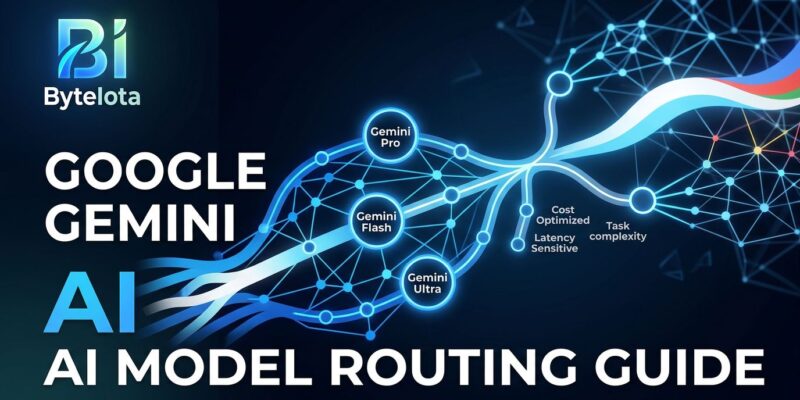
By Gemini 3.5 Pro is six days from launch — if July 17 holds. ByteIota covered the rebuild decision on July 8. This isn’t that story. This is the question that actually matters for your stack: when does it make sense to route traffic to Gemini 3.5 Pro, and when doesn’t it? Google rebuilt the model from scratch to close gaps in math reasoning, SVG generation, and image quality. Whether that gamble paid off shows up in six days. What you decide before the launch determines whether you extract value from it or end up debugging a production regression.
The One Thing That Makes Gemini 3.5 Pro Different
The 2M token context window. No GA competitor comes close: Claude Fable 5 tops out at 1M, GPT-5.6 Sol at 500K — and Sol still isn’t generally available as of this writing. If your workload fits inside 1M tokens, Gemini 3.5 Flash already covers you at a fraction of the cost. The 2M window matters specifically for these cases: entire large codebases in a single prompt, twelve months of meeting transcripts, multi-volume research datasets, or code review runs that span 50+ files and need cross-file reasoning without chunking artifacts.
Here’s the cost reality: at the reported (but unconfirmed) price of approximately $12–15 per million input tokens, a maxed-out 2M call runs you $24–30. That’s not prohibitive if the task justifies it. It’s extremely wasteful if Flash at $1.50/M would have done the job. The 2M number isn’t a novelty. It’s a specific capability for a specific class of problems.
Routing Decision Before the Model Card Ships
You already have enough information to make a preliminary routing call — even before Google publishes official benchmarks. Here’s how the frontier stack looks as of July 11:
- Gemini 3.5 Flash ($1.50/M input, 1M context): Default for agents, tool loops, MCP orchestration, and anything high-volume. Flash outperformed the previous Pro generation on terminal benchmarks in agent workloads. This is your baseline.
- Gemini 3.5 Pro (est. $12–15/M input, 2M context): Use when context exceeds 500K tokens, when math or SVG generation is the task, or when you need Deep Think reasoning for iterative multi-path analysis. The architectural rebuild specifically targeted these gaps.
- Claude Fable 5 ($10/M input, 1M context): Current leader on SWE-bench Pro at 80.3%. If software engineering is your primary workload and you want the most reliable coder available today, this is still the right call.
- GPT-5.6 Sol ($5/M input, 500K context): Best token efficiency for agentic tasks, but not GA yet. Wait.
The routing logic isn’t “replace Flash with Pro.” It’s “use Flash unless context or reasoning requirements push you to Pro.” For most production workloads, that ceiling never gets hit. A complete spec tracker for confirmed vs. reported Gemini 3.5 Pro capabilities is worth bookmarking before July 17.
Don’t Hardcode the Model ID
Google ships new models under a preview identifier before stabilizing the clean API string. Gemini 3.5 Pro will almost certainly arrive as gemini-3.5-pro-preview. Pointing your application directly at a preview ID is a deployment risk — Google can deprecate preview identifiers without a deprecation window.
# Risky: hardcoded to an unstable preview ID
model = "gemini-3.5-pro-preview"

# Better: read from environment, update once the stable ID ships
import os
import google.generativeai as genai

GEMINI_PRO_MODEL = os.environ.get("GEMINI_PRO_MODEL", "gemini-3.5-pro-preview")
client = genai.GenerativeModel(GEMINI_PRO_MODEL)
This costs you two minutes now and saves you a production incident later.
How to Access It on July 17
Google doesn’t announce model availability with press releases — it appears in the model picker. Watch aistudio.google.com directly. Enterprise Vertex AI customers on the allowlist will see it via the Model Garden around July 15; if you haven’t requested access through your Cloud account team, do it today. Broader GA for Gemini Advanced subscribers is expected July 22–28 based on Google’s typical rollout cadence. The official Gemini API changelog is the authoritative signal — the model card will appear there when the API is live.
Three Checks on Launch Day
When the model card drops, verify three things before committing any production traffic:
- Confirm the context window in the official docs — the 2M figure comes from third-party reporting, not Google documentation. Confirm it’s actually 2M before building workflows that depend on it.
- Check official pricing — all $12–15/M estimates circulating now are analyst estimates. The real number may be higher, lower, or split by context tier. Don’t budget on leaks.
- Run your workloads, not the benchmarks — Google’s numbers will look good. The question is whether the rebuilt model closes the math and SVG gaps on your specific tasks. Run a small evaluation batch on representative examples before routing real traffic.
Bottom Line
Gemini 3.5 Pro is worth testing — the 2M context window is genuinely unchallenged at the GA frontier tier, and if the architectural rebuild delivered on math reasoning and SVG, Google closes a real gap. But adopt selectively: Flash remains the right call for the majority of agent and tool-use workloads, Fable 5 remains the right call for software engineering tasks, and Pro earns its cost premium only when the problem specifically requires what it offers. Know which bucket your workload falls into before the model lands on July 17.