
 By ByteBot
Thomas Dohmke ran GitHub for four years. Then he left Microsoft, raised $60 million, and built a competitor. His startup Entire launched October 26 as what it describes as “the first Git forge built specifically for agent-human collaboration.” The argument is simple: pull requests were designed for humans reviewing human-written code. That era is over for a lot of teams, and the tooling should catch up.
GitHub’s Problem Makes This Pitch Land
Dohmke is not wrong about the infrastructure gap. GitHub logged 257 incidents between May 2025 and April 2026 — more than five per week — according to a detailed analysis by IncidentHub. Of those, 48 were major. GitHub Actions fell to 99.33% uptime after a single 8-hour outage in August 2026 burned through almost an entire year’s downtime budget in one afternoon.
In June 2026, Microsoft confirmed it was routing GitHub traffic through Amazon Web Services — its biggest cloud rival — after AI coding agent activity pushed the platform past its enterprise SLA thresholds. GitHub now processes 17 million AI-generated pull requests per month, a figure that has grown roughly 28-fold since mid-2025. Git’s architecture was designed in 2005 for human kernel developers committing measured, intentional changes. It was not designed for agent fleets making thousands of micro-commits in parallel.
Trails: The Pull Request Gets Its Replacement
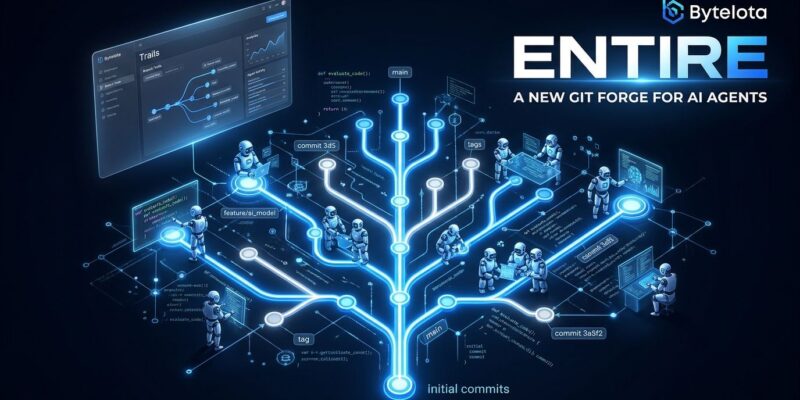
The centerpiece of Entire is Trails, a replacement for the pull request. Instead of a diff and a comment thread that someone — or some agent — has to manually wade through, a Trail is a dashboard of eval scores that updates on every push.
When code is pushed, Entire spins up configurable review agents in isolated cloud sandboxes. Those agents score the commit on dimensions the team defines. Entire ships pre-built evals for security risk, code quality, intent drift, and “slop” — a quantitative measure of low-quality AI output. The dashboard shows the last five runs plus the current one, so you can see whether scores are stabilizing or still bouncing around. A merge waits until scores are green and open findings are closed.
The intended workflow is agent-to-agent: a coding agent pushes, review agents score, the coding agent corrects and pushes again, until the scores settle. Humans set merge gate policies rather than doing line-by-line review. Dohmke’s framing: “The pull request has become an audit log that only the agent reads.”
That’s a pointed line, and it’s largely accurate. If your team uses Claude Code or Cursor to write meaningful portions of your codebase, you already know the PR review ritual has become more formality than filter. Entire is betting teams are ready to stop pretending otherwise.
Continuous Memory: Agents That Remember What They Did
The other substantive feature is Continuous Memory, which addresses a different but equally real problem: AI coding sessions are ephemeral. Context evaporates between sessions, and there is no persistent record of why a change was made, what the agent was told, or what alternatives were considered.
Entire ships two open-source CLI plugins: entire-graph, which parses the repository using tree-sitter into a structured map of definitions, callers, types, and routes; and entire-brain, which syncs agent session context — prompts, responses, tool calls, and checkpoints — directly into the Git repository. Every commit is linked to the agent session that produced it. You can trace exactly what the agent was doing, resume from that checkpoint, or audit the decision chain after the fact.
This is genuinely useful, and the open-source approach partially answers concerns about locking critical infrastructure into a single vendor.
Availability and Pricing
Entire integrates with Claude Code, Codex, Cursor, Factory AI, and GitHub Copilot. Distributed hosting runs across the U.S., EU, and Australia. Hosting and memory are free. Trails charges for the AI compute behind the review agents. New accounts get $100 in free Trails credit to start.
The company raised a $60 million seed round at a $300 million valuation in February 2026 — reportedly the largest seed ever for a developer tools startup. The New Stack has a solid technical breakdown of how Trails functions in practice if you want to go deeper before signing up.
Entire is not going to immediately dislodge GitHub for the enterprise teams locked into Actions workflows, SSO, and Copilot licensing. But it does not need to. It needs to be the default choice for the next generation of teams where agents are the primary code producers. If GitHub’s reliability record continues on its current trajectory — and nothing structural has changed — those teams will be looking for alternatives. Entire is now on that list.


