 By
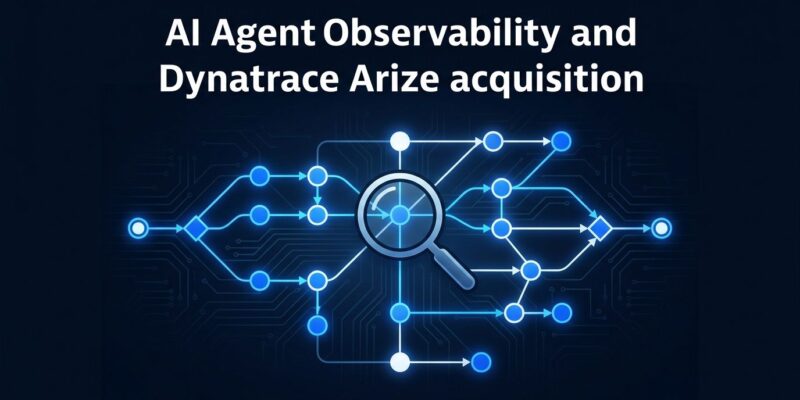
By Dynatrace closed its $915 million acquisition of Arize on October 1, 2026 — and if you’re building AI agents, this is not background noise. Arize built Phoenix, the open-source platform most developers reach for when they need to trace, evaluate, and debug agent workflows. The question isn’t whether Dynatrace overpaid. The question is whether Phoenix survives enterprise ownership with its developer-first soul intact.
Why AI Agent Observability Is a Genuinely Hard Problem
Traditional observability tools — Datadog, New Relic, old Dynatrace — are excellent at what they do: trace HTTP requests, monitor database latency, alert on CPU spikes. None of that helps when your AI agent returns a wrong answer.
Here’s why: a single agent run might involve a dozen LLM calls, several tool invocations, a retrieval step, and a chain of reasoning the agent assembled itself. When something goes wrong, there’s no stack trace. The failure often sits several steps upstream of the symptom — a bad document retrieved at step 2 produces a hallucinated answer at step 12. By the time you notice, the causal chain is buried in logs that weren’t designed to capture agent behavior.
That’s the gap Phoenix fills. It captures the entire execution: every model call with its prompt and response, every tool use, every retrieval span, every custom step. The result is a navigable timeline that shows you exactly where your agent spent time, money, and went wrong.
What Phoenix Does and How to Add It
Arize Phoenix is built on OpenTelemetry using a companion standard called OpenInference — semantic conventions for AI traces that do for LLM apps what OpenTelemetry did for traditional services. The instrumentation is deliberately minimal:
pip install arize-phoenix-otel openinference-instrumentation-openai

from phoenix.otel import register
tracer_provider = register(auto_instrument=True)
# Open http://localhost:6006 — all OpenAI calls are now traced
That auto_instrument=True flag scans for installed OpenInference instrumentation packages and activates them. Phoenix supports OpenAI, Anthropic, LangChain, LlamaIndex, DSPy, AWS Bedrock, and more. Beyond tracing, Phoenix auto-scores outputs for relevance, groundedness, and toxicity — which is what makes it useful for catching quality regressions in CI rather than just debugging manually.
What the Acquisition Actually Changes
Dynatrace says both Phoenix and OpenInference retain their open-source roles. No immediate changes for existing users. That’s the official line, and it’s the right line to take — the community value of Phoenix comes from developer trust, and torching it on day one would be self-defeating.
But “no immediate changes” is not “no changes.” The trajectory of enterprise acquisitions in developer infrastructure is not encouraging: HashiCorp moved Terraform to BSL, Elastic flipped its license, Confluent locked Kafka features. Dynatrace paid $915M for something — and they didn’t pay that for altruism. Over time, the serious eval features, the managed platform, and the enterprise dashboards will likely migrate toward Dynatrace’s paid tier. The open-source core may stay clean, but the ecosystem around it may not.
The practical upside: Dynatrace has 3,000 enterprise customers who have never heard of Phoenix. If Dynatrace pushes OpenTelemetry-compatible OpenInference through that distribution channel, it could become the dominant standard for AI tracing — which is good for the whole ecosystem regardless of what happens to the enterprise platform.
Where to Land in 2026
The AI observability space has matured fast. Three tools are worth evaluating:
- Arize Phoenix — Best eval rigor, OTel-native, open-source. Stay on it now. Watch for commercialization moves in 2027.
- LangSmith — The right choice if your stack is LangChain or LangGraph. Deep agent-trajectory tracing built for that ecosystem.
- Langfuse — MIT licensed, self-hostable, framework-agnostic. The most credible fallback if Phoenix starts moving features behind a paywall. Worth standing up now so your team knows how it works before you need it.
A common production pattern is Phoenix for eval scoring combined with Langfuse for prompt management and cost tracking. They’re not mutually exclusive — running both gives you a migration path with no urgency.
What to Do Today
If you’re running AI agents in production without observability, the Dynatrace acquisition changes nothing about your immediate problem — you still can’t see what your agents are doing. Phoenix is still free, still open-source, and still the fastest path to getting a trace timeline in front of your team.
The acquisition is a signal, not a crisis. AI observability just got validated as a serious infrastructure category: $915 million says enterprise buyers will pay for this. More acquisitions will follow — Datadog and Grafana are the obvious next candidates. The developers who instrument their agents now, before their organization makes a platform decision for them, will be better positioned when that happens.